Allergic Reaction Severity Checker
Check Your Reaction
This tool helps you identify if your medication reaction is mild, moderate, or severe based on symptoms. For severe reactions, seek emergency help immediately.
Your Reaction Assessment
When you take a new medicine, your body doesn’t always react the way you expect. Most of the time, it’s fine. But sometimes, your immune system mistakes the drug for an invader and goes into overdrive. This isn’t just a side effect-it’s an allergic reaction. And not all allergic reactions are the same. Some are annoying. Others can kill you in minutes.
What Makes a Reaction Allergic?
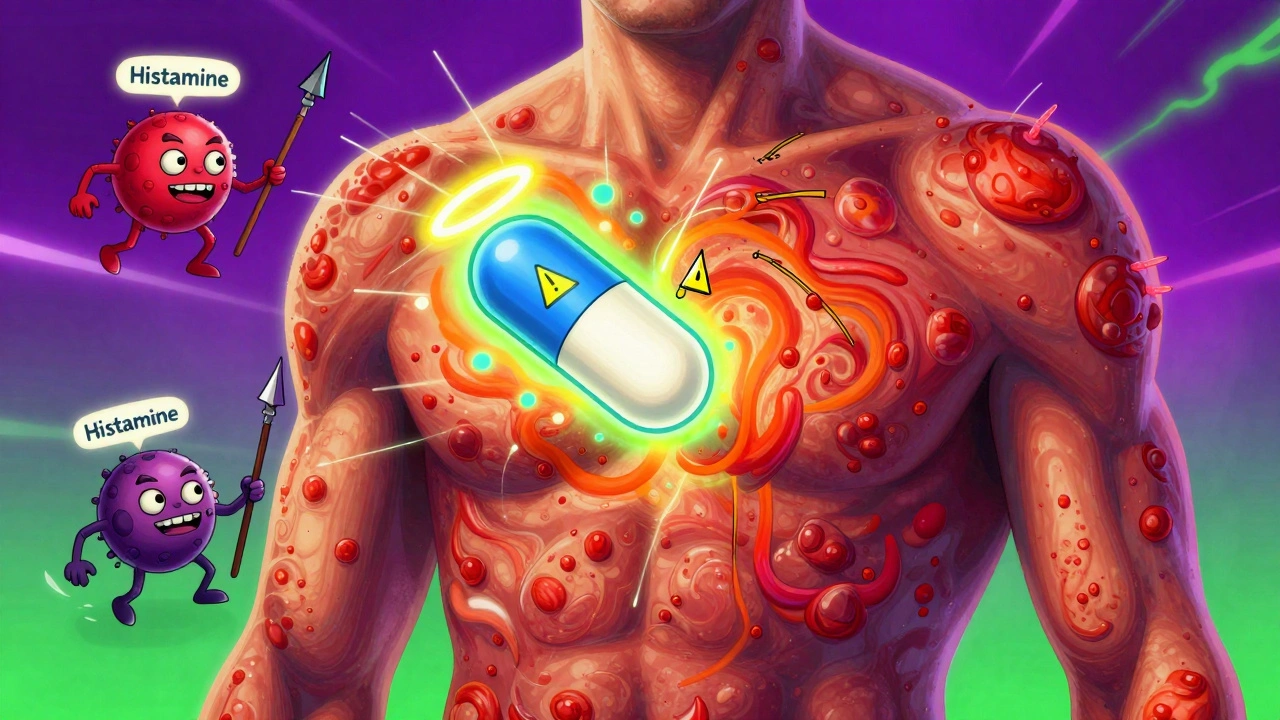
An allergic reaction isn’t just nausea, dizziness, or a headache. Those are side effects. An allergic reaction means your immune system has decided the drug is dangerous-even if it’s not. It releases chemicals like histamine, which cause swelling, itching, hives, or worse. About 10-15% of all bad reactions to meds are true allergies. The rest? Just side effects. But because the symptoms can look similar, many people get it wrong.
Take penicillin. A lot of people say they’re allergic. But when tested, up to 80% of them aren’t. They had a rash years ago, assumed it was an allergy, and avoided the drug ever since. That’s a problem. It means they get less effective, more expensive, or more toxic antibiotics instead. Mislabeling an allergy can be dangerous.
Mild Reactions: The Warning Sign You Might Ignore
Mild reactions are the most common. They affect 60-70% of people who have a true drug allergy. These are the ones that show up as a small patch of hives, a little itching, or a light rash-usually on the chest, arms, or face. The skin might feel warm or tender, but your breathing is fine. Your blood pressure stays normal. You might feel a bit uncomfortable, but you can still walk, talk, and go about your day.
These are often Type I (IgE-mediated) or Type IV (delayed T-cell) reactions. Type I hits fast-within minutes to an hour. Type IV takes days. A mild Type IV rash might appear three to five days after starting a new antibiotic like amoxicillin or a seizure drug like carbamazepine. It looks like flat red spots, not raised welts. It’s itchy, but not painful.
What to do? Stop the drug. Take an over-the-counter antihistamine like cetirizine or diphenhydramine. The rash usually fades in 24 to 48 hours. But here’s the catch: don’t assume it’s harmless just because it’s mild. A rash that starts small can grow. A little itching today could mean full-body hives tomorrow. Always tell your doctor. Don’t just shrug it off.
Moderate Reactions: When It Starts to Spread
Moderate reactions are the middle ground. They happen in 20-30% of cases. This is where things get serious-even if you’re not in immediate danger. Your rash covers 10-30% of your body. You might have swelling around your eyes or lips (angioedema). Your face could feel tight. You might get a fever above 38.5°C. Your throat might feel scratchy, but you’re still breathing okay.
These reactions often involve more than one system. Maybe you have hives plus joint pain. Or a rash plus swollen glands. NSAIDs like ibuprofen are common culprits. About 0.1% of people who take them get this level of reaction. It’s not rare. It’s just not as scary as the worst cases.
Here’s what needs to happen: stop the drug immediately. You’ll need a prescription for corticosteroids-like prednisone-to calm the immune system. You’ll likely need to be monitored for 4-6 hours in an urgent care or ER. Why? Because moderate reactions can slide into severe ones. One study found that 75% of these cases resolve within 72 hours with treatment. But 25% don’t. And those are the ones that end up in the ICU.
Don’t wait. If you’re getting worse after 24 hours-more swelling, more rash, trouble swallowing-go to the ER. Don’t text your doctor. Don’t wait for an appointment. This isn’t a "maybe tomorrow" situation.
Severe Reactions: The Emergency You Can’t Afford to Miss
Severe reactions make up only 5-10% of drug allergies. But they’re responsible for nearly 5% of all hospital admissions due to bad drug reactions. And they can kill.
The most dangerous is anaphylaxis. It hits fast-usually within minutes. Your throat closes. Your tongue swells. Your blood pressure crashes. You feel dizzy, weak, or like you’re going to pass out. Your skin turns pale or blue. You might vomit or lose control of your bowels. Your oxygen level drops below 90%. This isn’t an allergy. This is a full-body emergency.
Penicillin causes anaphylaxis in about 1-5 out of every 10,000 courses. That sounds rare. But if you’re the one in 10,000, it’s everything. And if you’ve had a mild reaction before, your risk goes up.
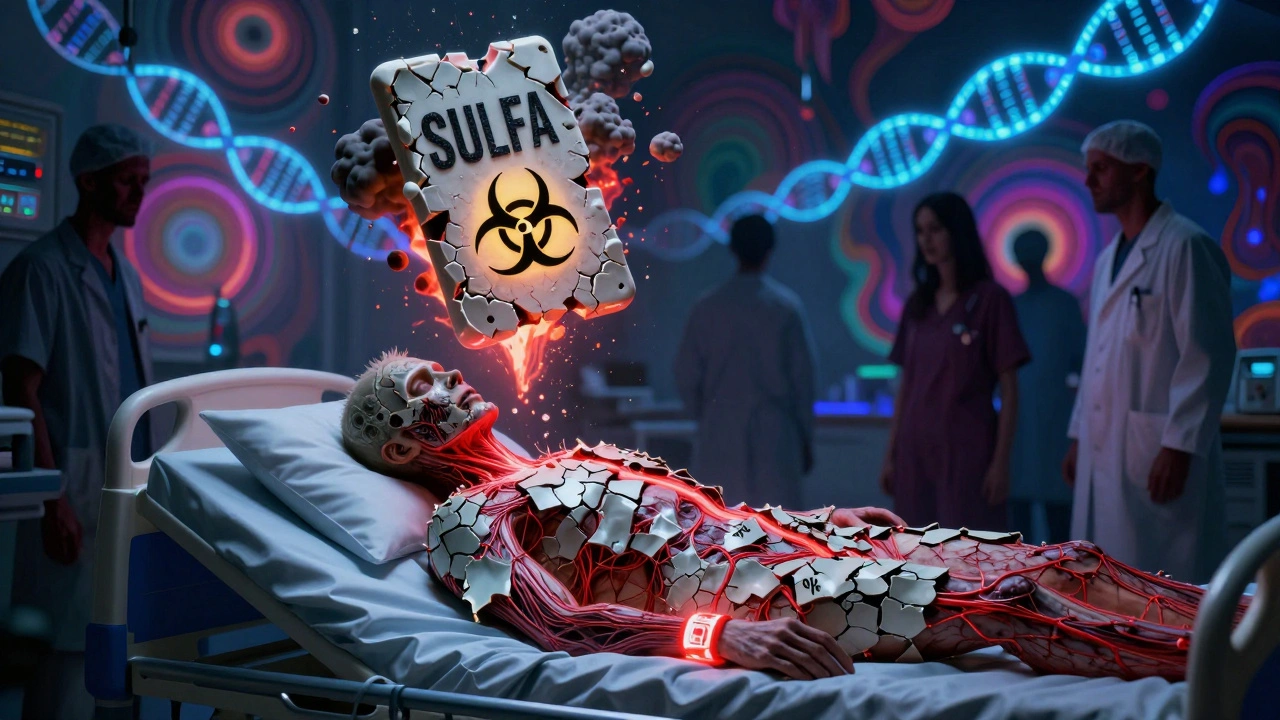
Then there are the skin killers: Stevens-Johnson Syndrome (SJS) and Toxic Epidermal Necrolysis (TEN). These are Type IV reactions. They start like a bad rash-maybe after taking sulfonamides, anticonvulsants, or allopurinol. But within days, your skin blisters and peels off. SJS affects less than 10% of your skin. TEN affects more than 30%. Mortality? Up to 35% for TEN. That’s higher than many cancers.
Another severe reaction is DRESS syndrome. It shows up weeks after starting a drug. Fever, swollen lymph nodes, liver damage, kidney problems. It’s not just a rash. It’s your organs failing.
What do you do? Call 911. Use your epinephrine auto-injector if you have one. Lie down, elevate your legs. Don’t stand up. Don’t wait. Don’t call your doctor first. Epinephrine is the only thing that stops anaphylaxis. Steroids and antihistamines help, but they’re too slow. You need adrenaline now.
Why Misdiagnosis Is Deadly
One Reddit user shared how her GP told her to keep taking a sulfa drug for a UTI. "Just a rash," he said. Three days later, she had 25% of her skin detached. She spent 18 days in a burn unit.
Another user on r/Allergy said her mild rash from ibuprofen turned into full-body hives and swelling. She didn’t think it was serious until her tongue started to swell. She used her EpiPen. She survived. But she’s now terrified of every new pill.
Doctors miss this all the time. Why? Because they’re rushed. Because they don’t know the difference between a side effect and an allergy. Because they think, "It’s just a rash." But in medicine, a rash isn’t just a rash. It’s a signal. And if you ignore it, your body might pay the price.
How to Know What You’re Dealing With
Here’s a quick way to tell the difference:
- Mild: Small rash, no swelling, no trouble breathing, no fever. You feel uncomfortable, but you’re not scared.
- Moderate: Widespread rash, swollen lips or eyes, fever, joint pain. You feel sick. You know something’s wrong.
- Severe: Trouble breathing, throat closing, chest tightness, dizziness, low blood pressure, skin peeling, blisters. You feel like you’re dying. You are in danger.
Use this as a guide, not a rule. If you’re unsure, assume it’s severe. Better safe than sorry.
What Happens After
If you’ve had a severe reaction, you need an allergy specialist. They’ll do skin tests or blood tests to confirm what caused it. For delayed reactions, they might need a lymphocyte transformation test-a specialized blood test that’s not available everywhere.
You’ll get a medical alert bracelet. You’ll get a list of drugs to avoid. And you’ll learn to read labels. Some drugs have hidden ingredients. A painkiller might contain aspirin. A cold medicine might have sulfa. You can’t trust the brand name. You have to check the active ingredients.
And here’s the future: genetic testing. If you’re Asian, and you’re about to take carbamazepine, your doctor should test you for HLA-B*15:02. That gene increases your risk of SJS by 10 times. If you have it, you don’t take the drug. Simple. That’s already standard in Taiwan and Thailand. In the U.S., it’s still rare. But it’s coming.
What You Can Do Today
1. Know your history. Did you ever get a rash after an antibiotic? Write it down. Include the drug name, when it happened, and what symptoms you had.
2. Don’t self-diagnose. If you think you’re allergic, get tested. Don’t assume. Don’t avoid meds based on a childhood rash.
3. Carry epinephrine if you’ve had a severe reaction. Even if it was years ago. Allergies don’t go away. They can get worse.
4. Teach your family. If you have an EpiPen, show your partner, your kids, your roommate how to use it. Don’t wait for an emergency to explain.
5. Speak up. If a doctor says "it’s just a rash," say, "I’ve had this before. I’m worried it could get worse." You are your best advocate.
Allergic reactions aren’t random. They’re signals. Mild ones are warnings. Moderate ones are alarms. Severe ones are sirens. Listen. Act. Save your life.
Ignacio Pacheco
December 2, 2025 AT 18:47So let me get this straight - if I get a rash from ibuprofen, I’m supposed to assume it’s an allergy and not just my body saying "bro, chill with the NSAIDs"? And if I don’t, I’m gonna wake up with my skin peeling off like a bad sunburn? Cool. Cool cool cool. I’ll just stop taking all meds and live in a cave.
Makenzie Keely
December 3, 2025 AT 16:43PLEASE STOP SELF-DIAGNOSING. I’ve seen too many people panic over a tiny rash and then refuse every antibiotic ever made - only to get sepsis because they avoided the one drug that would’ve saved them. If you had a mild reaction once, get tested. Don’t just label yourself allergic because you felt weird after a pill. Your doctor isn’t your enemy - ignorance is.
Gene Linetsky
December 3, 2025 AT 20:25Ever wonder why Big Pharma doesn’t want you to know the truth? They profit off misdiagnosed allergies - because if you think you’re allergic to penicillin, they sell you the $800 alternative instead of the $3 generic. And the FDA? They’re in bed with them. They don’t test for real allergies - they just let doctors guess. That’s why 80% of people who think they’re allergic aren’t. It’s not medicine - it’s a money scheme. Wake up.
Joykrishna Banerjee
December 5, 2025 AT 01:35As someone who actually studied immunology (unlike most of you), let me clarify: Type IV reactions aren't "delayed" - they're T-cell mediated, and the kinetics are highly variable depending on HLA haplotype, dose, and metabolic clearance. Also, DRESS syndrome is NOT "just a rash" - it's a systemic lymphoproliferative disorder with multi-organ involvement. If you're not citing peer-reviewed literature, you're just spreading misinformation. 🤦♂️
Katherine Gianelli
December 6, 2025 AT 12:33Hey - if you’ve ever had a rash from a med, don’t beat yourself up. I had a mild one after amoxicillin in college and spent years terrified of every pill. Then I got tested - turns out I wasn’t allergic. I cried. Not because I was wrong, but because I’d been scared for nothing. You’re not weak for being scared. You’re human. And you deserve to know the truth - not just a label.
Francine Phillips
December 8, 2025 AT 01:26idk man i read the post but like... i dont wanna think about this right now
Albert Essel
December 9, 2025 AT 06:30I appreciate the clarity here. Too often, people dismiss rashes as "no big deal" - but this breakdown makes it impossible to ignore the progression. I’ve seen a friend go from a small red spot to the ICU in 36 hours. This isn’t hypothetical. It’s real. And it’s preventable.
Rashmin Patel
December 10, 2025 AT 01:41OMG YES I’VE BEEN THERE 😭 My cousin took allopurinol for gout and woke up with her whole back covered in blisters - like, literally peeling like a sunburn but worse. She was in the hospital for 3 weeks. They didn’t even know what it was at first. Now she carries an EpiPen and a list of banned drugs in her wallet. If you ever get a rash after a new med - STOP. CALL. DON’T WAIT. I’m still scared every time she takes anything new… but at least she’s alive. 🙏
Charles Moore
December 10, 2025 AT 23:39One thing I wish more people understood: allergic reactions don’t always get worse with each exposure. Some people have a mild reaction once and never again. Others have a severe one after years of no issues. It’s not linear. So don’t assume your next reaction will be the same. But also - don’t gamble. When in doubt, get checked.
Myson Jones
December 12, 2025 AT 06:12As someone who works in ER, I’ve seen this exact scenario play out 17 times this year alone. Patient comes in with a rash, says "it’s fine, I just took the pill." We ask if they’ve had it before - "nope, never." Then we find out they had the same rash five years ago and didn’t tell anyone. Stop minimizing your body’s signals. We’re not trying to scare you - we’re trying to keep you alive.
parth pandya
December 12, 2025 AT 20:46hey i had a rash after taking cipro and i thought it was nothing but then my eye swelled up so i went to er and they said its an allergic reaction and i got steroids and now i avoid all quinolones. also i dont know how to spell but i hope this helps
sagar bhute
December 12, 2025 AT 20:58Typical medical propaganda. You think the system cares about your life? They care about liability. That’s why they scare you into avoiding penicillin - so you take their expensive alternatives. And now you’re scared to take anything. That’s the goal. You’re not a patient - you’re a revenue stream. Wake up.
Jim Schultz
December 14, 2025 AT 20:03Let’s be real - the only reason this post exists is because someone got sued after a patient died from a misdiagnosed reaction. Hospitals don’t care about education - they care about lawsuits. So now we get 12-page Reddit essays on rashes instead of, I don’t know… a 30-second warning on the prescription bottle? The system is broken. And we’re just the collateral damage.