
Anti-Xa Testing Appropriateness Calculator
Check if Anti-Xa Testing is Appropriate
This tool helps determine if Anti-Xa testing is clinically indicated for LMWH patients based on evidence-based criteria.
When you're on a blood thinner like enoxaparin (Lovenox), you expect it to work - not cause problems. But what if you're bleeding for no reason, or still getting clots despite taking your dose? That’s when Anti-Xa testing comes into play. It’s not a routine check. It’s not for everyone. It’s a targeted tool used only when something’s off. And when it’s used right, it can save lives. When it’s used wrong, it can hurt you.
Why Anti-Xa Testing Exists
Low Molecular Weight Heparin (LMWH) - drugs like enoxaparin, dalteparin, and tinzaparin - was designed to be predictable. Unlike older heparin, which needed constant blood tests, LMWH was supposed to work the same way in most people. Dose by weight. Once or twice a day. No monitoring needed. But biology doesn’t always follow the rules. In people with severe kidney problems, extreme weight, or during pregnancy, the body handles LMWH differently. The drug builds up. Or it clears too fast. And that’s when side effects show up: unexplained bleeding, or a clot despite being on therapy. That’s the moment Anti-Xa testing matters. Anti-Xa measures how much the drug is actually doing in your blood - specifically, how well it’s blocking Factor Xa, a key protein in clotting. It’s not a guess. It’s a number. And that number tells your doctor whether you’re under-dosed, over-dosed, or just right.When Testing Is Needed - The Real Triggers
Most people on LMWH never need this test. The American College of Chest Physicians says so clearly: routine Anti-Xa monitoring isn’t helpful. But there are exceptions. And they’re specific.- Severe kidney failure - CrCl below 30 mL/min. Below 15? Testing becomes critical. LMWH sticks around 12 to 24 hours instead of 4 to 5. That’s a 5x increase in drug exposure. Bleeding risk spikes.
- Extreme body weight - Under 40 kg or over 150 kg. Standard dosing based on total weight doesn’t always match body fat or muscle mass. In obese patients, some studies show levels can be too low. In very thin patients, they can be too high.
- Unexpected bleeding - A nosebleed that won’t stop, blood in urine, or a bruise the size of a fist after a light bump. If it’s not trauma-related, check the level.
- Clotting despite treatment - A deep vein thrombosis or pulmonary embolism while on therapeutic LMWH? That’s a red flag. Either the dose is wrong, or something else is going on.
- Pregnancy - Hormones and blood volume changes alter how LMWH behaves. Target levels shift to 0.2-0.6 IU/mL for treatment. Routine monitoring isn’t standard, but if a clot forms or bleeding occurs, Anti-Xa guides adjustments.
- Drug interactions - If you’re on another medication that affects kidney function or protein binding (like certain antibiotics or NSAIDs), it’s worth checking.
What the Numbers Mean
Anti-Xa levels aren’t a pass/fail test. They’re a range, and the target changes based on why you’re on LMWH.- Prophylactic dose (preventing clots after surgery): 0.2-0.5 IU/mL
- Therapeutic dose (treating clots or high-risk conditions): 0.6-1.0 IU/mL
- Pregnancy (treatment): 0.2-0.6 IU/mL
What the Test Can’t Do
Anti-Xa isn’t magic. It has limits.- It can’t tell you why - A high level doesn’t explain if you’re bleeding because of a stomach ulcer, a brain tumor, or just bad luck. It only tells you the drug level is high.
- It doesn’t distinguish between LMWH brands - Whether you’re on enoxaparin or dalteparin, the test reads the same. But their effects aren’t identical. This can lead to confusion.
- It doesn’t measure bleeding risk directly - Two people with the same Anti-Xa level can have totally different outcomes. One bleeds, the other doesn’t. Genetics, age, and other drugs play a role.
- It can’t detect DOACs - If you’re on apixaban or rivaroxaban, Anti-Xa won’t pick it up. Mixing up anticoagulants is a common error.
Why Doctors Get It Wrong
A 2018 audit from Ventura County Medical Center looked at 220 Anti-Xa tests ordered. Only 61 - 28% - had valid reasons. The rest? Routine post-op checks. Fear of lawsuits. “Just to be safe.” And here’s the scary part: when doctors adjusted doses based on those wrong tests, 8% of patients had bleeding complications. That’s not because the test failed. It’s because it was misused. Dr. Adam Cuker from the University of Pennsylvania studied 4,328 patients. He found that 72% of Anti-Xa orders led to unnecessary dose changes - and those changes didn’t improve outcomes. They just increased risk. The test isn’t the problem. The thinking behind it is.What Works - Real Cases
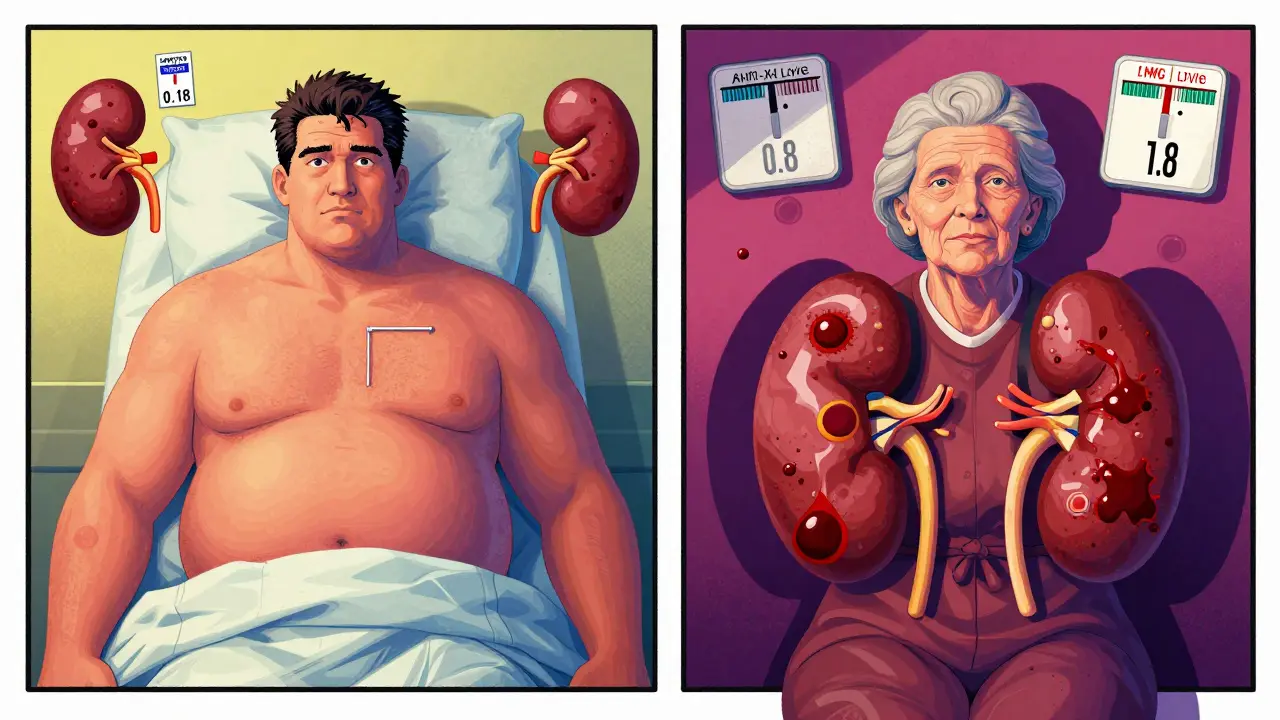
One patient, 320 kg, after a traumatic injury. Standard enoxaparin dose? Likely too low. Anti-Xa level came back at 0.18 IU/mL - below the prophylactic range. Dose doubled. No clots. No bleeding. Another, 78-year-old with CrCl of 18 mL/min. On daily LMWH. Developed a large hematoma after a fall. Anti-Xa level was 1.8 IU/mL - more than double the therapeutic max. Dose held. Kidney function monitored. Bleeding stopped. These aren’t rare. They’re predictable - if you know the triggers.
How to Avoid Mistakes
If you’re a clinician, here’s how to get it right:- Only test when there’s a clinical red flag - Bleeding? Clot? Kidney failure? Extreme weight? Otherwise, skip it.
- Draw at the right time - 4-6 hours after the last dose. Not before. Not random.
- Don’t act on one number alone - Correlate with symptoms. Check renal function. Review meds. Look at platelets.
- Use institutional protocols - Hospitals like UC Davis and Vanderbilt have order sets that block inappropriate requests. Use them.
- Know your lab’s range - Different machines give different results. Inter-lab variation can be up to 15%. Always ask what reference range your lab uses.
The Bottom Line
Anti-Xa monitoring for LMWH isn’t about checking every patient. It’s about protecting the ones who need it most. In 95% of cases, you don’t need it. In the other 5%, it’s lifesaving. The goal isn’t to test more. It’s to test smarter. If you’re on LMWH and something feels wrong - bleeding, clotting, feeling off - talk to your doctor. Ask: “Could my Anti-Xa level help explain this?” Not because it’s routine. But because it might be the key.Frequently Asked Questions
Do I need Anti-Xa testing if I’m on LMWH for a blood clot?
Not usually. Most patients on therapeutic LMWH for a clot don’t need monitoring. But if you’re also dealing with kidney failure, extreme weight, or you develop bleeding or another clot while on treatment, then testing is warranted. The goal is to make sure the dose matches your body’s needs - not just the standard formula.
Can Anti-Xa testing prevent bleeding?
It can, but only if used correctly. A 2018 study from Vanderbilt showed that when Anti-Xa levels were checked in high-risk patients (like those with severe kidney disease) and doses were adjusted based on results, bleeding complications dropped by 37%. But if you test without a reason - or adjust the dose based on a single number - you might actually increase bleeding risk. Precision matters.
Is Anti-Xa testing covered by insurance?
Yes, when medically necessary. Medicare reimburses $45-$75 per test. But insurers often deny claims if the ordering provider can’t show a valid clinical reason - like renal impairment, extreme weight, or unexplained bleeding. Routine testing for post-op patients is typically not covered.
How long does it take to get Anti-Xa results?
In most hospitals, results come back in 2 to 4 hours. Some labs offer stat testing within 90 minutes if flagged as urgent. But if the sample is drawn at the wrong time or sent to a lab without proper calibration, the result may be delayed or inaccurate. Timing and lab quality are just as important as the test itself.
Can I check Anti-Xa levels at home?
Not yet. While point-of-care devices are in development - like Diagnostica Stago’s STA-R Max 3 system - they’re not widely available or approved for routine use. All current testing requires a blood draw and lab analysis. Home testing for LMWH isn’t feasible or recommended.
lela izzani
February 24, 2026 AT 15:13Finally, someone laid this out clearly. I've seen so many residents order Anti-Xa for every post-op patient just because they're 'cautious.' It's not safety-it's defensive medicine. The real magic is in knowing when NOT to test. That 95/5 split is everything.
My ICU team started using the Vanderbilt order set last year. We cut unnecessary tests by 80%. No increase in complications. Just smarter care.
Also-timing matters more than people think. I once saw a level drawn at 2am after a 10pm dose. The result was 0.9. Turned out it was a trough. Dose was almost doubled unnecessarily. Chaos.
Always ask: 'Why are we doing this?' Not 'Can we do this?'
Stephen Archbold
February 26, 2026 AT 05:49lol i was just gonna say this but u beat me to it. anti-xa is like using a tesla to mow the lawn. sure it works, but why??
my bro’s a nurse in dublin and he told me they had a whole audit last year-like 70% of tests were ordered by interns who just googled ‘heparin monitoring’ and clicked ‘yes’ on the ehr prompt.
one guy even tested a patient on apixaban. like… dude. it’s not a magic wand. it’s a tool. use it like one.
also-ppl forget the lab ranges vary. my hospital’s normal is 0.5-1.0. the next one over says 0.4-0.9. same blood. different panic.
tl;dr: don’t test unless you’re ready to act. otherwise you’re just playing doctor roulette.
Gabrielle Conroy
February 27, 2026 AT 23:28YES!!! This is so important!!! I work in OB and we had a patient last month-32 weeks, 140 kg, history of PE-and she was on enoxaparin 40mg daily. Then she started spotting. We were about to panic and double the dose… until we checked the Anti-Xa. Level was 1.4!!! Way too high!!! We held it, monitored, and she was fine!!
So many people think ‘more is better’ with blood thinners. NO. It’s a tightrope. Anti-Xa is the rope. Don’t ignore it. Don’t abuse it.
Also-pregnancy targets are so under-discussed!! 0.2-0.6 for treatment?? Mind blown. I’m printing this out for my unit.
Thank you for writing this. Seriously. This should be mandatory reading for every med student.
❤️❤️❤️
Spenser Bickett
February 28, 2026 AT 03:37Wow. A post that doesn’t sound like it was written by a pharma rep trying to sell you a $400 lab test.
Imagine that. A medical guideline that says ‘don’t do this unless you have to.’ Radical. Unheard of.
Meanwhile, my hospital’s EHR auto-populates ‘Anti-Xa’ under ‘post-op prophylaxis’ with a checkbox that says ‘I understand this is not evidence-based.’
They still check it. Every time.
And then they wonder why our hospital costs are through the roof.
Also, the part about not distinguishing between LMWH brands? Classic. Dalteparin and enoxaparin are not the same drug. But your lab doesn’t care. Neither does your resident. Neither does your insurance.
Medicine: where we treat numbers, not people.
…and yet we call it science.
Christopher Wiedenhaupt
February 28, 2026 AT 08:05The data presented here is consistent with recent literature from the Journal of Thrombosis and Haemostasis. The 2018 Ventura County audit aligns with findings from the American Society of Hematology’s 2021 guidelines, which also discourage routine monitoring. The key insight is that clinical context supersedes laboratory values in the majority of cases.
Additionally, the timing of sampling is critical. A 2022 multicenter study demonstrated that 34% of Anti-Xa results were misinterpreted due to improper sampling time. This is preventable with standardized protocols.
Recommendation: Integrate lab-specific reference ranges into electronic order sets to reduce inter-lab variability. This simple step could reduce inappropriate dosing changes by over 40%.
John Smith
March 1, 2026 AT 00:53So let me get this straight. You're telling me the entire system is built on guesswork and fear, and this test is just another way to make doctors feel like they're doing something?
Of course. Because why fix a broken system when you can just add another lab test and bill it?
I'm sure the lab techs love this. $75 per test. 200 tests a day. That's $15,000. Per day.
Meanwhile, the patient's kidney is failing, their liver's overloaded, and their insurance is denying the next 12 months of care.
But hey. At least the Anti-Xa level was checked.
Thanks for the placebo medicine, docs.
Now I'm going to go take my aspirin and hope for the best.
Shalini Gautam
March 3, 2026 AT 00:18As someone from India where access to labs is limited, I find this post both fascinating and frustrating.
We don’t have Anti-Xa testing in 80% of rural hospitals. But we still give LMWH. We rely on clinical judgment. No numbers. Just observation. Bleeding? Stop. Clot? Increase.
Maybe the West overcomplicates things. We don’t need a machine to tell us if someone is bleeding out. We see it.
But I do agree-when you DO have the test, use it wisely. Not because it’s there. Because it matters.
Also-pregnancy? We don’t test. We watch. And we trust the mother’s symptoms. Sometimes, simple is better.
Respect to those who use it right. But don’t make it a religion.
Natanya Green
March 3, 2026 AT 19:23OMG I JUST HAD THIS HAPPEN TO MY MOM.
She’s 76, on Lovenox after hip surgery, had a HUGE bruise on her thigh. We were freaking out. Nurse said ‘oh we’ll run an Anti-Xa.’
Turns out she was over-dosed. Level was 1.9. They held the dose. Stopped the bleeding. She’s fine now.
But here’s the kicker-before that, the doctor said ‘it’s probably just aging skin.’
So we almost lost her because NO ONE thought to check.
And then the next day? Another patient in the same unit got tested for NO REASON. Level was normal. Dose was lowered. Two days later, she got a PE.
THIS IS WHY I’M SO ANGRY.
It’s not about the test. It’s about the thinking.
PLEASE. PLEASE. If you’re on LMWH and something feels off-ASK FOR THE TEST.
Don’t let them brush you off.
YOUR LIFE ISN’T A RISK ANALYSIS.
LOVE YOU.
❤️❤️❤️
Steven Pam
March 4, 2026 AT 15:04Love this breakdown. So many people think medicine is about doing more. But the real art is knowing when to do less.
I’ve seen so many patients get stuck in this loop: ‘We’ll check the level, adjust the dose, check again, adjust again.’ And then they end up with a bleeding ulcer because someone kept ‘tweaking’ based on a number that was 2 hours off.
My rule of thumb? If you’re not going to change the dose based on the result, don’t order it.
Also-don’t forget the 4-6 hour window. I had a resident once draw it at 10pm after a 9pm dose. ‘It’s close enough.’
It’s not. It’s a lie. And lies kill.
Keep this knowledge alive. Share it. Teach it. It’s the difference between a good clinician and a great one.
Timothy Haroutunian
March 5, 2026 AT 01:18I read the whole thing. Took me 20 minutes. I’m not even a doctor. But I’ve been on LMWH for a year. I didn’t know any of this.
Why isn’t this information in the patient handouts? Why isn’t it on the pharmacy label? Why do I have to find a Reddit post to understand what’s in my veins?
And why did my doctor say ‘it’s fine’ when I asked about bleeding? Because he didn’t know either.
So now I’m sitting here with a notebook, tracking my doses and timing my blood draws. Because apparently, I’m the only one who cares.
Thanks for the info. But this shouldn’t be a secret.
It should be standard.
And it’s not.
That’s the real problem.
Erin Pinheiro
March 5, 2026 AT 13:36Okay so I’ve been on LMWH for 3 years. I had a PE. I’m 42. I’m not obese. I’m not pregnant. I don’t have kidney disease. But I bleed EVERY TIME I get a flu shot. My doc says ‘it’s normal.’
So I went to a hematologist. She ordered an Anti-Xa. Level was 1.2. Therapeutic range is 0.6-1.0. I was OVERDOSED. For THREE YEARS.
My dose was cut. No more bleeding.
So now I’m mad. Why didn’t my primary care doctor know this? Why didn’t the ER docs? Why did I have to beg for a test?
And now I’m reading this and realizing-most docs DON’T KNOW THIS.
So who’s gonna save me next time?
Not the system.
Not the guidelines.
Just me.
And my notebook.
And my obsession.
And my rage.
Michael FItzpatrick
March 7, 2026 AT 12:25Man, this is one of those rare posts that feels like a gift. Not because it’s flashy, but because it’s quiet wisdom. Like a lighthouse in a storm of noise.
Anti-Xa isn’t a tool for the anxious. It’s a tool for the attentive. The ones who notice the subtle shift-the quiet bruise, the unexplained drop in Hgb, the patient who says ‘I just don’t feel right.’
That’s where the magic lives.
Not in the lab. Not in the EHR. Not in the checklist.
But in the pause.
The moment you stop and ask: ‘What’s really going on here?’
That’s when the number becomes meaningful.
That’s when it saves a life.
Keep speaking truth. Even if it’s quiet.
It’s still louder than the noise.