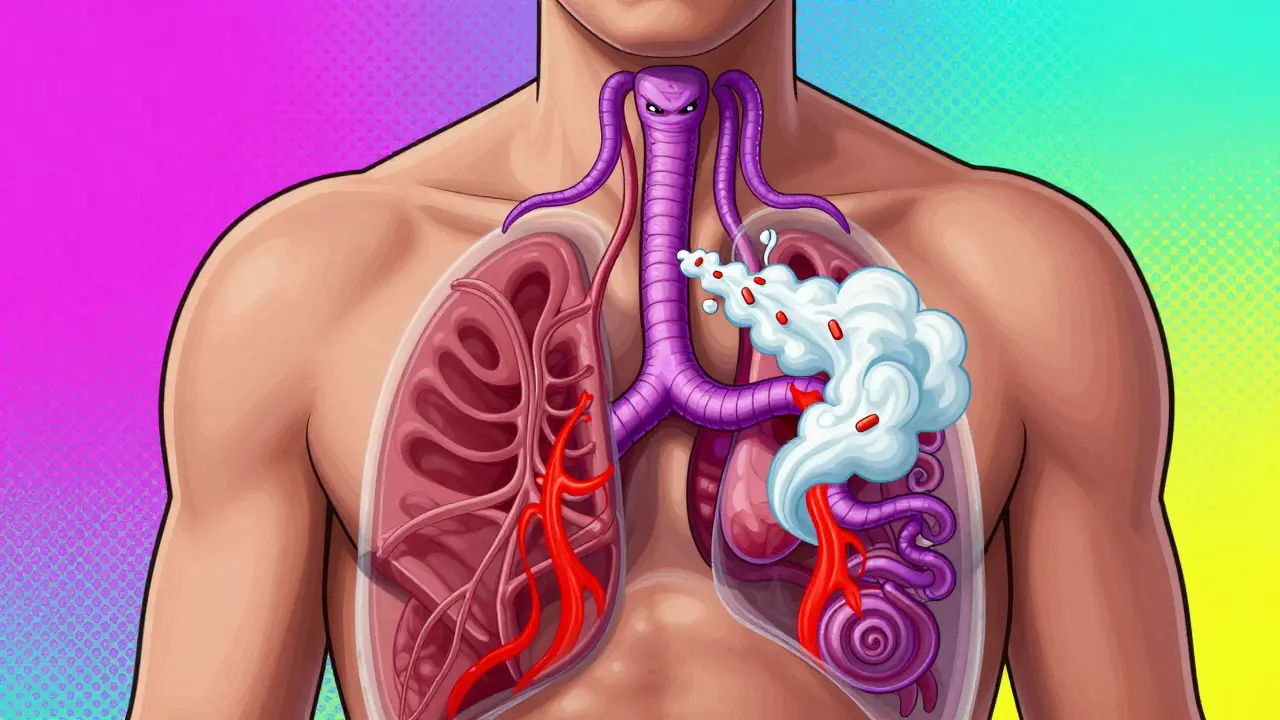
AERD Risk Assessment Tool
Assess Your AERD Risk
This tool helps you understand if you might have Aspirin-Exacerbated Respiratory Disease (AERD), also known as Samter's Triad. AERD involves asthma, nasal polyps, and reactions to aspirin/NSAIDs.
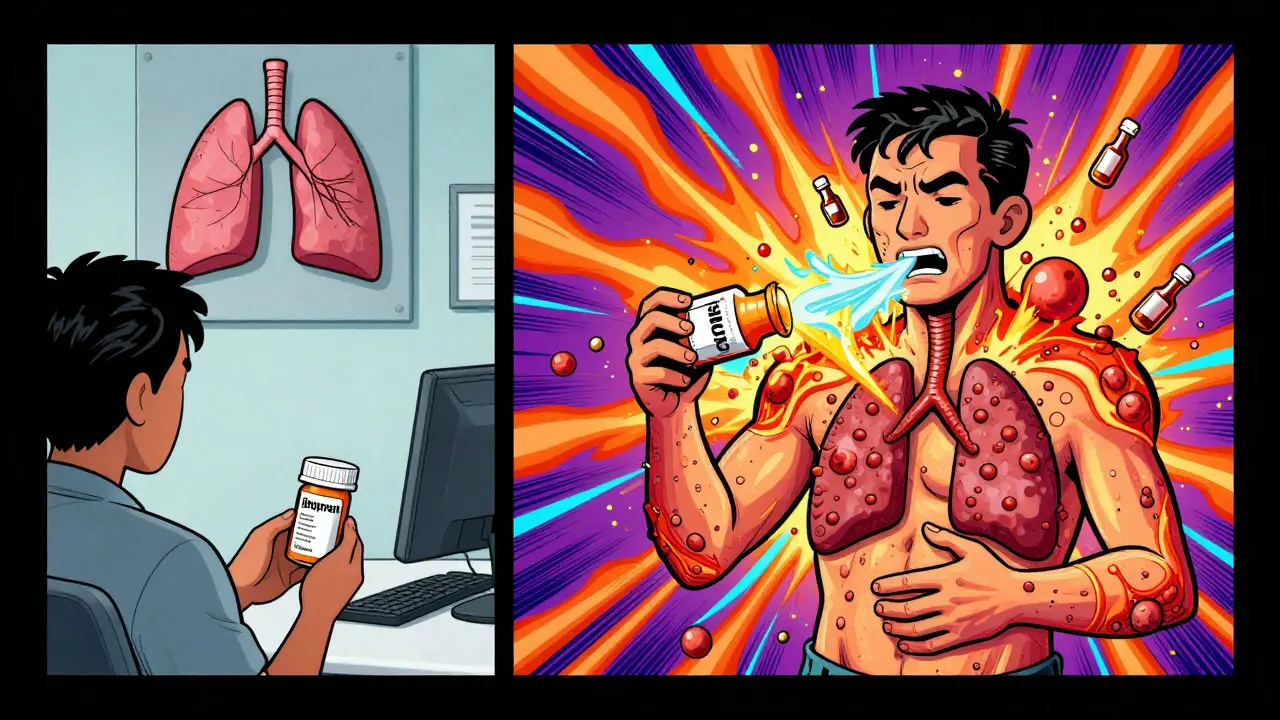
If you have asthma and keep getting nasal polyps, and every time you take ibuprofen or aspirin you feel like your airways are closing up - you’re not imagining it. This isn’t just bad luck or coincidence. It’s a real, underdiagnosed condition called Aspirin-Exacerbated Respiratory Disease, or AERD. It’s also known as Samter’s Triad because it involves three things happening together: asthma, chronic nasal polyps, and severe reactions to aspirin and other NSAIDs. About 9% of adults with asthma have it. Among people with both asthma and nasal polyps, that number jumps to 30%. And yet, most patients wait 7 to 10 years before getting the right diagnosis.
What Actually Happens in Your Body?
AERD isn’t an allergy in the classic sense. You’re not allergic to aspirin like you’re allergic to peanuts. Instead, your body’s inflammatory system goes haywire when certain drugs block an enzyme called COX-1. This triggers a cascade of chemicals - especially leukotrienes - that flood your airways and sinuses with inflammation. At the same time, your body makes less of a protective compound called prostaglandin E2. The result? Swollen nasal passages, blocked sinuses, wheezing, and sometimes full-blown asthma attacks.
It’s not just aspirin. Any NSAID that blocks COX-1 can set this off: ibuprofen (Advil, Motrin), naproxen (Aleve), diclofenac, and even some migraine meds. Even low doses can cause problems. And here’s something many don’t realize - alcohol can trigger symptoms too. About 75% of people with AERD react to alcohol, sometimes after just one drink. It’s not the sugar or the sulfites. It’s how alcohol affects the same inflammatory pathways.
The Classic Signs: It’s Not Just Asthma
If you’ve had asthma since childhood, AERD is unlikely. This condition almost always shows up in adulthood, between ages 20 and 50. And it doesn’t start with wheezing. It starts with sinuses.
- Chronic nasal congestion - nearly everyone has it
- Recurring nasal polyps - they grow back fast, often within a year after surgery
- Loss of smell - up to 90% of patients have trouble smelling food, perfume, or even smoke
- Constant sinus infections - you’re always on antibiotics or steroids
Then, after taking an NSAID, things get worse fast. Within an hour, your nose gets stuffed up, your eyes water, your chest tightens, and you start coughing or wheezing. Some people get hives or stomach pain. The reaction is predictable - and terrifying if you don’t know why it’s happening.
Why Standard Asthma Treatments Often Fail
Most asthma patients control their symptoms with inhalers - corticosteroids and bronchodilators. But for AERD patients, those often don’t cut it. Only about 35% get good control with standard inhalers alone. That’s because the inflammation driving AERD is deeper, more stubborn, and involves different immune signals than typical allergic asthma.
That’s why you might hear from patients who’ve had multiple sinus surgeries. Polyps come back, again and again. One study showed that 70-100% of AERD patients have polyp regrowth within 18 months after surgery - compared to just 30-40% in people without AERD. Each surgery costs around $15,000. And it doesn’t fix the root problem.
The Game-Changer: Aspirin Desensitization
Here’s the surprising part: the best treatment for AERD is taking aspirin - on purpose.
Aspirin desensitization is a controlled medical procedure where you’re given slowly increasing doses of aspirin under supervision, usually over 2-3 days in a hospital. Once your body adjusts, you start taking a daily low dose (usually 650 mg twice a day) for the rest of your life.
The results? In 85% of patients, asthma symptoms improve. Sinus infections drop. Nasal polyps grow back much slower - sometimes only once every few years instead of every six months. Emergency visits and hospitalizations go down by nearly half. One patient on the Samter’s Society forum said his polyps went from coming back every six months to every three years after desensitization.
It’s not risk-free. About 42% of patients have reactions during the process - sometimes severe. But with proper medical oversight, it’s safe. And it’s the only treatment that actually changes the course of the disease.
What About Biologics Like Dupixent?
For patients who can’t do aspirin desensitization - or who don’t respond - biologic drugs like dupilumab (Dupixent) are now an option. These injectables target specific inflammatory proteins (IL-4 and IL-13) that drive AERD. Studies show they reduce polyp size by 50-60% and improve breathing and smell in most patients.
But there’s a catch. Dupixent costs about $38,500 a year. Only 38% of AERD patients have insurance that covers it. And you have to keep taking it forever. It doesn’t cure the condition - it just suppresses the symptoms.
That’s why many specialists now use a combination approach: aspirin desensitization for long-term control, and biologics for patients who need faster relief or can’t tolerate daily aspirin.

Why So Many People Are Misdiagnosed
Most primary care doctors and even some allergists have never heard of AERD. Or they know the name but don’t recognize the alcohol connection. A 2022 survey found that 65% of patients struggled to find a doctor who understood the condition.
Patients often get labeled as “difficult” or “non-compliant” because their asthma won’t respond to standard treatment. Some get unnecessary sinus surgeries because no one connects the dots between their polyps, asthma, and NSAID reactions.
And then there’s the delay. People wait years. One Reddit user said it took 11 years and four ENT specialists before someone finally said, “This is AERD.”
There’s also a disparity in care. Black and Hispanic patients experience, on average, 3.2 years longer delays in diagnosis than white patients - a gap that needs urgent attention.
What You Should Do If You Suspect AERD
If you have adult-onset asthma, recurring nasal polyps, and reactions to NSAIDs or alcohol, talk to an allergist who specializes in AERD. There are only about 35 specialized centers in the U.S., mostly at major academic hospitals like Brigham and Women’s, University of Pennsylvania, and Johns Hopkins.
Start by asking:
- Have you ever had a bad reaction to ibuprofen, naproxen, or aspirin?
- Do your sinuses feel blocked all the time?
- Have you lost your sense of smell?
- Do you get asthma or congestion after drinking alcohol?
If you answered yes to most of these, request a referral to an AERD specialist. Don’t wait. The longer you go untreated, the more damage the inflammation does to your sinuses and lungs.
And if you’re already diagnosed, don’t avoid aspirin out of fear. Talk to your doctor about desensitization. It’s not a last resort - it’s the most effective long-term solution we have.
What’s Coming Next?
Research is moving fast. A new drug called MN-001 (lodadustat), which blocks leukotrienes more effectively than older meds, just got FDA breakthrough designation in 2023. Early results show a 70% drop in polyp regrowth. A national patient registry is now tracking 2,000 people with AERD to better understand how the disease progresses and who responds best to which treatments.
By 2028, experts predict precision medicine will cut AERD-related surgeries by 40%. But until then, awareness is the biggest tool we have.
Knowing you have AERD doesn’t mean you’re doomed. It means you can finally take control. Avoiding NSAIDs won’t stop the disease - but getting the right treatment can change your life.
Sarah Mailloux
January 15, 2026 AT 11:54Just found out my sister has this and it changed everything. We thought she was just bad with meds but turns out she’s been suffering for 8 years without knowing why. So glad this post exists.
Amy Ehinger
January 16, 2026 AT 21:14I’ve had nasal polyps since I was 28, lost my sense of smell by 32, and every time I take Advil I feel like I’m drowning in my own nose. I thought I was just unlucky until I read this. Now I’m begging my doctor to refer me to a specialist. Why isn’t this taught in med school? It’s everywhere.
Ayush Pareek
January 17, 2026 AT 18:32As someone from India where NSAIDs are sold over the counter like candy, this is critical info. I’ve seen patients come in with polyps and asthma, keep taking ibuprofen for headaches, and wonder why nothing works. This isn’t just a Western problem. We need more awareness here too.
Nilesh Khedekar
January 19, 2026 AT 04:23Ohhh so that’s why I get wheezing after a glass of wine?? I thought I was just allergic to sulfites. Turns out I’ve been drinking poison for 12 years and no one told me. Thanks for the confirmation. Now I’m mad I didn’t know sooner.
Nat Young
January 19, 2026 AT 22:26So aspirin is the cure? That’s wild. So let me get this straight - you’re telling me the thing that triggers your symptoms is also the treatment? Sounds like a joke. Next you’ll say chemotherapy cures cancer by making you sicker first. I don’t buy it.
Nicholas Urmaza
January 20, 2026 AT 01:51Listen. If you’re reading this and you’ve been told you have ‘chronic asthma’ but your inhalers barely help - stop accepting that. This isn’t normal. This is AERD. You’re not broken. You’re undiagnosed. Go find a specialist. Don’t wait 10 years like everyone else. Your lungs will thank you.
Jan Hess
January 20, 2026 AT 18:37I did the desensitization last year. It was rough. Felt like I was going to die on day two. But now? I can take ibuprofen. My polyps haven’t come back in 18 months. I smell coffee again. It’s not magic. It’s science. And it works. If you’re scared - talk to someone who’s done it. I’ll DM you.
Iona Jane
January 20, 2026 AT 21:09Wait… so this is why Big Pharma doesn’t want you to know about aspirin desensitization? It’s cheap. It’s old. It doesn’t require monthly $38k injections. Dupixent is a money grab. They’re keeping people dependent. I’m not taking it. I’m going to do the aspirin thing. And I’m telling everyone.
Nishant Garg
January 21, 2026 AT 15:07My uncle in Delhi had this. Doctors called him ‘difficult’ for refusing painkillers. Then he went to a US hospital on a trip - got diagnosed in 20 minutes. Came back, told his ENT, they laughed. He’s still suffering. This isn’t just medical ignorance. It’s systemic. In India, if it’s not in the textbook, it doesn’t exist. That’s the real tragedy.