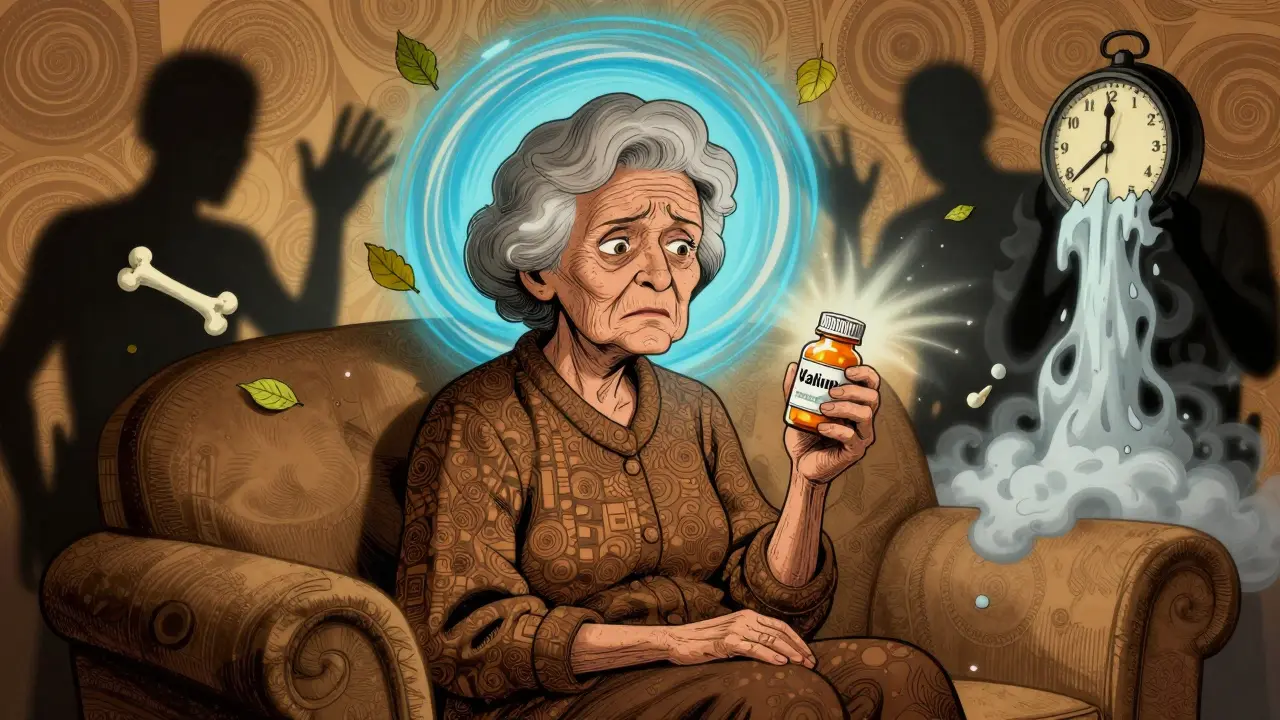
Every year, millions of older adults in the U.S. are prescribed benzodiazepines for anxiety or trouble sleeping. Drugs like Valium, Xanax, and Ativan seem harmless - after all, a doctor prescribed them. But for seniors, these medications carry hidden dangers that most patients never hear about. By age 70, your body processes drugs differently. Your liver slows down. Your brain becomes more sensitive. And what was once a quick fix can become a slow-motion crisis.
Why Benzodiazepines Are Riskier for Seniors
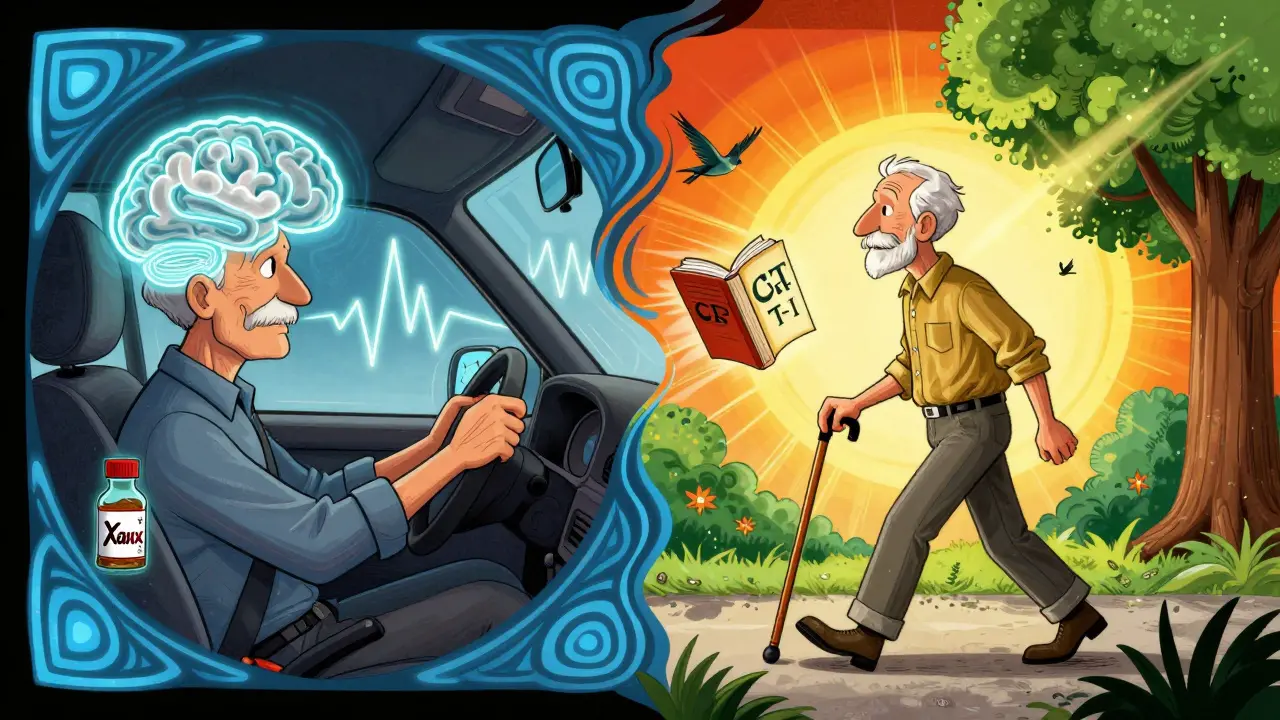
Benzodiazepines work by boosting GABA, a calming neurotransmitter in the brain. That’s why they help with panic attacks or short-term insomnia. But in older adults, the same mechanism causes serious side effects: dizziness, confusion, memory lapses, and unsteady walking. These aren’t just annoyances - they’re fall risks. A 2013 study in the American Family Physician journal found that seniors on benzodiazepines had at least a 50% higher chance of breaking a hip. And it’s not just falls. These drugs slow reaction time like alcohol. Driving after taking a nightly dose? That’s like driving with a blood alcohol level of 0.06% - illegal for younger adults, but often overlooked for seniors.
Long-acting benzodiazepines like Valium and Librium stick around longer in the body. Their half-lives can exceed 20 hours, meaning the drug is still active the next day. This leads to daytime grogginess, poor concentration, and increased risk of accidents. Even short-term use - just a few weeks - can leave seniors feeling foggy for months. A 2023 meta-analysis showed cognitive decline from long-term use didn’t fully reverse three months after stopping.
And then there’s the dementia link. Research from French and Canadian teams, published in 2023, found that seniors who took benzodiazepines for 3 to 6 months had a 32% higher risk of developing Alzheimer’s. For those on the drugs for more than six months? The risk jumped to 84%. The more you take, and the longer you take it, the greater the damage. Dr. Malaz Boustani’s research at Indiana University confirmed a 51% increased dementia risk in long-term users. These aren’t rare cases - they’re patterns backed by large studies.
What the Experts Say
The American Geriatrics Society (AGS) has labeled benzodiazepines as “potentially inappropriate” for seniors since 2019 - and their 2024 update made it even clearer: all benzodiazepines, regardless of how long they last in the body, pose serious risks. The STOPP guidelines, used by doctors worldwide, agree. So do Medicare and the FDA. In April 2024, the FDA required all benzodiazepine labels to include a warning about dementia risk in older adults.
Dr. Sharon K. Inouye, a leading geriatrician at Harvard, calls benzodiazepines “among the most dangerous medications for older adults.” Dr. Michael Steinman from UCSF, who helped write the AGS guidelines, says even short-term use carries risks most doctors underestimate. And it’s not just theoretical - real people are getting hurt. On Reddit’s r/geriatrics forum, a nurse shared that 9 out of 10 elderly patients she sees believe their benzos are completely safe because “the doctor said so.” That’s the problem: patients trust their doctors. They don’t know the guidelines have changed.
The Hidden Cost of “Just One More Night”
Many seniors start benzodiazepines after a stressful event - a death in the family, surgery, or a move to assisted living. They’re told, “Take this for a few days.” But it’s easy to slip into long-term use. Rebound anxiety and insomnia often kick in when the drug wears off, making patients feel like they need it more than ever. A 2015 study found that 68% of long-term users didn’t want to stop - even after learning about the risks. Why? Because stopping feels harder than continuing.
Withdrawal isn’t just uncomfortable - it can be dangerous. Symptoms like tremors, panic attacks, and seizures can occur if you quit too fast. That’s why tapering must be slow. The American Society of Addiction Medicine recommends reducing the dose by 5-10% every 1-2 weeks. For some, that means a 6-month to year-long process. And even then, 60-80% of patients experience withdrawal symptoms. The key? Don’t go it alone. Work with your doctor. Use behavioral tools. And don’t assume that because you’ve been on it for 10 years, you have to stay on it forever.
Safer Alternatives That Actually Work
There are better options - and they don’t come in a pill bottle.
- Cognitive Behavioral Therapy for Insomnia (CBT-I): This isn’t just “sleep hygiene.” It’s a structured program that reteaches your brain how to sleep. Studies show 70-80% of seniors improve significantly. Medicare has covered CBT-I since 2022, but only 12% of eligible patients use it - mostly because few providers offer it.
- SSRIs and SNRIs: For anxiety, drugs like sertraline (Zoloft) or venlafaxine (Effexor) are first-line choices. They take 4-6 weeks to work, but they don’t cause falls, memory loss, or addiction. They’re safer than benzos for long-term use.
- Ramelteon: A melatonin receptor agonist approved for sleep onset. It doesn’t cause dependence or cognitive side effects. It’s not as strong for staying asleep, but it’s far safer than anything in the benzo class.
- Non-drug strategies: Regular exercise, sunlight exposure, consistent bedtime routines, and cutting caffeine after noon can improve sleep and reduce anxiety naturally. A 2024 study found seniors who walked 30 minutes daily cut their anxiety symptoms by nearly half.
What about antihistamines like diphenhydramine (Benadryl)? They’re common - but dangerous. These drugs block acetylcholine, a brain chemical critical for memory. Long-term use is linked to a 43% higher dementia risk. They’re not safer - just less talked about.
What to Do If You’re on Benzodiazepines
If you or a loved one is taking a benzodiazepine, don’t panic. But don’t ignore it either. Here’s what to do:
- Review your meds with your doctor. Ask: “Is this still necessary?” and “Are there safer options?”
- Don’t stop cold turkey. Withdrawal can be severe. Work with a provider to create a slow taper plan.
- Ask about CBT-I or counseling. Many clinics now offer telehealth sessions. Medicare covers them.
- Track side effects. Keep a journal: Did you fall? Feel foggy? Forget names? These are clues your body is reacting badly.
- Involve caregivers. Family members often notice changes before the patient does. They should be part of the conversation.
Some seniors do well with tapering. Others need ongoing support. That’s okay. The goal isn’t to be drug-free at all costs - it’s to be safe, clear-headed, and independent for as long as possible.
The Bigger Picture
Prescriptions for benzodiazepines in seniors have dropped 18% since 2015 - from 10.8 million to 8.9 million annually. That’s progress. But 3.2 million older adults are still on them long-term. And in the 85+ group, nearly 1 in 10 still use them. The problem isn’t just doctors - it’s a system that moves slowly. CMS now flags inappropriate prescriptions. The FDA updated labels. The Beers Criteria are clear. But change takes time.
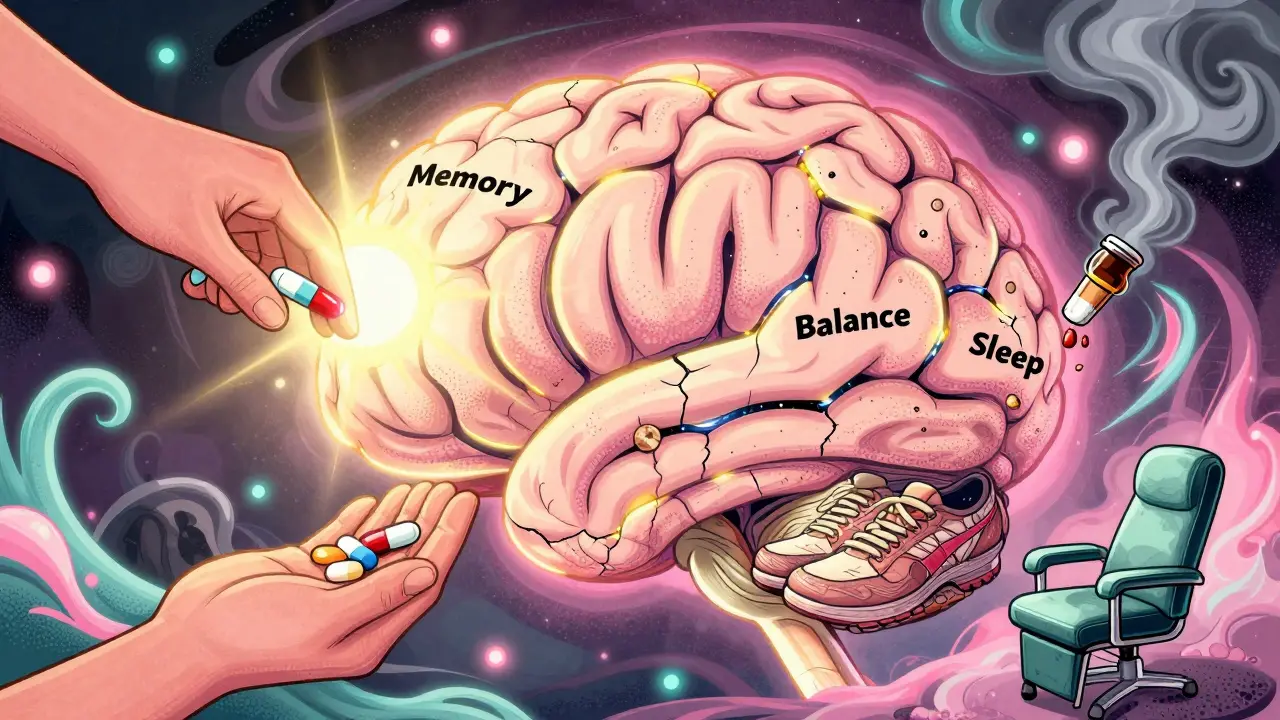
The NIH’s BRIGHT trial, launched in 2024, is testing telehealth-assisted deprescribing. Results won’t come until 2029. But we don’t have to wait. If you’re a senior on benzodiazepines, or the family member of one, you can act now. Talk to your doctor. Ask for alternatives. Demand better. Because your brain, your balance, and your future independence are worth more than a quick fix.
Are benzodiazepines safe for seniors if taken occasionally?
No. Even short-term use carries measurable risks for older adults. Studies show increased chances of falls, confusion, and car accidents after just a few doses. The American Geriatrics Society advises against any routine use in seniors, regardless of duration. What seems like an occasional pill can still affect balance, memory, and reaction time - all critical for safety in older age.
Can you stop benzodiazepines cold turkey?
Never. Stopping abruptly can cause seizures, severe anxiety, hallucinations, or even death. Withdrawal symptoms occur in 60-80% of long-term users. Tapering must be slow and supervised - usually over 8 to 16 weeks, sometimes longer. A doctor should create a personalized plan, often combining gradual dose reduction with therapy like CBT to manage rebound symptoms.
What’s the best alternative to benzodiazepines for sleep in seniors?
Cognitive Behavioral Therapy for Insomnia (CBT-I) is the most effective long-term solution. It’s proven to work better than medication for older adults, with no side effects. If medication is needed, ramelteon is the safest option - it doesn’t cause dependence or cognitive decline. Avoid antihistamines like diphenhydramine - they increase dementia risk. Always discuss options with your doctor before switching.
Does Medicare cover alternatives to benzodiazepines?
Yes. Since 2022, Medicare covers CBT-I under its Behavioral Health Integration benefit. Many telehealth providers now offer these sessions. However, only 12% of eligible seniors use them, mostly due to lack of awareness or provider shortages. Ask your doctor for a referral. Some community health centers also offer free or low-cost sleep and anxiety programs.
Why are benzodiazepines still prescribed if they’re dangerous?
Old habits die hard. Many doctors learned to prescribe these drugs decades ago, and changing practice takes time. Patients often ask for them because they’ve heard they work fast. There’s also a lack of access to non-drug therapies like CBT-I. But guidelines have changed. The Beers Criteria, FDA warnings, and CMS monitoring are pushing providers to rethink. The goal now is to reduce inappropriate use - not just manage it.
Gaurav Kumar
March 18, 2026 AT 11:02Wow, finally someone with actual data. In India, we call this 'doctor ke jadoo' - magic pills that don't exist. Benzodiazepines? More like brain fog generators. I've seen grandpas stumble around like they're in a TikTok dance challenge. 😅
And don't even get me started on diphenhydramine. That stuff is a dementia time bomb wrapped in a Benadryl ad. We need policy changes, not just blog posts. My uncle was on it for 7 years. Now he can't remember my name. That's not aging. That's negligence.
Jeremy Van Veelen
March 19, 2026 AT 12:41THIS IS A NATIONAL EMERGENCY. I swear to God, if I see one more 80-year-old on Xanax because 'the doctor said so,' I'm going to scream into a pillow. The FDA warning? A footnote. The AGS guidelines? A suggestion. We're letting our elders die slowly because we're too lazy to offer therapy. CBT-I is covered by Medicare and 88% of providers don't even mention it. This isn't healthcare. It's a crime scene with a white coat.
Laura Gabel
March 21, 2026 AT 08:47Andrew Mamone
March 22, 2026 AT 20:08I really appreciate how thorough this is. The stats are terrifying but necessary. I work in elder care and can confirm: the cognitive fog from benzos is often mistaken for 'just getting older.' It's not. It's pharmacology. Ramelteon and CBT-I aren't just alternatives-they're upgrades. I wish more docs had this level of awareness. 🙏
Also, the 60-80% withdrawal rate? That's not 'difficult'-that's a systemic failure. We need dedicated deprescribing clinics. Not just 'talk to your doctor.'
MALYN RICABLANCA
March 24, 2026 AT 05:42OH MY GOD. OH. MY. GOD. Did you SEE the part about 84% increased dementia risk?!! I mean, I literally had to stop reading and go lie down because my heart started pounding like I was in a horror movie. And then-AND THEN-THEY STILL PRESCRIBE IT?!?! Like, is there a secret benzodiazepine cult meeting in some backroom of the AMA?! I swear, if my grandma had taken one more pill after her hip surgery, I’d have to file a missing-person report for her personality.
And don’t even get me started on diphenhydramine. It’s like giving someone a sugar cube laced with liquid regret. ‘Oh, just take Benadryl for sleep!’ NO. NO. NO. It’s not sleep. It’s a slow, chemical lobotomy with a side of confusion. I’m not mad. I’m just… disappointed. In humanity. In medicine. In the fact that my dentist knows more about geriatric pharmacology than my geriatrician.
Also, why isn’t this on the evening news? Why isn’t Dr. Phil doing a special? Why isn’t Oprah holding a town hall with a giant screen showing MRI scans of aging brains? We need a movement. A protest. A TikTok challenge. ‘#DontDoseMyGrandma.’ I’m making merch.
gemeika hernandez
March 24, 2026 AT 23:51Nicole Blain
March 26, 2026 AT 18:35This is so important. I work with seniors and see this every day. The 'just one more night' mindset is so real. I love how you included CBT-I and ramelteon. Also, walking 30 mins a day? That’s the real MVP. 🌞🚶♀️
Kathy Underhill
March 28, 2026 AT 18:26There’s a quiet dignity in letting go of unnecessary medication. The fear of withdrawal is real-but so is the fear of losing oneself to fog. This isn’t about abandoning comfort. It’s about reclaiming clarity. The body remembers how to heal when we stop interfering. Patience, not pills, is the most underused therapy.
Srividhya Srinivasan
March 29, 2026 AT 10:58THIS IS ALL A BIG PHARMA SCAM. They don't care about your grandma. They care about profits. I saw a documentary-these drugs are designed to keep seniors dependent. The FDA? Controlled. The doctors? Paid. The CBT-I? Too expensive to promote. It's all a trap. I'm not even sure I trust this article anymore. Who wrote it? Are they on the payroll? 🤔
And why is there no mention of the Chinese government's role in opioid production? I think benzodiazepines are just a distraction. The real agenda? Population control. You think I'm crazy? Look at the numbers. The decline since 2015? Coincidence? I think not.
Prathamesh Ghodke
March 29, 2026 AT 21:49Man, this hits hard. I’ve seen my dad go from sharp as a tack to barely recognizing his own photos after 5 years on Ativan. No one told us the risks. Just ‘take it, it’s fine.’
CBT-I is the real deal. My cousin tried it through VA telehealth-slept like a baby in 6 weeks. No pills. Just talk and routine. If more docs knew this, we wouldn’t be having this conversation.
Also, walking 30 mins? My old man started doing it after he quit benzos. Now he’s hiking on weekends. Who knew the cure was a pair of sneakers?
Stephen Habegger
March 31, 2026 AT 06:34Great breakdown. I’ve been helping my mom taper off Xanax for 8 months now. It’s slow, but she’s brighter, calmer, and walks without a cane. CBT-I was the game-changer. Medicare covered it-just needed someone to push for it. You’re not alone. Keep fighting.
Sanjana Rajan
April 1, 2026 AT 07:26Ugh. Another one of these ‘doctors are evil’ posts. Some of us actually like our benzos. My aunt’s been on them for 15 years and she’s fine. Why are you trying to shame people for using prescribed meds? Maybe she’s just better off this way? Not everyone wants to ‘walk more’ or ‘do CBT.’ Some people just want peace.
Also, why is everyone obsessed with dementia? My aunt doesn’t care if she forgets where she put her keys. She’s happy. Isn’t that what matters?
Kyle Young
April 3, 2026 AT 03:19It’s fascinating how deeply embedded these prescriptions are in geriatric practice. The inertia of medical tradition is almost invisible until you see its consequences. The fact that 1 in 10 seniors over 85 are still on benzodiazepines suggests a systemic failure-not just individual ignorance. Is this a failure of education? Policy? Or something more fundamental, like our cultural aversion to discomfort?
If we’re willing to accept cognitive decline as inevitable, then we’re not treating illness-we’re normalizing erosion. What does that say about how we value the elderly?
Alexander Pitt
April 4, 2026 AT 21:47As a pharmacist, I’ve counseled hundreds of seniors on benzos. The biggest barrier isn’t the doctor-it’s the patient’s fear of withdrawal. They’ve been told for years that this is their ‘lifeline.’ Changing that mindset requires repeated, compassionate conversations. CBT-I works. Ramelteon works. But no one asks. No one offers. We need to start asking: ‘Is this helping you live-or just helping you sleep?’
Manish Singh
April 5, 2026 AT 21:35As an Indian-American, I’ve seen both sides. In India, elders often avoid meds unless absolutely necessary. In the US? It’s ‘take this, you’ll feel better.’ But here’s the truth: sleep isn’t solved with a pill. It’s solved with routine, light, and movement.
I got my mom off benzos using a 7 PM dinner, no screens after 8, and a walk around the block. No therapy. No meds. Just consistency. She’s been drug-free for 2 years. Better sleep. Sharper mind. More laughter.
It’s not rocket science. It’s just… human.
gemeika hernandez
April 6, 2026 AT 23:38