
When you pick up a generic pill at the pharmacy, you expect it to work just like the brand-name version. But how does the FDA know it will? The answer lies in bioavailability studies - the invisible science that makes generic drugs safe, effective, and legal to sell. These aren’t just lab tests. They’re rigorous, tightly controlled studies that measure whether your body absorbs the generic drug the same way it absorbs the original. And if they don’t match up, the drug doesn’t get approved.
What Exactly Is Bioavailability?
Bioavailability sounds technical, but it’s simple: it’s how much of the drug actually gets into your bloodstream and where it needs to go. Think of it like pouring water into a cup. If you spill half before it reaches the cup, you didn’t get full value. With drugs, if only 60% of the active ingredient enters your blood instead of 100%, you might not get the full effect - or worse, you might have side effects because your body is processing it differently. The FDA defines bioavailability as "the rate and extent to which a therapeutically active chemical is absorbed from a drug product into the systemic circulation and becomes available at the site of action." Two numbers matter most: AUC (Area Under the Curve) and Cmax (Maximum Concentration). AUC tells you how much drug your body was exposed to over time - total absorption. Cmax tells you how fast it got there - how quickly it peaked in your blood. A third number, Tmax, records when that peak happened. These aren’t guesses. They’re measured by drawing blood from volunteers after they take the drug - sometimes 12 to 18 times over 24 to 72 hours. The samples go to labs that use highly validated methods to detect even tiny amounts of the drug. Accuracy must be within 85-115% of the true value. Precision? Less than 15% variation. If the lab can’t hit those numbers, the whole study is thrown out.How Do They Prove a Generic Is the Same?
Generic drug makers don’t run full clinical trials like brand-name companies. That’s why the 1984 Hatch-Waxman Act created the Abbreviated New Drug Application (ANDA) pathway. Instead of proving the drug works in patients with disease, they prove it behaves the same way in the body. That’s bioequivalence. Here’s how it works: healthy volunteers take both the brand-name drug and the generic, in random order, with a clean break between doses (called a washout period). Blood samples are taken after each. Then, the AUC and Cmax values from the generic are compared to the brand-name version. The rule? The 90% confidence interval of the ratio (generic/brand) must fall between 80% and 125%. That means the generic’s absorption can’t be more than 25% higher or 20% lower than the original. Sounds loose? It’s not. Most generics land between 95% and 105%. A study might show a 10% difference - that’s fine. But if the upper limit of the confidence interval hits 130%, even if the average looks good, the drug fails. One real case showed a generic with an AUC ratio of 1.16 - 16% higher. It failed because the confidence interval went over 1.25. This isn’t arbitrary. Dr. John Jenkins, former head of FDA’s drug review office, said the 80-125% range is based on decades of clinical experience: a 20% difference in absorption rarely changes how a drug works for most people. The American College of Clinical Pharmacy adds that this standard actually ensures the true difference is almost certainly under 25% - tighter than most people realize.Why Not Just Test Patients With the Disease?
You might think: why not give the drug to people with high blood pressure or epilepsy and see if it lowers their numbers? That’s expensive, slow, and ethically tricky. Bioavailability studies use healthy volunteers because they eliminate disease variables. If the drug gets absorbed the same way in healthy people, it’s very likely to behave the same in sick people - especially for common oral pills. This is called the Fundamental Bioequivalence Assumption. It’s the backbone of the entire generic system. And it works. Since 1984, the FDA has approved over 15,000 generic drugs. Today, 97% of U.S. prescriptions are filled with generics. And according to the Generic Pharmaceutical Association, 90% of people can’t tell the difference in effectiveness. But there are exceptions. For drugs with a narrow therapeutic index - like warfarin, digoxin, levothyroxine, or anti-seizure meds - even small changes can be dangerous. For these, the FDA requires tighter limits: 90-111% for the confidence interval. Some states even require doctors to approve generic switches for these drugs.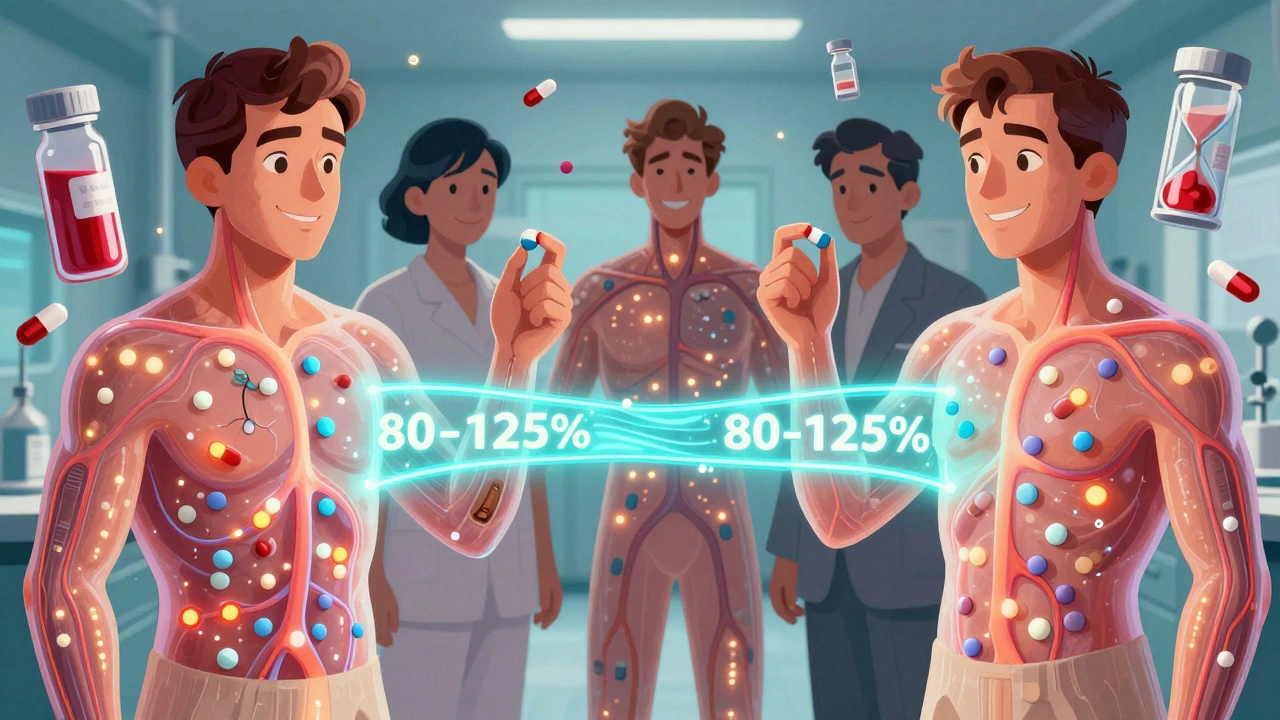
What About Complex Generics?
Not all drugs are pills. Some are inhalers, gels, patches, or extended-release tablets. These are harder to copy. A generic testosterone gel might look the same, but if the skin absorbs it slower, the patient gets less drug over time. Or a delayed-release capsule might dissolve in the wrong part of the gut. For these, standard AUC and Cmax tests aren’t enough. The FDA has issued 11 new product-specific guidances since 2023 for complex generics like budesonide inhalers, testosterone gels, and extended-release metformin. They now require multiple time-point measurements, pharmacodynamic endpoints (like measuring skin redness for topical drugs), or even in vitro-in vivo correlation (IVIVC) models that link lab tests to real-world absorption. Highly variable drugs - where people’s bodies absorb the same dose very differently - are another challenge. For these, the FDA allows reference-scaled average bioequivalence (RSABE). If a drug shows high variability (over 30% within-subject variation), the acceptance range widens to 75-133%. This was used for a generic version of tacrolimus, a kidney transplant drug, in 2021.How Are These Studies Done?
A typical bioequivalence study involves 24 to 36 healthy adults. They’re fasted overnight. They take the drug with water. Then, they sit in a clinic for hours while nurses draw blood every 15 to 60 minutes. The study is randomized and double-blinded - neither the volunteers nor the lab techs know which pill they got. The washout period? At least five half-lives of the drug. For a drug with a 12-hour half-life, that’s 60 hours. This ensures no leftover drug from the first dose messes up the second. It’s expensive. Each study costs $100,000 to $500,000. Globally, contract labs run about 1,200 of these a year - worth $1.8 billion. The FDA requires that every step follows strict guidelines. From how the blood tubes are labeled to how the data is analyzed - every detail is auditable.
Are There Any Problems?
Yes. And they’re real. In 2023, the Epilepsy Foundation reported 187 cases where patients had more seizures after switching to a generic anti-seizure drug. The FDA investigated and found only 12 cases - about 6.4% - might be linked to bioequivalence issues. The rest were due to missed doses, stress, or other factors. Still, doctors like Dr. Michael Chen report rare cases where patients on amlodipine had palpitations after switching - symptoms that vanished when they went back to the brand. These aren’t common. But they’re enough to keep regulators cautious. That’s why the FDA is investing in new tools. In 2023, they partnered with MIT to use artificial intelligence to predict bioequivalence from formulation data. Their model predicted AUC ratios with 87% accuracy across 150 drugs. If this scales, future generics might need fewer human studies. Still, the core rule hasn’t changed: if a generic doesn’t match the brand’s absorption profile within strict limits, it doesn’t get approved. That’s not bureaucracy. It’s science.Why Should You Care?
Generics save the U.S. healthcare system over $300 billion a year. Without bioequivalence studies, that wouldn’t be possible. You’d pay $200 for a blood pressure pill instead of $4. You’d wait months for a new cancer drug to become affordable. But you also deserve confidence. When your doctor prescribes a generic, you want to know it’s not a cheap knockoff. It’s a scientifically proven copy - tested in real people, measured with precision instruments, and approved by the most rigorous drug agency in the world. The system isn’t perfect. Complex drugs, high variability, and rare patient reactions remind us that biology is messy. But for the vast majority of pills you take - antibiotics, statins, antidepressants, painkillers - bioequivalence studies are the quiet, powerful reason they work just as well as the brand.What’s Next?
The FDA’s 2023 draft guidance on model-informed drug development (MIDD) could soon reduce the need for human studies for some drugs. If a generic’s formulation is nearly identical to the brand - same ingredients, same particle size, same dissolution rate - advanced modeling might predict bioequivalence without blood draws. But until then, the gold standard remains: blood samples, controlled environments, and strict statistical limits. Because when it comes to your health, there’s no shortcut to proof.Do generic drugs have the same active ingredients as brand-name drugs?
Yes. By law, generic drugs must contain the same active ingredient, strength, dosage form, and route of administration as the brand-name version. The difference is in the inactive ingredients - like fillers, dyes, or coatings - which don’t affect how the drug works in your body.
Why do some people say generics don’t work as well?
In rare cases, patients report changes after switching - like increased side effects or reduced effectiveness. This is most common with drugs that have a narrow therapeutic index, like warfarin or levothyroxine. For most people, these reports are due to factors like stress, diet, or missed doses - not the drug itself. But because even small changes matter for these drugs, doctors sometimes prefer to keep patients on the same version.
Are bioequivalence studies only done in the U.S.?
No. The FDA, European Medicines Agency (EMA), and Japan’s PMDA all follow similar bioequivalence standards for most oral drugs. This alignment, led by the International Council for Harmonisation (ICH), means a generic approved in one country often meets requirements in others - speeding up global access.
Can a generic drug be approved without human studies?
Yes - but only under specific conditions. Drugs classified as BCS Class 1 (high solubility, high permeability) with identical formulations to the brand can qualify for a waiver. This means the FDA accepts in vitro dissolution tests instead of blood draws. This applies to common drugs like aspirin or metformin. But it’s rare for complex or poorly soluble drugs.
How long do bioequivalence studies take?
The actual study lasts 2-8 weeks, depending on the drug’s half-life. But the entire process - from protocol design to FDA review - can take 12 to 24 months. Most of that time is spent preparing the study, validating lab methods, analyzing data, and submitting paperwork to the FDA.
Is it safe to switch from brand to generic?
For most people, yes. Over 90% of Americans use generics without issue. The FDA’s approval process ensures that bioequivalent drugs perform the same way in the body. If you’ve been stable on a brand-name drug and your doctor suggests switching, it’s generally safe. But if you’re on a narrow therapeutic index drug, talk to your doctor first - they may recommend staying on the same version.
sandeep sanigarapu
December 13, 2025 AT 04:17Generic drugs work because of strict bioequivalence standards. The science is solid. Healthy volunteers, blood draws, AUC/Cmax - it’s not guesswork. 97% of prescriptions are generics for a reason.
Adam Everitt
December 13, 2025 AT 16:00so like… if the drug gets absorbed 110%? that’s fine? but 130% and it’s out? kinda wild that such a small range makes or breaks a whole product. also… who even tests this? like… real people? with needles? yikes.
wendy b
December 13, 2025 AT 19:11Actually, the 80-125% confidence interval is not 'loose' - it is statistically derived from pharmacokinetic variance observed across thousands of clinical cases. The American College of Clinical Pharmacy has repeatedly affirmed its validity. Those who claim otherwise misunderstand the difference between statistical significance and clinical relevance.
Ashley Skipp
December 14, 2025 AT 20:29They say generics are the same but I know someone who had a seizure after switching. The brand worked fine. The generic didn’t. End of story. They’re not all equal no matter what the FDA says.
Nathan Fatal
December 14, 2025 AT 20:44There’s a lot of fear around generics because people don’t understand the science. The bioequivalence thresholds are conservative. Even when a generic shows a 10% difference in Cmax, the actual clinical impact is negligible for 99% of drugs. The system works because it’s built on real data, not assumptions. We should trust the process - not anecdotes.
Stacy Foster
December 15, 2025 AT 15:59Let’s be real - the FDA is in bed with Big Pharma. They approve generics that are ‘close enough’ so the brand-name companies don’t lose money. That’s why they let the 125% upper limit slide. And don’t get me started on how they use healthy volunteers - how do you know it works in someone with liver disease? They’re hiding the truth. I’ve seen the documents.
nikki yamashita
December 15, 2025 AT 20:03Generics saved me $200/month on my antidepressant. No side effects, no issues. Science rules. 💪
Laura Weemering
December 16, 2025 AT 23:03And yet… the variability… the pharmacokinetic outliers… the intrasubject variance… the lack of long-term pharmacodynamic monitoring… the reliance on single-dose studies… the absence of real-world evidence integration… the FDA’s own 2023 internal audit flagged 17% of ANDA submissions for incomplete PK modeling… and still… we’re told to trust the 80-125%? It’s not science - it’s convenience dressed up as rigor.
Audrey Crothers
December 17, 2025 AT 02:05My grandma takes levothyroxine and they switched her to generic - she got dizzy, tired, gained 10 lbs. Went back to brand - she’s back to normal. So yeah, sometimes it matters. Don’t tell me it’s ‘rare’ - it matters to her.
Robert Webb
December 18, 2025 AT 09:35What’s fascinating is how bioequivalence studies evolved from crude pharmacokinetic models in the 70s to today’s AI-assisted predictive frameworks. The FDA’s partnership with MIT isn’t just about cutting costs - it’s about reducing human exposure to experimental protocols while maintaining precision. The 87% accuracy rate on AUC prediction across 150 drugs is a huge leap. In five years, we might see waivers for 40% of oral solids without a single blood draw. But we still need the human data as a baseline. It’s not about replacing science - it’s about refining it. And honestly, the fact that we can predict drug absorption from particle size and dissolution profiles alone? That’s the future. The current system is the bridge - imperfect, expensive, but necessary.
Lawrence Armstrong
December 20, 2025 AT 05:33Just saw a study where a generic metformin had a 5% slower Tmax - patient reported bloating for 3 weeks. Switched back - gone. So yeah, even small differences can feel big. Not everyone is a lab rat. 🤷♂️
Reshma Sinha
December 20, 2025 AT 23:25RSABE for high variability drugs is a brilliant innovation. The 75-133% range is not a loophole - it’s a mathematical necessity. Without it, drugs like tacrolimus would never have affordable generics. The FDA’s approach is adaptive, not rigid. That’s what makes it world-leading.
Donna Anderson
December 22, 2025 AT 18:53generic vs brand its all the same but i swear my anxiety got worse when i switched i think its the dye or something
Nathan Fatal
December 24, 2025 AT 09:14That’s why for drugs with high variability or narrow therapeutic windows, the FDA allows for individualized monitoring and prescriber discretion. It’s not a flaw - it’s a safeguard. The system doesn’t treat everyone the same because biology isn’t uniform. That’s why your anecdote matters - not to invalidate the system, but to improve it.