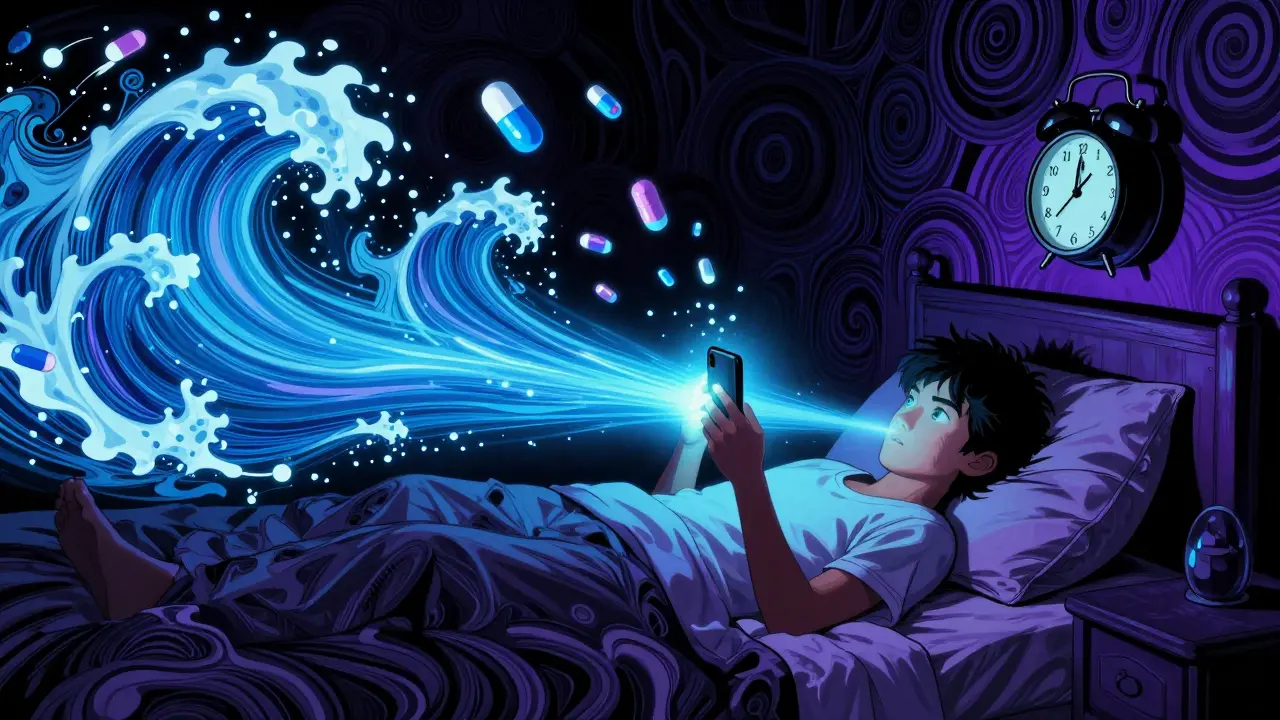
How many times have you laid in bed at night, scrolling through your phone, only to feel wide awake despite being exhausted? You’re not alone. Millions of people struggle to fall asleep because of something as simple as the light from their screens. The culprit? Blue light.
Why Blue Light Keeps You Awake
Blue light isn’t bad-it’s actually helpful during the day. Natural sunlight contains a lot of it, and that’s why you feel alert in the morning. But when you’re exposed to blue light from phones, tablets, and laptops at night, it tricks your brain into thinking it’s still daytime. This happens because special cells in your eyes, called ipRGCs, send signals to your brain’s internal clock. When they detect blue light, especially between 460 and 480 nanometers, they shut down melatonin production-the hormone that tells your body it’s time to sleep. Research from Harvard Medical School in 2012 showed that just 6.5 hours of blue light exposure suppressed melatonin for about 3 hours. That’s double the effect of green light. Even worse, modern LED screens emit 30-40% blue light, compared to just 15% in old incandescent bulbs. If you’re scrolling at 30 cm distance for two hours before bed, you’re getting 30-50 lux of blue light-enough to cut melatonin in half compared to dim red light.The Real Impact on Your Sleep
It’s not just about taking longer to fall asleep. Blue light at night messes with the whole sleep cycle. Studies show people who use screens before bed have:- Longer time to fall asleep (often 45+ minutes)
- More nighttime awakenings
- Less deep sleep
- Lower sleep satisfaction
What Experts Say: Consensus and Controversy
Not every study agrees. A 2022 experiment from the University of Toronto found no difference in melatonin levels when participants were exposed to blue, yellow, or white light-so long as the total stimulation of ipRGCs was the same. That suggests it’s not blue light itself, but total light intensity that matters. But here’s the catch: most real-world situations don’t control for that. When you’re scrolling on your phone in a dark room, you’re not getting balanced light-you’re getting a spike of blue light at a time when your body should be quieting down. Dr. Charles Czeisler from Brigham and Women’s Hospital puts it bluntly: blue light at night can contribute to cancer, diabetes, heart disease, and obesity-not because it directly causes them, but because it disrupts sleep, and poor sleep is a major risk factor for all of them. Meanwhile, the American Academy of Sleep Medicine (AASM) doesn’t wait for perfect data. In 2020, they officially recommended avoiding screens for at least one hour before bed. Why? Because the evidence is strong enough to act on.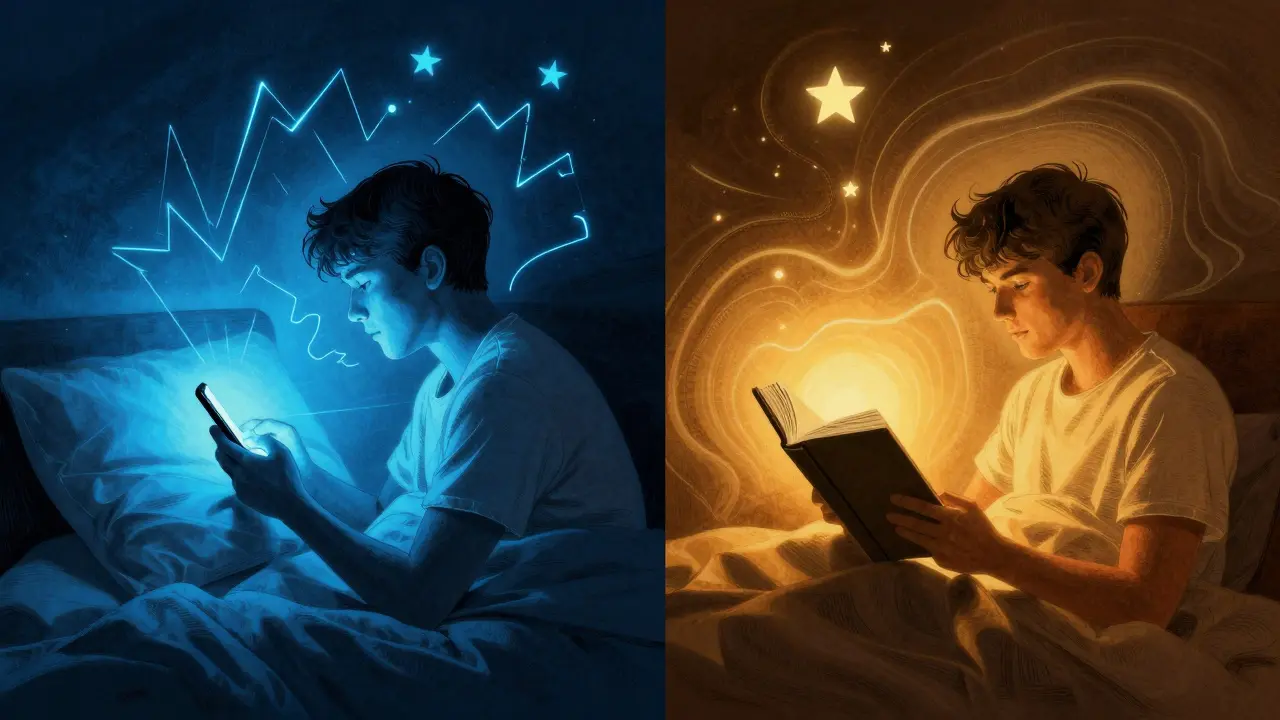
Screen Time Limits That Actually Work
So how much screen time is too much? The answer isn’t one-size-fits-all, but here’s what works for most people:- Stop all screens 1 hour before bed-this is the AASM’s minimum standard.
- 90 minutes is better-83% of people who follow this rule in Sleep Foundation surveys cut their sleep onset time from over 45 minutes to under 20 minutes.
- Avoid screens after 9 PM-if your bedtime is 11 PM, Harvard researchers say this is the sweet spot.
- Turn on Night Shift (iOS) or f.lux (Windows/Mac)-they reduce blue light by about 60%.
- Lower brightness to below 50 nits (about 30% of max brightness).
- Hold your device at least 40 cm away from your face.
Blue Light Glasses: Do They Help?
You’ve seen the ads-blue light blocking glasses for better sleep. Do they work? The answer is mixed. A 2023 study in Physiopedia found that people who wore blue-light-blocking glasses for two hours before bed had better sleep scores, longer sleep duration, and felt more rested. But another study from the University of Toronto showed no difference between wearing the glasses and not wearing them, as long as the room was dim. Here’s what’s really happening: the glasses help if you’re still using screens in a bright room. But if you’re already in a dark room and not looking at bright screens, the glasses add little benefit. And some users report the yellow tint makes reading hard or causes eye strain. Amazon reviews of these glasses show 68% say they helped them fall asleep faster-but 22% say the color distortion made screen use frustrating. So they’re not magic. They’re a tool. Use them only if you’re stuck with evening screen time.What Works Better Than Filters
The real solution isn’t a filter-it’s a habit. Many people think turning on Night Shift is enough. But here’s what the data shows:- 32% of users in Sleepopolis forums saw no improvement from blue light filters alone.
- Those who improved did so by combining filters with other changes: no screens, reading a book, dim lights, a cool room, and a consistent bedtime.
How to Build a Better Nighttime Routine
You don’t need expensive gear. Just follow this simple plan:- Set a bedtime alarm 90 minutes before sleep.
- When it goes off, put your phone in another room.
- Do something calm: read a physical book, listen to quiet music, stretch, journal.
- Keep lights low-use warm-toned lamps, not overhead LEDs.
- Stick to this for 5-7 days. A University of Glasgow study found it takes about 5.7 days to form the habit.
The Bigger Picture: Why This Matters
The market for blue light products is booming-projected to hit $11.67 billion by 2030. But regulation lags behind. The FDA hasn’t approved any product for sleep improvement. The European Commission says evidence is still insufficient. Yet, 43% of Fortune 500 companies now have “digital sunset” policies, telling employees to stop screen use before off-hours. Why? Because sleep isn’t optional. Poor sleep affects focus, mood, immunity, and long-term health. And when you’re constantly exposed to screens at night, you’re not just losing sleep-you’re training your body to stay awake when it should rest. Apple’s new Sleep Focus mode in iOS 17 (released Sept 2023) is a step forward-it automatically dims your screen and silences notifications an hour before bedtime. But it still relies on you setting a schedule. The tech helps, but the habit is yours to build.Final Takeaway
You don’t need to quit screens. You just need to give your brain a chance to wind down. Blue light is one piece of the puzzle-but the bigger issue is the lack of quiet, predictable routines before bed. Try this tonight: Put your phone on Do Not Disturb. Turn off the main light. Read a few pages of a book. Sit in the dark for 10 minutes. Notice how your body responds. That’s your real cure.Does blue light from screens really affect sleep?
Yes. Research from Harvard Medical School and others shows that blue light between 460-480 nanometers suppresses melatonin production, delaying sleep onset and reducing sleep quality. This effect is strongest in the evening when your body expects darkness.
How long before bed should I stop using screens?
The American Academy of Sleep Medicine recommends at least one hour. For better results, aim for 90 minutes. People who follow this rule report falling asleep 20-25 minutes faster on average.
Are blue light blocking glasses worth buying?
They can help if you must use screens at night, but they’re not a magic fix. Studies show mixed results. Some users report better sleep, while others find the yellow tint uncomfortable. The best approach is reducing screen use first, then using glasses as a backup.
Does Night Shift or f.lux really work?
Yes, but not perfectly. These tools reduce blue light by about 60%, which helps. But they don’t eliminate the mental stimulation from using your phone. For best results, combine them with dimming brightness, increasing viewing distance, and avoiding stimulating content.
What if I work late and need to use a computer?
Use Night Shift or f.lux, keep brightness below 50 nits, and sit at least 40 cm away. After you’re done, avoid checking your phone. Instead, step outside for 5 minutes of natural light (if possible) or sit under a warm lamp. This helps reset your circadian rhythm without adding more blue light.
Can blue light cause long-term health problems?
Not directly-but chronic poor sleep from screen use can. Studies link long-term sleep disruption to higher risks of obesity, diabetes, heart disease, and depression. Blue light is one factor in a larger pattern of poor sleep hygiene.
Is there a difference between phone, tablet, and computer blue light?
The blue light spectrum is similar across devices. But phones are worse because they’re usually held closer to the face (30 cm vs. 60+ cm for computers) and used in darker rooms. This means higher exposure per unit of time. Tablets fall in between.
What should I do instead of scrolling before bed?
Read a physical book, write in a journal, listen to calm music, do light stretching, or practice deep breathing. These activities signal to your brain that it’s time to rest. Avoid anything mentally stimulating-no work emails, no intense shows, no arguments on social media.
How long does it take to adjust to less screen time before bed?
Most people notice improvement in 3-5 days. But forming a lasting habit takes about 5.7 days on average, according to a University of Glasgow study. Consistency is key-skip a night, and you might feel the effects the next day.
Do children need the same screen time limits?
Yes-often more strictly. Children’s circadian systems are more sensitive to light. The National Institutes of Health launched a $2.4 million study in 2023 to examine blue light’s impact on teens. Early data suggests limiting screen use 2 hours before bed improves sleep quality and school performance in adolescents.
Milad Jawabra
March 4, 2026 AT 20:32Renee Jackson
March 5, 2026 AT 12:09Richard Elric5111
March 6, 2026 AT 13:46Dean Jones
March 8, 2026 AT 10:35Betsy Silverman
March 9, 2026 AT 15:04Ivan Viktor
March 10, 2026 AT 18:48Gretchen Rivas
March 10, 2026 AT 21:19Mike Dubes
March 12, 2026 AT 03:52Helen Brown
March 14, 2026 AT 02:10John Cyrus
March 15, 2026 AT 22:31John Smith
March 17, 2026 AT 03:25Sharon Lammas
March 18, 2026 AT 05:10Aisling Maguire
March 19, 2026 AT 08:15marjorie arsenault
March 20, 2026 AT 09:23Deborah Dennis
March 21, 2026 AT 01:53