Every year, millions of people take calcium and iron supplements without realizing they might be making their medications less effective. It’s not just about forgetting to take your pill - it’s about calcium, iron, and other minerals quietly blocking your prescriptions from working. If you’re on antibiotics, thyroid medicine, or heartburn drugs, these everyday supplements could be silently undermining your treatment.
How Calcium Blocks Antibiotics
Calcium doesn’t just build bones. It also binds to certain antibiotics like tetracycline and ciprofloxacin, forming a solid compound your body can’t absorb. This isn’t a myth - it’s science. A study in U.S. Pharmacist found calcium carbonate can cut the absorption of ciprofloxacin by 40%. That means if you take a calcium supplement with your antibiotic, you might not get enough of the drug to kill the infection. The result? A lingering infection, possible complications, or even antibiotic resistance.
Doctors and pharmacists recommend spacing calcium supplements at least two hours before or after taking tetracyclines or fluoroquinolones. But for safety, many experts suggest waiting four to six hours. Why? Because the binding doesn’t just happen in your stomach - it can last through your entire digestive tract. If you’re on a short course of antibiotics (like for a sinus infection), it’s often easier to skip calcium supplements entirely during that time.
Iron and Antibiotics: A Dangerous Pair
Iron supplements - especially ferrous fumarate - face the same problem. Iron binds tightly to tetracycline, doxycycline, and minocycline, just like calcium does. If you take them together, your antibiotic becomes useless. The GoodRx medical team recommends taking iron at least two hours before or four hours after these antibiotics. No shortcuts. No "I’ll just take them 30 minutes apart."
But here’s the twist: iron needs stomach acid to be absorbed. That’s why heartburn medications like omeprazole (Prilosec) or famotidine (Pepcid) can make iron supplements less effective. These drugs reduce stomach acid, and without enough acid, your body can’t unlock the iron. So if you’re taking both, timing matters even more. One option: take iron up to two hours before your heartburn pill. Another: ask your doctor if switching to a different iron form - like ferrous bisglycinate - might help. It’s less affected by stomach pH.
Calcium and Thyroid Medicine: A Silent Saboteur
If you’re on levothyroxine (Synthroid or a generic version) for hypothyroidism, calcium is one of your biggest enemies. A study in the South Medical Journal showed that taking calcium within four hours of levothyroxine can reduce thyroid hormone absorption by up to 30%. That’s enough to throw your whole hormone balance off. Symptoms creep back: fatigue, weight gain, brain fog.
Most endocrinologists now insist on a four-hour gap between calcium (or multivitamins with calcium) and thyroid medication. Many patients take their thyroid pill first thing in the morning on an empty stomach, then wait until after breakfast - or even lunch - to take their calcium supplement. That’s not just advice. It’s a medical necessity.
Iron and Milk: A Common Mistake
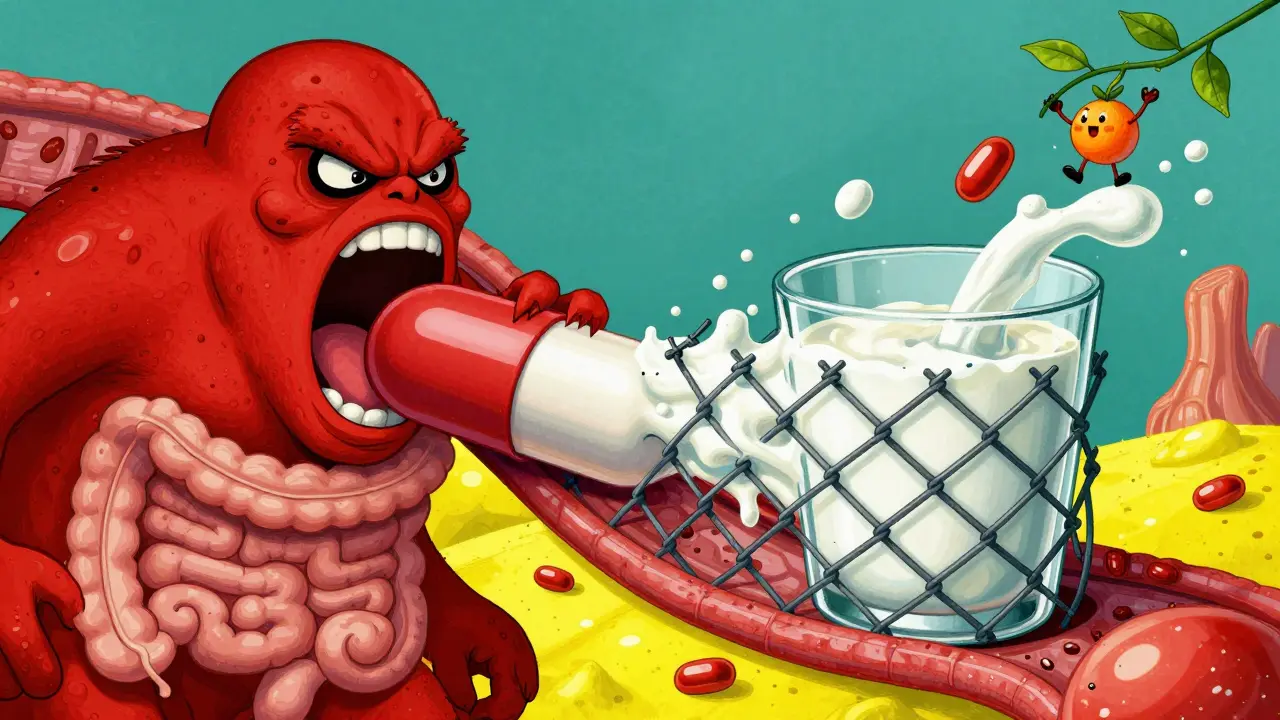
Parents often give iron supplements to kids with anemia, and it’s common to pair them with milk because it’s familiar, safe, and tastes better. But milk is full of calcium - and calcium binds iron. A child taking iron with milk might not absorb a single milligram. The same goes for adults. HealthyChildren.org warns that dairy products can cut iron absorption by as much as half.
Instead, pair iron with vitamin C. Orange juice, strawberries, or bell peppers help your body absorb iron better. One study found vitamin C can double iron uptake. So if you’re taking an iron pill, drink a glass of OJ with it - not a glass of milk.
Other Minerals That Interfere
Calcium and iron aren’t the only troublemakers. Zinc, magnesium, and aluminum (found in antacids) also bind to antibiotics and thyroid meds. Even some multivitamins with these minerals can cause problems. If you’re on a medication that’s sensitive to minerals, read the label. Look for warnings about "metal cations," "divalent cations," or "antacids." Those are red flags.
And don’t forget about phosphate binders - used by people with kidney disease. These can also interfere with thyroid and antibiotic absorption. If you’re on multiple prescriptions, it’s not just about drug-to-drug interactions. It’s about drug-to-supplement interactions too.
What Should You Do?
Here’s what works in real life:
- Write down every supplement you take - even the ones you think are "harmless." Include calcium, iron, zinc, magnesium, and multivitamins.
- Check your prescriptions - antibiotics, thyroid meds, and heartburn drugs are the most likely to interact.
- Space them out - keep calcium and iron at least 4 hours apart from antibiotics and levothyroxine.
- Take iron with vitamin C - orange juice, tomato juice, or a 100mg vitamin C tablet.
- Avoid dairy with iron - skip milk, cheese, and yogurt for at least two hours before and after your iron dose.
- Ask your pharmacist - they have interaction checkers built into their systems. They’ll spot risks you might miss.
It’s not about avoiding supplements. It’s about timing them right. A 2023 NHS guideline says it plainly: "It’s a good idea to leave a gap between taking ferrous fumarate and any other medicine." That advice applies to calcium too.
Why This Matters More Than You Think
67% of women and 25% of men take calcium supplements. Nearly half of all adults over 50 take at least one mineral supplement. And nearly one in five Americans is on a medication that can be blocked by these minerals. Most people don’t realize their supplement is sabotaging their prescription. They think, "I took my pill, why am I still sick?" The answer might be in their medicine cabinet.
Pharmacists are now trained to ask: "Are you taking any calcium or iron?" That question used to be rare. Now it’s standard. Because the data doesn’t lie - these interactions are common, preventable, and dangerous.
Don’t wait until you’re back in the doctor’s office with the same infection or the same fatigue. Take control now. Know what’s in your pills. Know when to take them. And don’t be afraid to ask: "Could this supplement make my medicine less effective?"
Can I take calcium and iron together?
No, you shouldn’t. Calcium and iron compete for absorption in the gut. Taking them together reduces how much of each your body can use. If you need both, space them at least four hours apart - ideally, take one in the morning and the other at night.
Does it matter if I take my calcium with food?
Yes. Calcium carbonate (the most common form) needs stomach acid to absorb well, so it works best with food. But if you’re taking it with antibiotics or thyroid meds, food doesn’t help - the binding still happens. Always separate calcium from these medications by at least four hours, regardless of when you eat.
What if I forget and take my iron with my antibiotic?
Don’t panic. One time won’t ruin your treatment. But don’t make it a habit. If it happens, skip your next dose of the antibiotic and take it at least four hours after your iron. If you’re on a short course (like 7 days), talk to your doctor - they may extend the treatment to make sure the infection clears.
Can I take vitamin D with calcium and my medications?
Vitamin D doesn’t interact with antibiotics or thyroid meds. But if your vitamin D supplement contains calcium (many do), then yes - it can interfere. Check the label. If it says "calcium carbonate" or "calcium citrate," treat it like calcium. Take it separately from your medications.
Are there supplements that are safer to take with medications?
Yes. Magnesium oxide and potassium chloride have fewer interactions. But many forms of magnesium (like magnesium citrate) can still bind to antibiotics. The safest approach is to avoid all mineral supplements during short-term antibiotic courses. For long-term use, stick to one mineral at a time and space them from your meds.
Dean Jones
March 2, 2026 AT 22:48Let me tell you something that nobody else will: the entire supplement industry is built on a lie. We’ve been sold this fantasy that popping pills is the same as eating real food, but the body doesn’t work like a vending machine. Calcium and iron aren’t just blocking antibiotics - they’re rewriting the rules of bioavailability in ways we barely understand. The science is clear, sure, but the real problem is that we’ve outsourced our health to convenience. We take supplements because we’re too tired to cook, too busy to sleep, too distracted to notice what’s actually happening inside us. And now we’re surprised when the medicine doesn’t work? It’s not magic. It’s chemistry. And chemistry doesn’t care about your schedule.
People say "just space it out" like it’s easy. Try doing that when you’re on a 9-to-5, have three kids, and your thyroid med is already making you feel like a ghost. The system is broken. The advice is right. The implementation? Impossible for most.
And don’t get me started on vitamin D with calcium. That’s not a supplement - it’s a trap. Label reading? Sure. But who reads labels anymore? We’re not lazy. We’re overwhelmed.
So yes, the science is solid. But the real answer isn’t timing. It’s systemic change. We need better education, not more reminders.
And no, I don’t take supplements anymore. I eat. I sleep. I move. And I’m not sorry for it.
Matt Alexander
March 4, 2026 AT 11:16Just want to say - if you’re on levothyroxine, take it first thing in the morning, wait 4 hours, then eat. Easy. No need to overcomplicate it. I’ve been doing this for 8 years. No issues. Just stick to the rule. Your body will thank you.
Gretchen Rivas
March 5, 2026 AT 05:53My pharmacist caught my calcium and Synthroid combo. I didn’t even know they interacted. Now I take iron at night, calcium at lunch, and Synthroid on an empty stomach. Game changer. Seriously, ask your pharmacist. They’re not just filling prescriptions - they’re saving lives.
Mike Dubes
March 6, 2026 AT 12:26So I took my iron with my coffee this morning and then my antibiotic an hour later… and I felt like garbage for a week. Turns out coffee has tannins too. Who knew? Now I just take everything with water and wait. Dumb mistake. Don’t be like me.
John Cyrus
March 7, 2026 AT 00:28People take supplements like candy and then wonder why they’re still sick. You don’t need calcium pills if you drink milk. You don’t need iron if you eat spinach. This whole industry is a scam. Stop letting corporations profit off your ignorance. Eat real food. Or shut up.
John Smith
March 8, 2026 AT 07:14Man I used to be one of those guys who popped calcium like it was candy. Then I got a UTI and my cipro didn’t work. Turned out I was taking my calcium 2 hours before. Felt like an idiot. Now I take mine at bedtime and my meds in the morning. Simple. Clean. Works. Stop overthinking it. Just separate the damn things.
Richard Elric5111
March 9, 2026 AT 23:29The fundamental error in contemporary pharmacological discourse lies in the anthropocentric assumption that biological systems can be manipulated through temporal discretization alone. The binding kinetics of divalent cations with tetracycline derivatives are not merely a matter of spatial or temporal separation, but rather an emergent property of ionic affinity governed by the Nernst equation and the pH-dependent solubility of chelated complexes. To suggest that a four-hour interval is universally sufficient is to ignore the heterogeneity of gastric emptying times, the influence of dietary fiber on transit velocity, and the polymorphic expression of intestinal transporters across human populations. One cannot reduce physiology to a checklist. The body is not a machine to be programmed - it is a dynamic equilibrium, constantly adapting, and our interventions must reflect that complexity.
Jeff Card
March 10, 2026 AT 19:24I’m not a doctor, but I’ve been on levothyroxine for 12 years and took calcium with it for the first 5. I gained 30 pounds, felt like a zombie, and my doctor kept saying "your levels are fine." Then I read this article and spaced it out. Within 3 weeks, I had energy again. I’m not saying this is science - I’m saying this is my life. If you’re tired and it feels like nothing works - try this. It might save you.
Helen Brown
March 10, 2026 AT 22:24Did you know the FDA doesn’t regulate supplements like drugs? That means the calcium pill you bought could have lead in it. Or it could be filler. Or it could be nothing. And now you’re taking it with your thyroid med? You’re not just risking interaction - you’re risking poisoning. Check your supplements. Look up the brand. If you don’t know where it’s made - stop. Your life isn’t worth a $12 bottle from Amazon.
Sharon Lammas
March 12, 2026 AT 21:13I used to think this was overblown. Then my mom’s thyroid levels crashed after she started taking her multivitamin with breakfast. She didn’t even realize it had calcium. Now she takes her meds on an empty stomach, waits 6 hours, then eats. She’s sleeping better, thinking clearer. It’s not glamorous. But it works. Just listen.
marjorie arsenault
March 14, 2026 AT 13:17Hey - if you’re reading this and you’re scared about your meds? You’re not alone. I was too. I used to take everything at once because I was tired of remembering. Then I made a little chart. I stuck it on my fridge. Now I take my pills like clockwork. It’s not hard. You just have to start. One day at a time. You got this.
Deborah Dennis
March 14, 2026 AT 22:01Wow. Another "science article" that just repeats what every pharmacist says. Did you even read the study? The 40% reduction was in healthy young men. What about elderly women? Diabetics? People with IBS? No. This is just fear-mongering dressed up as advice. If you’re worried, stop taking supplements. Or better yet - don’t believe everything you read online.
Shivam Pawa
March 16, 2026 AT 17:55As someone from India where iron deficiency is rampant and calcium supplements are marketed aggressively - I’ve seen this firsthand. Women take calcium with tea, iron with milk, and wonder why they’re still anemic. The cultural norms clash with pharmacology. Education is the real gap. Not the science. The solution? Community health workers. Not memes. Not Reddit posts. Real outreach.
Diane Croft
March 18, 2026 AT 12:39I used to take my iron with breakfast. Then I started drinking orange juice with it. My ferritin went up 50 points in 3 months. No side effects. No drama. Just vitamin C. Simple. Free. Effective. Why make it hard?
Tobias Mösl
March 19, 2026 AT 14:13They don’t want you to know this - but calcium and iron supplements are part of a pharmaceutical-industrial complex designed to keep you dependent. The same companies that sell your thyroid med also sell the calcium that blocks it. They profit when you’re sick. They profit when you’re confused. They profit when you keep buying more pills. This isn’t about health. It’s about control. Question everything. Especially the labels. Especially the "experts."