When you start noticing that breathing feels harder than it used to-like climbing stairs leaves you winded, or you’re coughing more than usual-it’s easy to blame aging. But if you’re a current or former smoker over 40, those symptoms might not be normal. They could be early signs of COPD, a progressive lung disease that quietly steals your ability to breathe. The good news? Knowing your stage can change everything.
What COPD Stages Really Mean
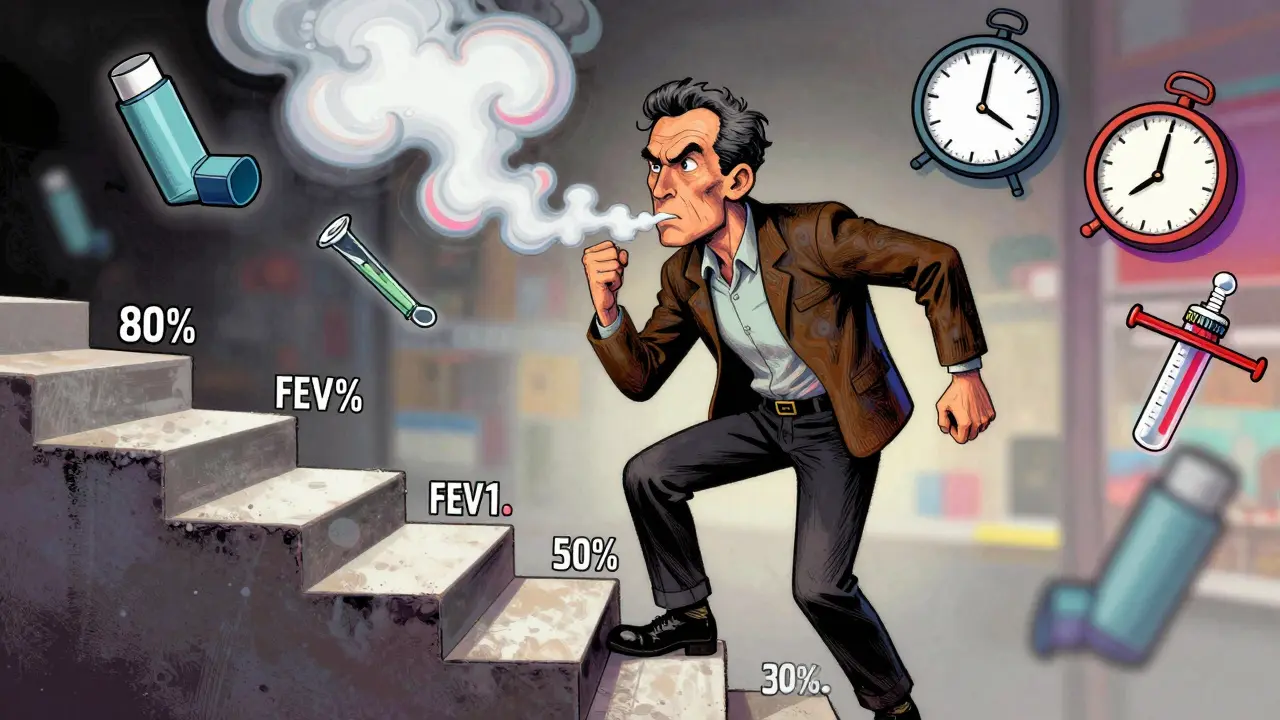
COPD isn’t just one thing. It’s a group of conditions-mostly emphysema and chronic bronchitis-that damage your lungs and make it harder to push air out. The Global Initiative for Chronic Obstructive Lung Disease (GOLD) system, updated in 2023, breaks COPD into four stages based on a simple breathing test called spirometry. This test measures how much air you can forcefully blow out in one second-called FEV1. That number, compared to what’s normal for someone your age, height, and sex, tells doctors how far your lungs have declined.
Stage 1 (Mild): FEV1 is 80% or more of predicted. You might not even know you have it. Stage 2 (Moderate): FEV1 drops to 50-79%. This is where most people finally get diagnosed. Stage 3 (Severe): FEV1 falls to 30-49%. Breathing becomes a daily struggle. Stage 4 (Very Severe): FEV1 is under 30%. Oxygen therapy often becomes necessary.
But here’s the catch: your FEV1 number doesn’t tell the whole story. Two people with the same FEV1 can have wildly different lives. One might be active and rarely sick. The other might be stuck at home, scared to walk to the mailbox. That’s why GOLD now uses a second layer-Groups A, B, C, and D-based on how bad your symptoms feel and how often you get sick.
Stage 1: Mild COPD - The Silent Start
If you’re in Stage 1, your lungs are still working at 80% or better. You might not need medication yet. But you’re not fine. This is the last chance to stop the damage.
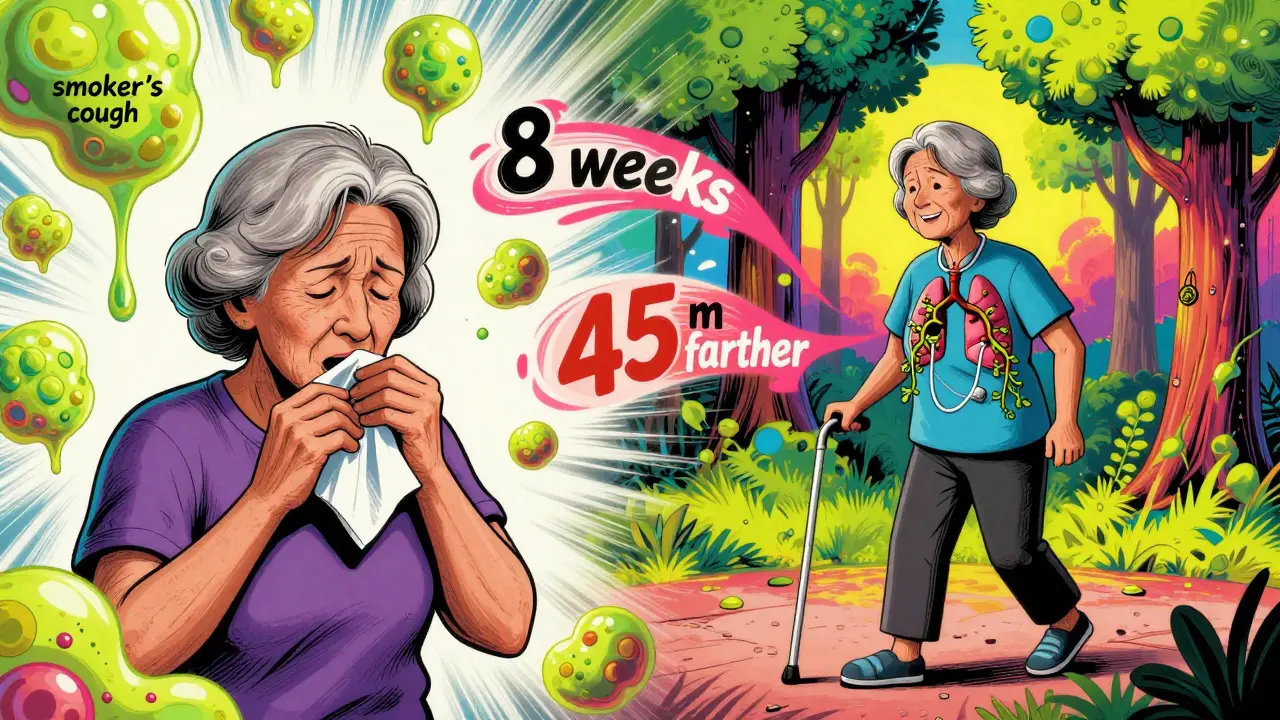
Most people here have a persistent cough and mucus-often called "smoker’s cough." They think it’s normal. A 2021 study in CHEST found that 65% of Stage 1 patients only get short of breath when walking fast or climbing hills. That sounds harmless. But if you’re avoiding stairs, skipping walks, or skipping social events because you’re too tired, your lungs are already changing.
The single most powerful thing you can do? Quit smoking. The Lung Health Study showed that quitting cuts the rate of lung function decline in half-from 60 mL per year to 30 mL. That’s like hitting pause on the disease. If you’re still smoking, you’re losing lung function faster than your body can repair itself.
Doctors may prescribe a short-acting inhaler (like albuterol) for emergencies. But the real treatment? Lifestyle. Pulmonary rehab isn’t mandatory yet-but if you start moving more, even light walking or chair yoga, you’ll feel better faster. And yes, get your flu shot. It cuts your risk of a bad flare-up by 32%.
Stage 2: Moderate COPD - The Turning Point
Stage 2 is where things get real. FEV1 drops to 50-79%. You’re not just winded on hills-you’re winded on flat ground. You stop to catch your breath every few minutes. You’re coughing more. Mucus builds up. You might skip laundry because it’s too hard to carry the basket.
A 2022 survey from the Lung Institute found that 83% of Stage 2 patients have to pause while walking on level ground. That’s not aging. That’s disease.
This is the stage where doctors start prescribing long-acting inhalers-either LABA (like formoterol) or LAMA (like tiotropium). These aren’t quick fixes. They’re daily maintenance. One study showed they improve FEV1 by 100-150 mL on average. That’s the difference between gasping and being able to walk to the kitchen.
Pulmonary rehab becomes critical. It’s not just exercise. It’s breathing techniques, nutrition advice, and mental support. The Cochrane Review found people who complete rehab walk 45-75 meters farther in six minutes. That’s huge. You can go from needing to sit down after a shower to being able to take a shower without stopping.
And here’s the hidden danger: many patients get dismissed. A 2023 survey from the COPD Foundation found that 78% of Stage 2 patients said their doctor first told them it was "just getting older." That delay? On average, it’s 3.7 years. By then, more damage is done.
Stage 3: Severe COPD - The Breaking Point
FEV1 is now 30-49%. Your lungs are working at less than half capacity. Breathing isn’t just hard-it’s exhausting. You can’t dress yourself without stopping. You’re on oxygen during chores. Your oxygen levels drop below 90% just walking to the bathroom.
By this stage, doctors usually add combination therapy: two long-acting inhalers (LAMA + LABA). Studies show this cuts severe flare-ups by 14% compared to one inhaler alone. If you have high eosinophils (a type of white blood cell), you might also get an inhaled steroid. It doesn’t fix the damage-but it reduces flare-ups by 25%.
Many patients here describe panic attacks triggered by simple tasks. One Reddit user wrote: "I can’t walk to my mailbox (20 feet) without stopping to breathe. My doctors keep saying I’m ‘only’ Stage 3, so I must be exaggerating." That’s the gap between numbers and reality. Your FEV1 is a number. Your suffering is real.
Annual 6-minute walk tests become standard. They measure how far you can go before stopping. If you’re walking less than 350 meters, your risk of hospitalization jumps. Exercise isn’t optional anymore-it’s survival.
Stage 4: Very Severe COPD - The Fight for Every Breath
FEV1 is below 30%. You’re in the danger zone. You need oxygen for at least 15 hours a day. You’re hospitalized often. Each flare-up carries a 22% risk of death within a year.
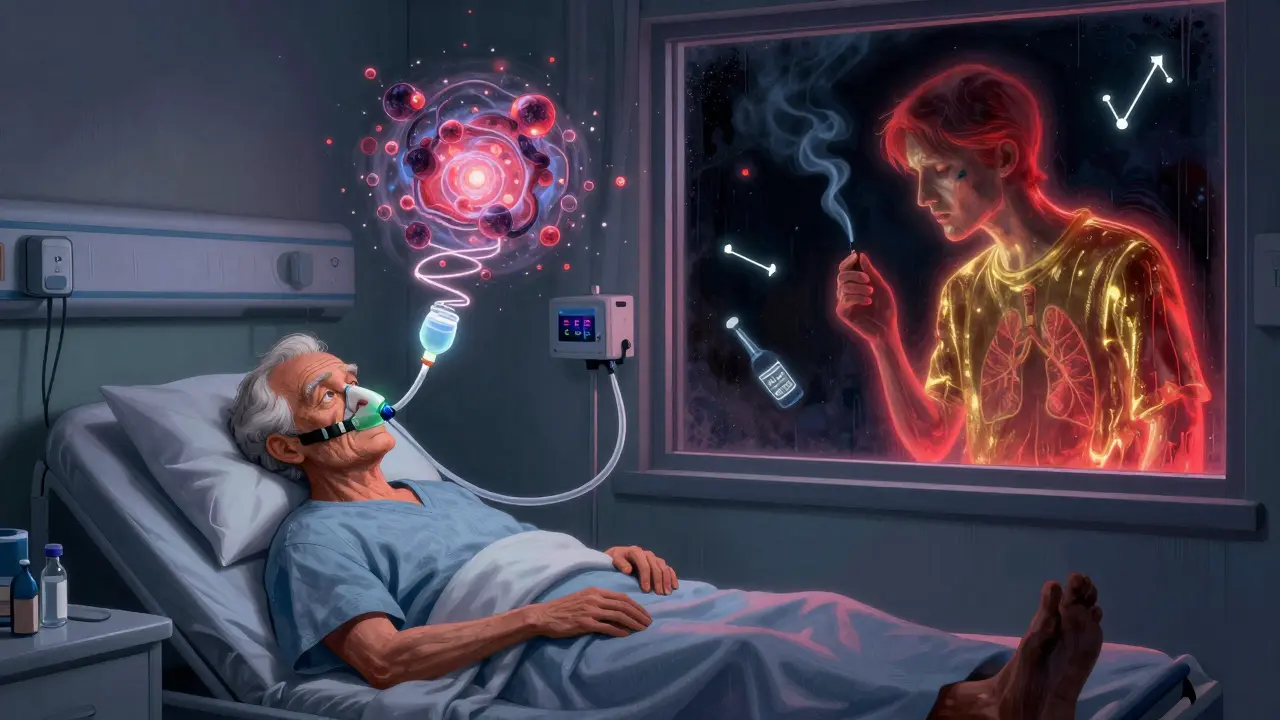
Long-term oxygen therapy is the cornerstone. The NOTT trial showed it boosts one-year survival from 73% to 90%. That’s not a small gain. That’s life or death.
Non-invasive ventilation (like a BiPAP machine) becomes common. It helps your lungs rest, especially at night. One 2022 study found it cuts hospital readmissions by 28%.
But the hardest part isn’t the machines. It’s the isolation. A 2022 American Lung Association survey found 44% of Stage 4 patients feel socially cut off. They can’t go out. They can’t travel. They’re afraid to leave the house. And the cost? Oxygen equipment averages $287 a month out-of-pocket-even with Medicare.
There’s no cure. But there’s still hope. With the right team-pulmonologist, respiratory therapist, social worker-you can live longer, and better.
Why Most People Miss the Early Stages
Only 12.3% of people over 40 who smoke get tested for COPD. Why? Because the symptoms feel like aging. Because doctors don’t ask. Because spirometry isn’t routine.
A 2022 JAMA Internal Medicine study found 42% of primary care providers misclassify COPD stages because they don’t use spirometry correctly. You can’t diagnose COPD with a stethoscope alone. You need the numbers.
Dr. MeiLan Han from the University of Michigan says patients delay diagnosis for an average of 5.2 years. That’s over half a decade of lung damage you could’ve stopped.
And here’s what most don’t know: COPD isn’t just a lung disease. Dr. Don Sin’s 2023 study in The Lancet found that 65% of Stage 2 patients have heart disease. Your lungs are failing-but your heart is under stress too. That’s why survival isn’t just about oxygen. It’s about checking your blood pressure, cholesterol, and heart rhythm.
What You Can Do Right Now
- If you smoke: Quit. Today. No delay. It’s the only thing proven to slow COPD.
- If you’re over 40 and have a cough or shortness of breath: Ask for spirometry. Don’t wait for your doctor to bring it up.
- If you’re in Stage 1 or 2: Get into pulmonary rehab. Even 8 weeks can change your life.
- If you’re in Stage 3 or 4: Ask about oxygen therapy, non-invasive ventilation, and home support services.
- Get your flu shot every year. And ask about the pneumonia vaccine.
- Track your symptoms. Write down when you get winded, how often you cough, and how many days you miss activities. That data helps your doctor adjust your plan.
There’s no magic pill. But there’s a path. And it starts with knowing your stage.
Can you have COPD without smoking?
Yes. While smoking causes 80-90% of COPD cases, non-smokers can develop it from long-term exposure to air pollution, chemical fumes, secondhand smoke, or genetic conditions like alpha-1 antitrypsin deficiency. In fact, about 1 in 5 COPD patients in the U.S. have never smoked.
Is COPD the same as asthma?
No. Asthma is often reversible with medication and starts earlier in life. COPD is progressive, usually linked to smoking or long-term exposure to lung irritants, and doesn’t fully reverse. Some people have both-called asthma-COPD overlap syndrome (ACOS)-which requires a different treatment approach.
Does COPD get worse even if you quit smoking?
It can, but much slower. Quitting doesn’t reverse damage, but it stops the rapid decline. Studies show lung function drops 60 mL per year in continuing smokers-but only 30 mL per year in those who quit. That’s a 50% slowdown. Many people stabilize for years after quitting, especially if they start early.
What’s the life expectancy with COPD?
It varies. Stage 1 patients who quit smoking often live near-normal lifespans. Stage 4 patients have a higher risk of early death, especially with frequent flare-ups. But survival isn’t just about stage-it’s about oxygen use, heart health, weight, and how often you’re hospitalized. With good management, many live 10-20 years after diagnosis.
Can COPD be reversed?
No. Damaged lung tissue doesn’t heal. But progression can be slowed dramatically-especially if caught early. Treatment doesn’t cure COPD, but it can help you live better, breathe easier, and avoid hospitalizations.
Robert Bliss
March 10, 2026 AT 17:42Man I wish I'd known this sooner. I quit smoking last year after 25 years and thought I was fine. Now I get winded just walking to the mailbox. 😔 But hey, at least I stopped before it got worse. Pulmonary rehab is kinda awkward but worth it. My wife says I walk like a robot now but I can actually do laundry without stopping. 🙌
Peter Kovac
March 10, 2026 AT 23:16The data presented here is statistically sound but lacks methodological rigor in its application. The GOLD criteria are not universally applicable across demographic cohorts, particularly when socioeconomic variables such as access to spirometry are unaccounted for. Furthermore, the assertion that smoking cessation reduces decline by 50% is drawn from the Lung Health Study, which had a 92% retention rate - a non-representative sample. Generalizing these findings to the broader population is methodologically unsound.
APRIL HARRINGTON
March 11, 2026 AT 16:21OMG I JUST REALIZED I’M STAGE 2 😭 I’ve been ignoring my cough for 3 years thinking it was just allergies or stress or whatever but NOOOOO it’s COPD 😭 I stopped going out with friends because I was too tired and now I’m crying in my kitchen because I can’t even carry my dog to the car anymore 💔 I need to quit smoking I need to do rehab I need to live I need to breathe I need help someone please help me 🤯
Leon Hallal
March 12, 2026 AT 02:43They don’t tell you how lonely it gets. I used to love fishing. Now I sit on the porch and watch the birds. My wife says I’m lucky I still have breath. I don’t feel lucky. I feel like I’m slowly disappearing. The inhaler helps but it doesn’t fix the fact that I can’t hug my grandkids without stopping to catch air. No one talks about that part.
Judith Manzano
March 14, 2026 AT 00:11This was so helpful. I’m a nurse and I’ve seen so many patients dismissed as "just getting old." I’m going to push my clinic to start offering free spirometry screenings for anyone over 40 with a smoking history. Also - shoutout to pulmonary rehab. My mom did it and now she’s gardening again. It’s not a cure, but it’s a lifeline. You’re not alone.
rafeq khlo
March 14, 2026 AT 16:29Smokers deserve what they get. The government wastes billions on oxygen tanks for people who refused to stop poisoning themselves. Why should taxpayers pay for your laziness? You knew the risks. You chose to smoke. Now you’re a burden. Quit or die. Simple. No sympathy. No pity. Just facts.
Morgan Dodgen
March 16, 2026 AT 12:24Have you considered that COPD is a manufactured crisis? The pharmaceutical industry profits from inhalers, oxygen tanks, and rehab programs. The real cause? Glyphosate in our food and 5G radiation. Spirometry is a scam - your lungs don’t care about FEV1 numbers. I’ve been using a Himalayan salt pipe for 18 months and my breathing improved 300%. The truth is buried under corporate greed. Wake up.
Philip Mattawashish
March 18, 2026 AT 12:18You people are pathetic. You sit around waiting for a pill or a machine to fix your laziness. I’ve worked construction since I was 16. I’ve breathed dust, fumes, smoke - and I never complained. You think a little cough means you’re broken? Get up. Move. Breathe. You’re not sick - you’re weak. The system pampers you until you forget how to stand on your own. Quit whining. Quit smoking. Quit being a victim.
Tom Sanders
March 19, 2026 AT 21:15So basically if you smoke you’re gonna die. Cool. I’ll just keep smoking then. Why stress? I’ve got my chair, my TV, and my vape. If I’m gonna go, at least I’m chillin’. Also, I don’t believe in rehab. Sounds like a cult.