
Cumulative Drug Toxicity Calculator
Calculate Your Cumulative Dose
Most people assume that if a medication is safe for a few weeks, it’s safe for years. But that’s not always true. Some drugs don’t hurt you right away - they wait. Slowly, over months or even years, they build up in your body until something breaks. This is cumulative drug toxicity: side effects that don’t show up until it’s too late.
Why Some Drugs Get Worse With Time
Your body is good at clearing out most medicines. Liver enzymes break them down. Kidneys flush them out. But not all drugs are made the same. Some stick around. Fat-soluble ones - like vitamin A, certain antibiotics, or heart drugs - get stored in your fat tissue. Heavy metals like lead or mercury? They bury themselves in your bones. And once they’re in, they don’t leave fast.Think of it like filling a bathtub with the drain half-closed. The water comes in faster than it drains. Over time, the tub overflows. That’s what happens with drugs that have long half-lives - especially those over 24 hours. Each dose adds to the last. Even if you take the same amount every day, your body can’t keep up. By cycle 3, 4, or 5, you’re not just taking the drug - you’re carrying the weight of every previous dose.
It’s not just about dosage. It’s about your body’s ability to handle it. If your liver or kidneys aren’t working at 100%, you’re at higher risk. Studies show people with reduced organ function can hold 30% to 50% more drug in their system than healthy adults. That’s why older patients are especially vulnerable. Their organs slow down. Their metabolism changes. And they’re often on multiple medications, each adding to the pile.
Real Cases, Real Consequences
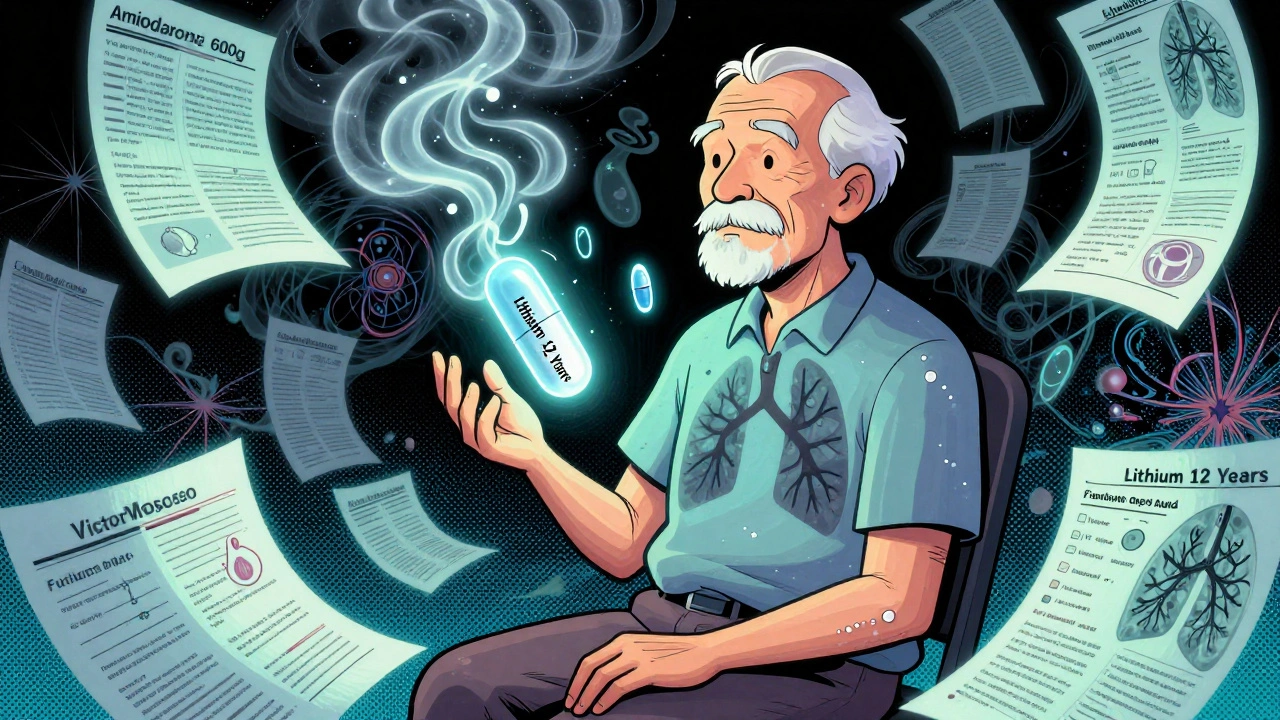
A 68-year-old woman took amiodarone for her irregular heartbeat for seven years. Every blood test looked fine. Her doctor checked her levels regularly. She felt okay. Then, out of nowhere, she started coughing nonstop. Breathing became hard. A CT scan showed scarring in her lungs - pulmonary fibrosis. The cause? Cumulative amiodarone toxicity. She’d taken over 600 grams total. That’s the red line. And no single dose had ever been too high. It was the sum of every pill.Another case: a man on long-term lithium for bipolar disorder. He’d been stable for 12 years. Then he started trembling, forgetting names, stumbling when he walked. His lithium level was still in the “normal” range. But his kidneys had weakened with age. The drug had been quietly building up. He needed dialysis to get it out.
These aren’t rare. Between 2018 and 2022, over 12,000 cases of cumulative toxicity were reported to the FDA. Nearly half involved blood thinners like warfarin. Almost a third involved heart drugs like digoxin. And 19% came from cancer treatments. In oncology, the numbers are even more telling: after six rounds of certain targeted therapies, more than half of patients developed serious side effects - even though the first few cycles seemed fine.
How It’s Different From Acute Reactions
Acute toxicity? That’s the immediate reaction. Take too much acetaminophen, and your liver shuts down in hours. Swallow a dangerous dose of morphine, and you stop breathing. These are emergencies. You know what happened. You fix it.Cumulative toxicity is silent. It doesn’t scream. It whispers. You might feel a little tired. Your hands might shake a bit. You think it’s stress. Or aging. Or just getting older. But over time, those tiny signs pile up. By the time you feel really sick, the damage might already be permanent.
And here’s the kicker: stopping the drug doesn’t always fix it. Because the drug isn’t just in your bloodstream anymore. It’s in your fat. Your bones. Your organs. It takes months - sometimes years - to clear out. That’s why some side effects linger long after you’ve quit the medicine.
Drugs Most Likely to Cause This
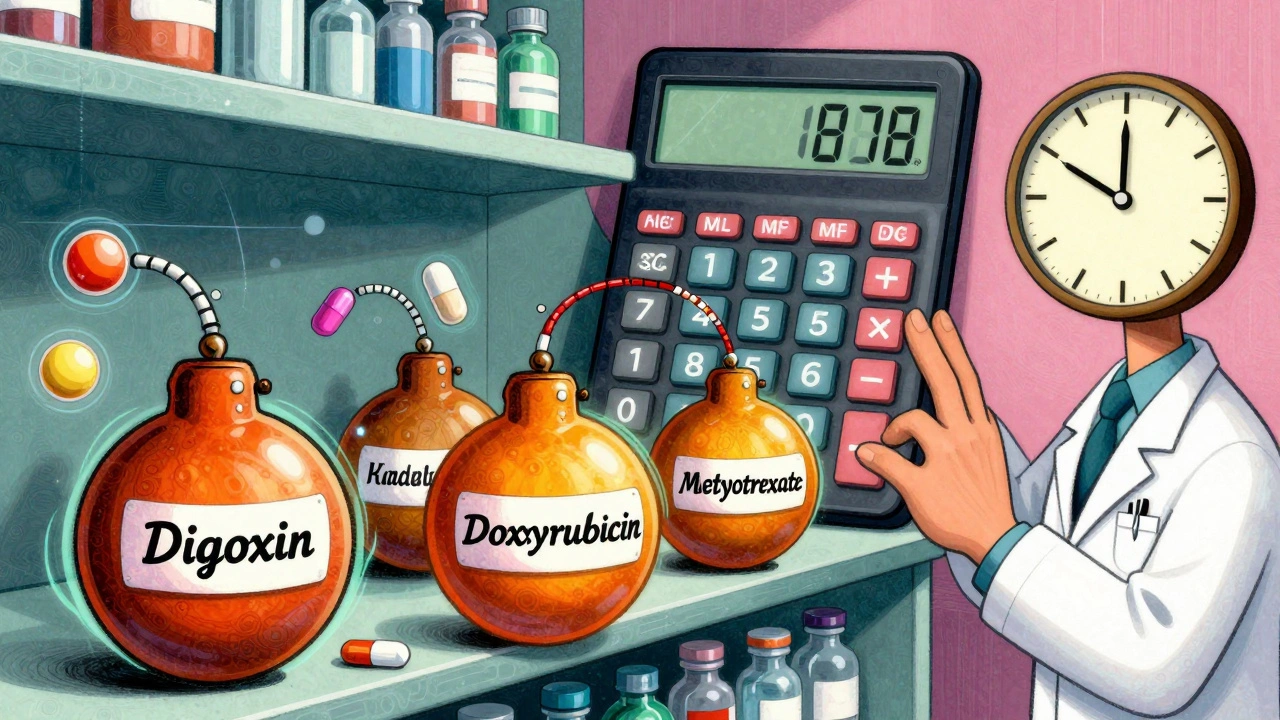
Not all medications build up. But some are notorious for it:- Amiodarone - used for heart rhythm problems. Can cause lung, liver, and thyroid damage after years.
- Digoxin - for heart failure. Narrow safety margin. Easy to overdose if kidneys slow down.
- Lithium - for bipolar disorder. Kidneys clear it. If they decline, toxicity follows.
- Methotrexate - for rheumatoid arthritis and cancer. Builds up in the liver and bone marrow.
- Anthracyclines - chemo drugs like doxorubicin. Can permanently damage the heart. Lifetime dose limit: 450 mg/m².
- Aminoglycosides - antibiotics like gentamicin. Can wreck your hearing and kidneys over time.
The American Geriatrics Society Beers Criteria lists 34 medications with high cumulative risk for older adults. These aren’t just warnings - they’re red flags. Some drugs are outright avoided in seniors because the long-term harm outweighs the benefit.
How Doctors Try to Stop It
There’s no magic bullet, but there are tools:- Therapeutic Drug Monitoring (TDM): Regular blood tests to check drug levels. Used for lithium, digoxin, vancomycin, and others. But here’s the problem: TDM measures current levels, not what’s stored in your tissues. So you can have normal blood levels and still be toxic.
- Cumulative dose tracking: Some clinics now calculate your total lifetime exposure. For example, oncology practices track how much doxorubicin you’ve had over your life. If you hit 450 mg/m², they stop - even if you’re still responding to treatment.
- Regular organ checks: If you’re on a risky drug, your doctor should monitor your liver, kidneys, heart, and lungs - not just your blood counts.
- Pharmacist involvement: Studies show pharmacist-led programs reduce hospitalizations from drug toxicity by nearly 30%. They catch the hidden patterns others miss.
Yet, only 38% of U.S. electronic health records can automatically track cumulative doses. Most still rely on doctors manually adding up pills from old prescriptions. That’s a recipe for missed warnings.
What You Can Do
If you’re on long-term medication, here’s what matters:- Know your drug. Is it known for cumulative effects? Ask your pharmacist. Look it up. Don’t assume it’s safe just because you’ve taken it for years.
- Track your total dose. Write down how much you’ve taken. Keep a log. Some apps can help. If you’ve been on amiodarone for five years, ask: “Have I hit the 600g threshold?”
- Get baseline tests. Before starting a high-risk drug, get liver, kidney, heart, and lung tests. That gives you a reference point. If things change later, you’ll know why.
- Speak up about new symptoms. Fatigue, dizziness, ringing in the ears, dry cough, unexplained weight loss - don’t brush them off. They might be signs of buildup.
- Ask about alternatives. Is there a drug with less accumulation risk? Sometimes switching to a newer agent can cut your long-term risk dramatically.
One rheumatology clinic cut methotrexate toxicity by 37% just by starting a simple spreadsheet to track each patient’s cumulative dose. It didn’t cost much. It just required attention.
The Bigger Picture
This isn’t just about individual patients. It’s about how medicine is designed. For decades, drug trials focused on short-term safety. Three months. Six months. Rarely more than a year. But millions of people take these drugs for decades. We’re learning too late that the long-term cost - in health, in hospitalizations, in lives - is enormous.The FDA now requires cumulative toxicity warnings on 78% of new cancer drugs. The European Medicines Agency made it mandatory for all chronic-use drugs starting in 2024. That’s progress. But it’s not enough. We still don’t screen most older adults for hidden buildup. We still don’t track total doses in most primary care offices.
And the cost? In the U.S. alone, cumulative toxicity drives 22% of cancer treatment changes and 15% of treatment stops. That’s $1.2 billion a year in extra care - not counting the human toll.
Future tools are coming. AI models at Memorial Sloan Kettering can now predict your personal risk of toxicity by analyzing 27 different factors - your genes, your age, your kidney function, your other meds. These tools could save lives. But they won’t help if clinics don’t use them.
Bottom Line
Medications aren’t always safe just because they’re prescribed. Some don’t hurt you today - they hurt you five years from now. The danger isn’t in the pill you take today. It’s in the sum of every pill you’ve ever taken.If you’re on long-term medication - especially if you’re over 60, have kidney or liver issues, or take more than three drugs - ask your doctor: “Could this build up in my body? Should I be tracking my total dose?”
Don’t wait for the cough. Don’t wait for the tremor. Don’t wait until your heart gives out. Ask now. Track now. Because sometimes, the side effect you don’t feel is the one that will kill you.
Ada Maklagina
December 5, 2025 AT 07:18Been on amiodarone for 6 years. No cough. No issues. Maybe my body just doesn't care.
Jennifer Patrician
December 5, 2025 AT 20:59They're hiding this on purpose. Big Pharma doesn't want you to know drugs accumulate like radioactive waste. That's why your doctor never mentions it. They get paid per script. The FDA? Bought and paid for. Look up the 2019 internal memo about lithium and kidney damage. It's buried under 17 layers of red tape.
Manish Shankar
December 6, 2025 AT 01:02This is a profoundly important article. The medical community's focus on acute outcomes neglects the slow erosion of organ function over time. In India, where polypharmacy is common among elderly patients with limited access to monitoring, this silent toxicity is a growing crisis. We must institutionalize cumulative dose tracking as a standard of care, not an afterthought. The ethical imperative is clear.
sean whitfield
December 7, 2025 AT 13:14So let me get this straight. You're telling me the same pills I've been taking since 2012 are secretly turning my organs into concrete? And the only reason I haven't died yet is because I'm not rich enough to afford the fancy AI that predicts when I'll turn into a human ashtray? Thanks for the heads up, Doctor Google.
Harry Nguyen
December 8, 2025 AT 21:48Every time someone says 'cumulative toxicity' I hear the sound of a liberal crying over a pill. If you can't handle your meds, don't take them. Stop blaming science for your poor life choices. You're not a victim of Big Pharma, you're a victim of your own laziness. Take your pills, get your bloodwork, or don't be surprised when your body rebels. It's not a conspiracy. It's biology.
Katie Allan
December 10, 2025 AT 00:56This is the quiet revolution medicine needs. We treat drugs like they're one-time fixes, but our bodies remember every dose. I've seen patients with 12-year lithium use, normal labs, and tremors so bad they couldn't hold a cup. The answer isn't more pills-it's more listening. More tracking. More humility from doctors who think 'normal' means 'safe'. We owe our elders better than that.
Deborah Jacobs
December 10, 2025 AT 22:31I used to think my chronic fatigue was just stress-until I found out I’d taken 580g of amiodarone. My lungs were already scarred. No one ever asked me to track it. No one even mentioned it could build up. I’m 61. I’ve been on this drug since I was 54. I thought I was doing everything right. Turns out, I was just lucky. Now I keep a spreadsheet. Every pill. Every date. My doctor says it’s ‘overkill’. I say it’s survival.
Lucy Kavanagh
December 11, 2025 AT 18:05Did you know the government is using these drugs to control the elderly population? The slow buildup? It’s not an accident. It’s a system. They want us docile. Quiet. Out of the way. That’s why they don’t warn you. That’s why your doctor doesn’t check your bone density every year. They’re not careless-they’re complicit. I’ve seen the documents. The pills are laced with something else. You think it’s digoxin? No. It’s something older. Something deeper.
Chris Brown
December 13, 2025 AT 10:15There is a moral failing here. Not in the drugs. Not in the science. But in the people who allow this to continue. To prescribe without tracking. To ignore the slow decay. To treat aging as a disease to be managed with more chemicals instead of a natural process to be respected. This is not medicine. This is chemical negligence dressed in white coats.
Krishan Patel
December 15, 2025 AT 05:45The notion that toxicity is cumulative is a metaphysical fallacy. The body is not a vessel to be filled. It is a dynamic system of equilibrium. To claim that a drug accumulates as if it were a fossil deposit is to misunderstand homeostasis. The real issue is not pharmacokinetics-it is the erosion of personal responsibility. Why do we outsource our health to pharmaceutical algorithms? Why do we not cultivate metabolic resilience? The answer lies not in tracking doses, but in restoring the sacred bond between human physiology and conscious living.
Carole Nkosi
December 16, 2025 AT 09:25So you're saying we're all just walking time bombs because we took a pill for a headache 10 years ago? That's not science. That's fear porn. If every drug had cumulative toxicity, we'd all be dead by 30. Stop scaring people. Your article reads like a cult pamphlet. Go outside. Breathe. Stop reading medical journals like they're prophecies.
Stephanie Bodde
December 17, 2025 AT 03:45Hey, if you're on long-term meds, I got you. Start a simple Google Sheet. Name of drug, dose, date started. Add a column for symptoms. Even if you think it's nothing. You'll be shocked what shows up over time. I did this for my mom’s lithium-and we caught her kidney drop early. She’s fine now. You don’t need AI. You just need to care enough to write it down. You’re not alone. 💪
Philip Kristy Wijaya
December 17, 2025 AT 10:16Interesting how you frame this as a systemic failure when it's clearly just poor patient compliance. If people took their meds properly, monitored themselves, and didn't rely on doctors to babysit them, none of this would happen. The real problem is not the drugs-it's the culture of passive dependency. You don't need a spreadsheet. You need discipline. You don't need AI. You need to stop treating your body like a broken appliance that needs constant repair. Wake up. Take responsibility. The pills aren't the enemy. Complacency is.