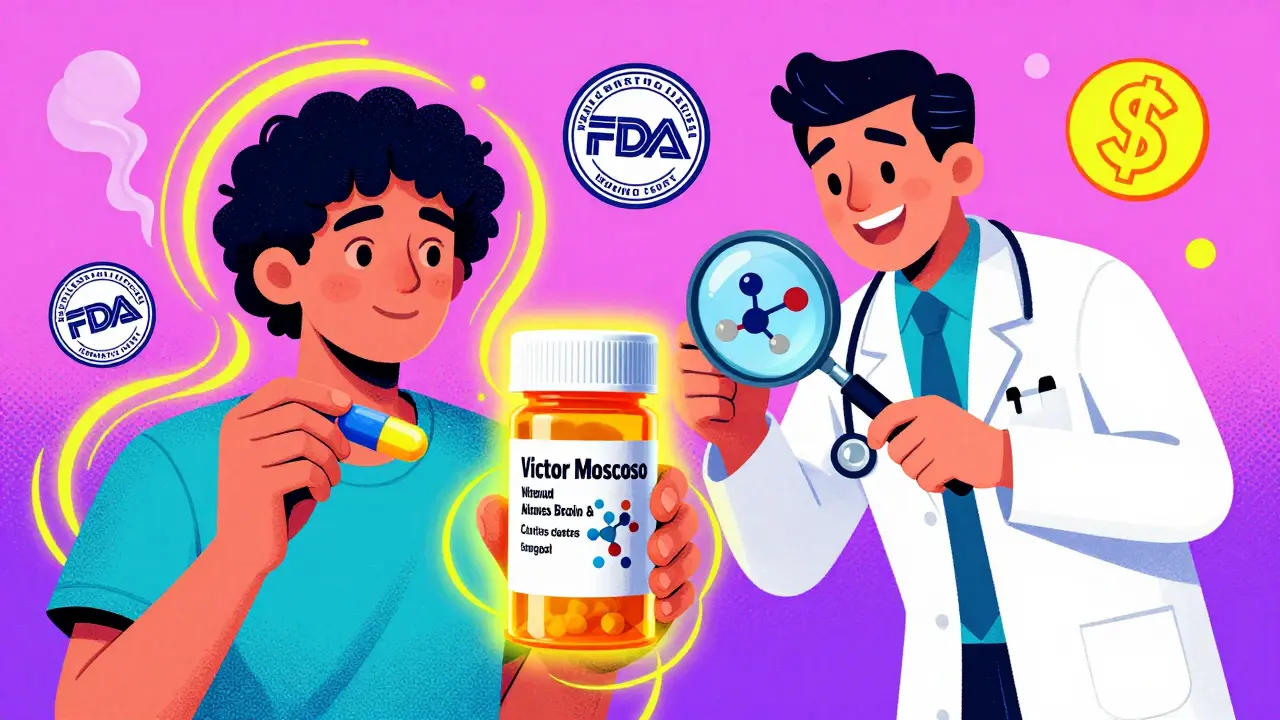
When your doctor hands you a prescription, you might notice the pill looks different from what you’ve taken before. Maybe it’s a different color, shape, or has a weird logo on it. You might wonder: Does this generic version really work the same? You’re not alone. Millions of people in the U.S. have this exact question - and most of them don’t ask their doctor about it. That’s a problem, because the right conversation can save you hundreds - even thousands - of dollars a year, without sacrificing your health.
What Exactly Is a Generic Drug?
A generic drug is not a copy. It’s not a cheaper version that cuts corners. It’s the exact same medicine, made with the same active ingredient, in the same strength, and taken the same way as the brand-name version. The FDA requires it to work the same way in your body. That means if you’re taking a generic version of lisinopril for high blood pressure, it’s chemically identical to the brand-name Zestril. The same goes for metformin, atorvastatin, levothyroxine - you name it.
The only differences? The inactive ingredients. Things like dyes, fillers, or coatings that help the pill hold its shape or make it easier to swallow. These don’t affect how the medicine works. But they’re why your generic pill might be blue instead of white, or oval instead of round. The FDA checks these inactive ingredients too - they have to be safe. And they’re regulated under the same strict standards as the brand-name drug.
Why Do Generics Cost So Much Less?
Brand-name drugs cost a lot because the company that made them spent years and millions developing the drug, running clinical trials, and getting FDA approval. Once that patent runs out - usually after 10 to 12 years - other companies can make the same drug. They don’t need to repeat all those expensive studies. They just have to prove their version works the same way. That’s called bioequivalence.
The FDA requires generics to deliver the same amount of medicine into your bloodstream within a very tight range - between 80% and 125% of the brand-name drug. That’s not a guess. It’s tested in real people using blood samples. And if a generic doesn’t meet that standard, it doesn’t get approved. In 2023, the average cost of a generic prescription was $15.78. The same brand-name drug? Around $675. That’s not a typo. You’re paying about 97% less.
And here’s the kicker: 90% of all prescriptions filled in the U.S. are generics. That’s not because doctors are pushing them. It’s because patients are saving money - and still getting the same results.
What Do Studies Really Say?
Some people worry generics don’t work as well. But dozens of studies say otherwise. A 2020 analysis in JAMA Internal Medicine looked at 47 clinical trials comparing generics and brand-name drugs for heart conditions. The results? No meaningful difference in effectiveness. Not one. Another study found that patients on generic statins had the same risk of heart attack or stroke as those on brand-name versions.
And when it comes to adherence - meaning, taking your medicine as prescribed - generics actually win. People are more likely to keep taking a drug if it’s affordable. One major study of 11 million patients showed that those on generics had 8-12% higher adherence rates than those on brand-name drugs. That’s huge. Missing doses because you can’t afford your meds? That’s what leads to hospital visits, complications, and worse outcomes.
Even in tricky cases - like thyroid medication - the FDA requires tighter standards. For levothyroxine, the bioequivalence range is narrowed to 90-110%. That’s stricter than most drugs. And if you’ve had trouble switching, it’s not because the generic didn’t work. It’s because your body is sensitive to tiny changes. That’s rare - less than 1% of patients - and your doctor can help you manage it.
Why Do People Doubt Generics?
It’s not about science. It’s about perception. A 2022 survey found that 68% of patients believe “cheaper means worse.” Another 52% worry about manufacturing quality, especially if the drug is made overseas. And 47% just don’t trust the system.
But here’s the truth: the same factories that make brand-name drugs often make generics too. The FDA inspects every single facility - whether it’s in the U.S., India, or China - using the same rules. In 2023, 98.7% of generic drug plants passed inspection. That’s higher than the pass rate for brand-name plants. And if a plant fails, the FDA shuts it down. No exceptions.
And about those inactive ingredients? They’re the main reason people report side effects after switching. But in 99.9% of cases, those are minor - like a headache or upset stomach - and go away. The American Society of Health-System Pharmacists says only 0.8% of patients have real issues tied to inactive ingredients. If you’re one of them, your doctor can switch you to a different generic or even back to the brand - but only after trying a few options.
How to Start the Conversation With Your Doctor
You don’t need to be an expert. You just need to ask. Here’s how to do it without sounding confrontational:
- Ask what’s available. “Is there a generic version of this medication?”
- Ask why. “If there is, why aren’t we using it?”
- Ask about cost. “How much will this cost with and without insurance?”
- Ask about safety. “Is the generic just as safe and effective?”
Doctors aren’t mind readers. If you don’t bring it up, they assume you’re fine with the brand-name version - especially if it’s what’s in the system. But if you say, “I’d like to save money if it’s safe,” most doctors will respond with relief. They want you to take your meds. They don’t want you to skip doses because you can’t afford them.
Use the “Ask-Tell-Ask” method. Ask what they think you know. Tell them what you’ve heard. Then ask them to explain it back. “So, just to make sure I got this - the generic has the same active ingredient, right? And the FDA checks it just like the brand?” If they nod, you’re good. If they hesitate, ask for more info.
What If Your Doctor Says No?
Sometimes, they will. That’s okay. It doesn’t mean you’re wrong. Some drugs are harder to copy - like inhalers, injectables, or creams. These are called complex generics. For them, bioequivalence is harder to prove. In those cases, your doctor might stick with the brand until a better generic comes along.
But if your doctor says, “I don’t trust generics,” that’s a red flag. The American Medical Association and the FDA both say doctors should endorse generics. If your doctor won’t, ask why. If they can’t give you a clear, science-based reason, consider getting a second opinion.
And if your doctor says, “This one’s different,” ask for proof. What’s different? Is it the active ingredient? The dose? Or just the pill’s appearance? If it’s just the color - that’s not a reason to avoid it.
What to Do After You Switch
When you start a new generic, pay attention. For the first week or two, note any changes: headaches, nausea, dizziness, mood shifts. Most people feel nothing. But if you do notice something unusual, write it down. Don’t assume it’s the drug. Stress, sleep, diet, or even a cold can cause symptoms too.
But if the problem sticks around, call your doctor. Say: “I switched to the generic, and I’ve had [symptom] for more than a week. Can we look at this?” Most doctors will try a different generic brand before switching back to the original. There are often 3-5 different generic versions of the same drug. One might work better for you.
And if you’re on a drug with a narrow therapeutic index - like warfarin, lithium, or levothyroxine - your doctor may want to check your blood levels after switching. That’s normal. It’s not because generics are unsafe. It’s because small changes matter more in these cases. And your doctor knows that.
How Much Can You Really Save?
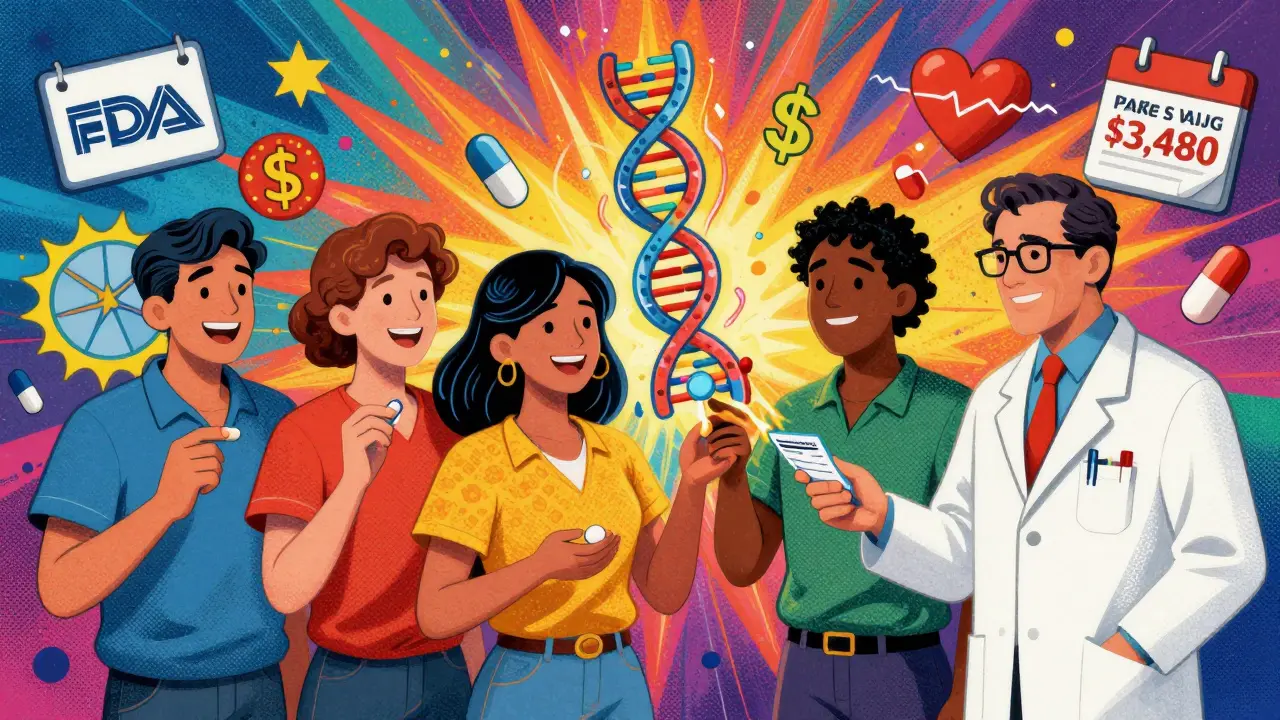
Let’s say you’re on a monthly prescription for a brand-name statin. That could cost $300 a month with insurance. The generic? $10. That’s $3,480 saved in a year. For someone on three brand-name meds? That’s over $10,000 a year. That’s a car payment. A vacation. Rent. Or just peace of mind.
And it’s getting even better. Starting in 2025, Medicare Part D will cover generics with $0 cost-sharing. That means if you’re on Medicare, you won’t pay anything out of pocket for most generics. That’s a game-changer.
Final Thought: You’re Not Being Cheap - You’re Being Smart
Taking a generic isn’t settling. It’s choosing science over marketing. It’s choosing your health over your wallet. And it’s not just about saving money. It’s about sticking with your treatment. People who can afford their meds are less likely to end up in the hospital. Less likely to need expensive procedures. Less likely to suffer complications.
So next time your doctor writes a prescription, ask: “Is there a generic?” Don’t wait until the pharmacy says it’s different. Don’t assume the brand is better. Ask. Talk. Learn. Your body - and your bank account - will thank you.
Chris Buchanan
December 24, 2025 AT 08:26So let me get this straight - the FDA says generics are identical, the studies prove it, and yet people still think they’re ‘fake medicine’? 😅 I once switched my blood pressure med to generic and saved $280/month. My doctor was like, ‘You’re lucky you even have insurance.’ I just smiled and paid $12. Science wins again.
Wilton Holliday
December 25, 2025 AT 14:50Y’all need to stop being scared of pills that look different. 😊 I switched my statin to generic and my cholesterol dropped even more. My pharmacist said, ‘You’re one of the lucky ones - most people never even ask.’ Seriously, if your doctor doesn’t mention generics, ask. It’s not rude. It’s responsible. 💪
Ajay Sangani
December 27, 2025 AT 03:36generic are good but i think the body is more than chemestry… like maybe the soul of the pill? no? maybe i am too much think… but i feel diferent when i take the white pill vs blue one… maybe its placebo? or maybe its the energy of the factory? 🤔
Steven Mayer
December 27, 2025 AT 11:53Let’s not conflate bioequivalence with therapeutic equivalence. The 80–125% range is a statistical loophole, not a guarantee. And the inactive ingredients? They’re not inert - they’re excipients with pharmacokinetic implications that are rarely studied in vulnerable populations. The FDA’s inspection pass rate is meaningless if the manufacturing protocols aren’t harmonized globally. You’re trading cost for systemic risk.
Charles Barry
December 28, 2025 AT 06:5790% of prescriptions are generics? That’s because Big Pharma and the FDA are in bed together. The same factories in India that make your ‘generic’ metformin also made the tainted cough syrup that killed kids in Gambia. And you think the FDA checks every batch? HA. They inspect one out of 500. They’re not regulators - they’re PR agents for multinational corporations. Your ‘savings’ are subsidizing a global health scam.
Rosemary O'Shea
December 28, 2025 AT 21:11Oh, so now we’re supposed to be grateful for subpar pharmaceuticals because they’re ‘affordable’? How quaint. I suppose we should also drink tap water because it’s cheaper than bottled. The fact that you’re proud of taking a pill made in a facility that barely passed inspection is… tragic. I mean, really - is this the pinnacle of modern healthcare? ‘It’s good enough.’
suhani mathur
December 30, 2025 AT 20:18My mom switched to generic levothyroxine and had a panic attack for a week. Turns out, the new brand had a different filler - cornstarch. She’s allergic. Doctor didn’t know. We switched brands, problem solved. Point is: generics aren’t all the same. Ask for the manufacturer. Don’t just accept the first one. And if you feel weird? Speak up. No one’s listening unless you do.
Dan Gaytan
January 1, 2026 AT 10:17THIS. 💯 I used to be scared of generics too… until I saw my dad’s insulin bill drop from $600 to $12. He’s been on it for 3 years now, no issues. My doctor actually high-fived me when I asked. 🙌 You’re not being cheap - you’re being smart. And if your doctor acts weird? Just say, ‘I’m doing my research.’ They’ll back off. Trust the data, not the fear.
Usha Sundar
January 1, 2026 AT 12:37My doctor refused to prescribe generic. Said ‘I don’t trust them.’ I left and got a second opinion. Got the generic. Saved $300. Still alive. Still taking it. Done.