
Every time you take a pill, injection, or vaccine, there’s a quiet, global system working behind the scenes to make sure it’s safe. This isn’t science fiction-it’s pharmacovigilance, the science of tracking harmful side effects from medicines after they reach the public. And it’s bigger than any one country. The world relies on a network of systems that collect, analyze, and act on reports of bad reactions to drugs. If you’ve ever heard about a medicine being pulled from shelves or getting a new warning label, this is how it happened.
How the Global System Started
The story begins in 1963, when the World Health Assembly realized something important: drugs are tested in controlled trials, but real people use them in messy, unpredictable ways. People take multiple meds at once. They have different genes, diets, or health conditions. Side effects that never showed up in clinical trials could show up later-sometimes years later. So they passed a resolution calling for a global way to collect this information. By 1968, the WHO launched the Programme for International Drug Monitoring (PIDM), and the Uppsala Monitoring Centre (UMC) in Sweden became its nerve center.
Today, that system holds over 35 million individual reports of adverse drug reactions. That’s more than seven times what it held in 2012. These aren’t just numbers-they’re stories: a woman in Brazil who developed liver damage after taking a common painkiller, a child in India with a rare skin rash after a vaccine, a man in Canada who had a dangerous heart rhythm after starting a new antidepressant. Each report is a piece of a puzzle that helps scientists spot patterns no single country could see alone.
The Backbone: VigiBase and How Data Flows
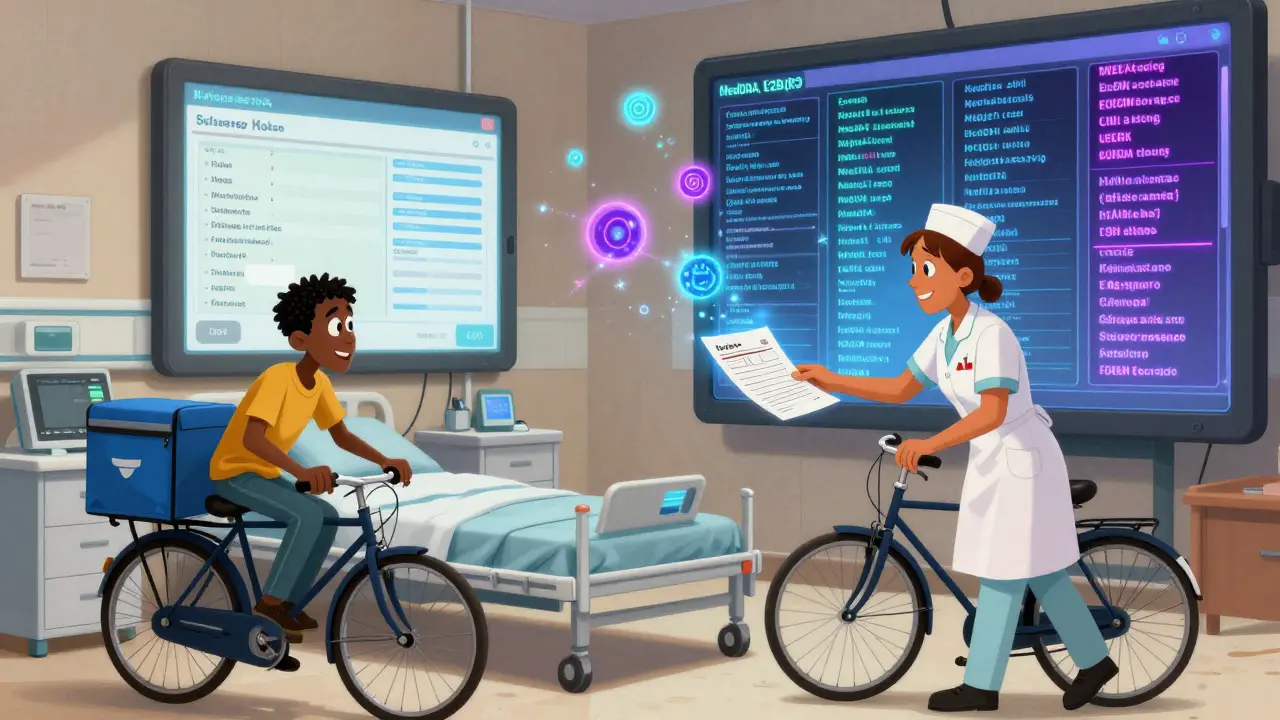
The heart of this system is VigiBase, the WHO’s global database of adverse reaction reports. It’s not a single website you log into-it’s a massive, secure server in Uppsala that receives data from 170+ countries. But here’s the catch: countries don’t all send data the same way. Some use paper forms. Others use electronic systems built into hospitals. A few have apps doctors can use on their phones.
To make sense of this chaos, every report must follow strict rules. The format is called E2B(R3), a technical standard developed by the International Council for Harmonisation. Every drug is labeled using WHODrug Global, a dictionary with over 300,000 medicine names. Every symptom is coded using MedDRA, a medical language with 78,000+ terms. Without these standards, a report from Japan about “fever” wouldn’t match one from Nigeria about “high temperature.” They’d be invisible to each other.
Once a report arrives, it’s cleaned, checked for duplicates, and analyzed. The goal isn’t to prove a drug caused a reaction-it’s to find signals. A signal is when a certain side effect appears more often than expected. For example, if 50 people in different countries report the same rare liver problem after taking a new diabetes drug, that’s a red flag. That’s when regulators step in.
Regional Systems: EU vs. U.S. vs. WHO
Not all countries play by the same rules. The European Union runs EudraVigilance, a system that’s faster, stricter, and legally binding. Companies must report adverse events within 15 days. The EU’s Pharmacovigilance Risk Assessment Committee (PRAC) has to review urgent signals within 60 days. As a result, the EU gets signals acted on in about 75 days on average.
The U.S. has FAERS, the FDA’s system. It gets about 2 million reports a year-more than any other single country. But it doesn’t talk directly to VigiBase. The FDA chooses what to share. That means a dangerous reaction spotted in the U.S. might not show up in VigiBase for months, if at all.
Meanwhile, the WHO system is the only one that covers the entire globe. It’s the only place you can see what’s happening in Nigeria, Laos, or Peru. But it’s voluntary. Countries aren’t forced to report. And many don’t have the resources to do it well. This creates a huge blind spot.
The Big Gap: Rich Countries vs. Poor Countries
Here’s the uncomfortable truth: 85% of all reports to VigiBase come from countries that make up only 16% of the world’s population. Sweden reports 1,200 adverse events per 100,000 people each year. Nigeria reports 2.3. That’s not because Swedes have more side effects-it’s because they have better systems.
In many low-income countries, pharmacovigilance budgets are less than 2 cents per person per year. Some clinics still use paper forms that get mailed by hand. Doctors don’t know how to report. Nurses don’t have internet. A WHO study found that 68% of pharmacovigilance officers in Southeast Asia had received less than 15 hours of training-when WHO recommends 40.
But change is happening. Ethiopia cut its reporting time from 90 days to 14 after using a web tool called PViMS. Countries like Ukraine and Yemen have reactivated their national systems after years of conflict. And since 2020, 45 low- and middle-income countries have started using digital tools for vaccine safety monitoring-cutting reporting time from two months to one week.
How AI Is Changing the Game
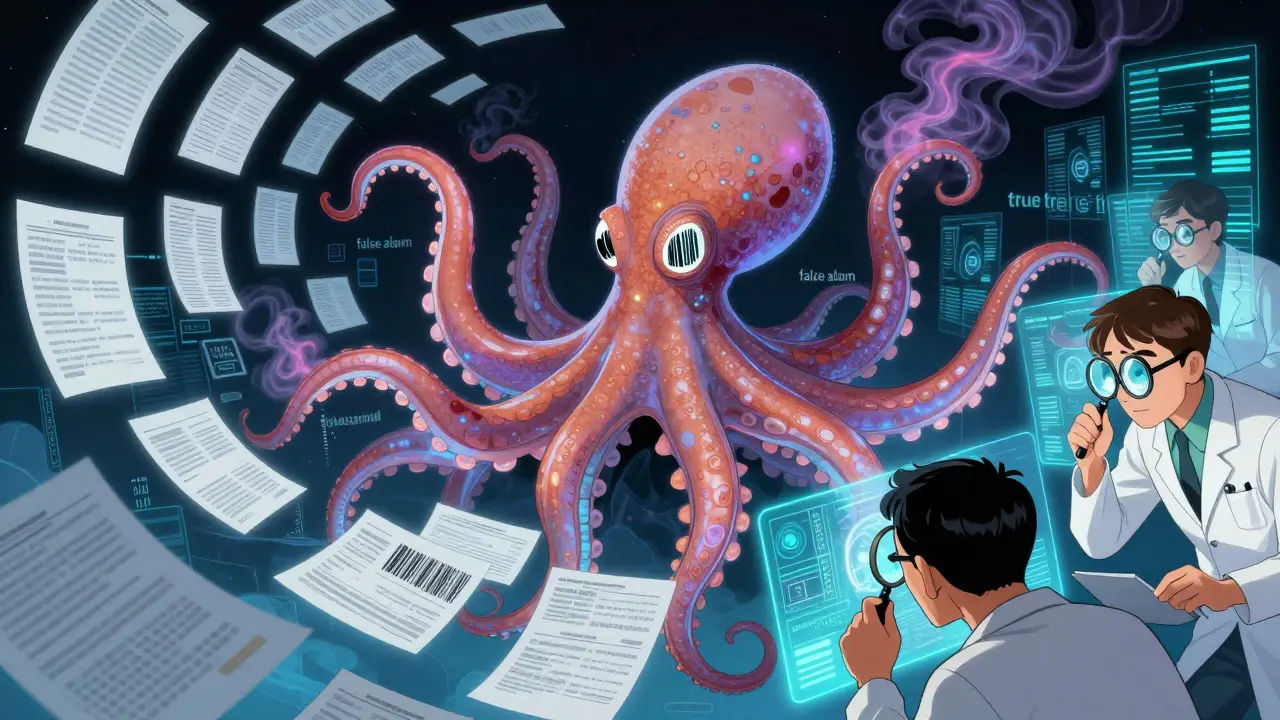
With 35 million reports and growing, humans can’t read them all. That’s where artificial intelligence comes in. UMC now uses AI to scan reports for patterns. One 2023 study showed AI cut false alarms by 28%. Instead of getting 100 potential signals, analysts now get 72 that are actually worth looking at.
AI can also spot things humans miss. For example, it found a link between a common blood pressure drug and a rare type of kidney injury that had been buried in thousands of reports. The signal was there-but no one had connected the dots until the algorithm did.
But AI isn’t perfect. It can’t understand context. A report saying “patient felt dizzy after taking the drug” could mean the drug caused it-or the patient had low blood sugar, or was dehydrated. That’s still up to a human to figure out.
What’s Next? Standards, Access, and Trust
By 2025, a new global standard called ISO IDMP will roll out. It will make sure every medicine is identified the same way across every system-by its chemical name, manufacturer, dosage, even the color of the pill. Right now, “ibuprofen 200mg” might be listed 20 different ways in different databases. With IDMP, it’ll be one. That could improve cross-border data matching by 40%.
And now, anyone can look at the data. VigiAccess, launched in 2015, lets patients, doctors, and researchers search anonymized reports from VigiBase. Over 12 million people have used it. A mother in Australia found out her daughter’s rash might be linked to a vaccine. A researcher in Brazil used it to study a drug’s effect on pregnant women. Transparency builds trust.
But trust also needs accountability. Experts warn that without independent review of controversial safety issues, the system can be influenced by politics or corporate pressure. A 2022 study found that U.S. and EU assessors agreed on whether a drug caused a reaction only 63% of the time. That’s a big gap.
Why This Matters to You
You might think, “I’m not a doctor. I don’t work in pharma. Why should I care?” But here’s the thing: you take medicine. Maybe it’s your blood pressure pill. Your insulin. Your child’s antibiotic. That drug was tested on thousands-but not on everyone. Someone, somewhere, had a reaction no one saw coming. That’s why this system exists.
If you experience a side effect, report it. Even if you’re not sure. Even if it seems small. Your report could be the one that saves a life in another country. And if you’re a patient or caregiver, you can use VigiAccess to see what others have experienced. Knowledge is power.
The global drug safety system isn’t perfect. It’s uneven. It’s underfunded in places. It’s slow in others. But it’s the only thing standing between a new drug and a hidden danger. And it’s getting better-with more countries joining, more tech being used, and more people speaking up.
What is pharmacovigilance?
Pharmacovigilance is the science of detecting, understanding, and preventing harmful side effects from medicines after they’re on the market. It’s not about testing drugs in labs-it’s about watching what happens when real people use them in real life.
How does VigiBase work?
VigiBase is the WHO’s global database for adverse drug reaction reports. Countries send in reports using standardized formats like E2B(R3) and code symptoms with MedDRA. The Uppsala Monitoring Centre manages the system, cleans the data, and looks for patterns called signals. These signals help regulators decide if a drug needs a warning, a dose change, or to be pulled from the market.
Why do rich countries report more adverse reactions?
It’s not because they have more side effects-it’s because they have better systems. High-income countries have trained staff, electronic reporting tools, funding, and public awareness campaigns. Low-income countries often lack internet, funding, or even basic training. Sweden reports 1,200 cases per 100,000 people. Nigeria reports 2.3. The difference is infrastructure, not medicine safety.
Can I look up drug safety data myself?
Yes. VigiAccess is a free, public tool from the WHO that lets anyone search anonymized reports from VigiBase. You can look up a drug, see what side effects others have reported, and even filter by age, gender, or country. It’s a powerful resource for patients and caregivers.
What’s the difference between WHO’s system and the EU’s?
The WHO system is global and voluntary-it collects data from 170+ countries but has no power to force action. The EU system is legally binding: drug companies must report within 15 days, and regulators must review urgent signals within 60 days. The EU moves faster and has better data from electronic health records, but it only covers 30 countries. The WHO covers the world but moves slower.
Are AI tools making drug safety monitoring better?
Yes. AI helps sort through millions of reports to find real signals faster. One system at UMC cut false alarms by 28%, so analysts focus on what matters. But AI can’t replace human judgment-it doesn’t understand context. A dizzy spell might be from the drug, or from not eating breakfast. Humans still make the final call.
What’s the future of global drug safety monitoring?
The future is standardization and inclusion. By 2025, the ISO IDMP standard will make sure every drug is identified the same way worldwide, improving data matching. More low-income countries are getting digital tools for reporting. And public access to data through VigiAccess is building trust. But sustainability remains a challenge-many systems still depend on donor money.
Joy F
January 2, 2026 AT 18:31Let’s be real-this whole pharmacovigilance thing is just corporate theater wrapped in WHO-branded bureaucracy. They collect 35 million reports? Cool. But how many of those actually lead to action? Meanwhile, Big Pharma’s lobbying arms are rewriting guidelines faster than analysts can flag signals. This isn’t safety-it’s damage control with a side of PowerPoint.
And don’t get me started on VigiAccess. It’s like giving a toddler a live grenade and saying, ‘Here, figure it out.’ You think a mom in Ohio is going to decode MedDRA codes to understand why her kid got a rash? No. She’s gonna Google it and end up on a Reddit thread about lizard people controlling vaccines.
AI cuts false alarms by 28%? Great. So now we’re outsourcing judgment to algorithms trained on data from Sweden and ignoring the 85% of reports from everywhere else. That’s not innovation. That’s colonialism with a dashboard.
ISO IDMP? Sounds like another $200M project that’ll take 10 years to implement while kids in Nigeria still hand-write reports on napkins. We’re optimizing the wrong things. Again.
Haley Parizo
January 3, 2026 AT 09:29You know what this system reveals more than drug safety? The brutal hierarchy of human value. A report from Sweden gets processed with laser precision. A report from Nigeria? It’s lost in a pile of paper, ignored by a harried nurse who hasn’t been trained since 2012. We don’t have a global drug safety system-we have a global hierarchy of suffering.
The WHO calls it ‘voluntary.’ That’s a polite word for ‘we don’t care enough to force rich countries to fund the poor ones.’
And AI? Don’t be fooled. It doesn’t see patterns-it sees bias. If every data point comes from the Global North, the algorithm will think heart arrhythmias are rare because they’re not reported from the Global South. That’s not intelligence. That’s statistical genocide.
We don’t need better tech. We need justice. Real, tangible, fund-it-now justice. Until then, this whole system is just a mirror reflecting our moral bankruptcy.
Ian Detrick
January 4, 2026 AT 00:46This is one of the most important invisible systems on the planet, and nobody talks about it. Think about it: every time you pop a pill, someone in Uppsala is quietly watching for patterns across continents. That’s wild.
And yeah, the system’s broken-of course it is. But it’s not broken because it’s flawed. It’s broken because we refuse to fund it like the life-saving infrastructure it is.
Imagine if we spent the same amount on drug safety as we do on space tourism. We’d have real-time global alerts, AI that actually understands context, and reporting tools in every clinic from Lagos to Laos.
It’s not about tech. It’s about will. And right now, the will is missing. But it’s not gone. It’s just waiting for someone to say: ‘This matters.’
So… does it? Because if it does, we need to act like it.
Angela Fisher
January 4, 2026 AT 17:31OK but what if the whole system is a scam? 🤔
Think about it-why do ALL the reports come from rich countries? Coincidence? Or did they just make up side effects to scare people into buying ‘safer’ drugs? I read somewhere that the FDA pays pharma companies to report ‘adverse events’-like, literally pays them. So every time someone sneezes after a vaccine, they get a bonus.
And VigiBase? That server in Sweden? It’s probably just a shell. The real data is locked in a bunker in Switzerland with BlackRock and Pfizer. They don’t want you to know that the ‘rare’ liver damage? It’s happening in 1 out of 3 people. They just don’t report it unless it’s ‘statistically significant.’
And AI? LOL. They’re using it to bury the truth. Every time someone reports ‘dizziness,’ the algorithm tags it as ‘likely dehydration’-even if they’re on a drug that causes vertigo. They’re gaslighting us with code.
They told us vaccines were safe. Now they’re telling us this system works. I’m not buying it. 😈
Lori Jackson
January 6, 2026 AT 09:16It’s profoundly irresponsible to frame this as a ‘global system’ when the data is so catastrophically skewed. You can’t claim equity when 85% of your inputs come from 16% of the population. That’s not science-it’s performative inclusion.
And VigiAccess? A PR stunt. A digital placebo. Patients aren’t equipped to interpret MedDRA-coded entries. They’re not trained epidemiologists. Giving them access doesn’t empower them-it weaponizes their ignorance.
Let’s be clear: this isn’t about transparency. It’s about liability mitigation. The EU moves faster because they’re terrified of lawsuits. The WHO is slow because they’re terrified of losing funding. Neither cares about truth. They care about optics.
And AI? Please. Algorithms trained on biased data don’t uncover signals-they reinforce hegemony. The ‘rare’ kidney injury found by AI? It was only rare because it was never reported from the Global South. The algorithm didn’t find truth. It found privilege.
Wren Hamley
January 6, 2026 AT 22:21Okay, but the real story here isn’t the system-it’s the silence. The 35 million reports? That’s just the tip of the iceberg. The real number is 350 million-because for every report that makes it in, there are 10 people who didn’t know how to report, 100 who didn’t trust the system, and 1,000 who never even knew they could.
And the jargon? E2B(R3)? MedDRA? WHODrug? It’s all just gatekeeping dressed up as standardization. If you’re a nurse in rural Peru with a phone and no Wi-Fi, you’re not filling out a form-you’re praying someone finds your scribbled note.
But here’s the cool part: Ethiopia cut reporting time from 90 days to 14 with a web tool. That’s not tech magic. That’s human ingenuity. We don’t need more standards. We need more people who care enough to build something simple, cheap, and local.
And yeah, AI helps. But the real signal? It’s not in the data. It’s in the fact that people are still trying to fix this. Against all odds. That’s the story worth telling.
Ian Ring
January 7, 2026 AT 20:17Interesting piece. Really well-researched. I appreciate the nuance in distinguishing between EU and US systems-too many people conflate them.
That said, I think the mention of ISO IDMP is crucial. If we finally get consistent drug identification across borders, we could see real breakthroughs in cross-border signal detection. Especially for generics-right now, a generic in Germany might be listed under five different names in Brazil, and the system can’t connect them.
Also, the point about VigiAccess is spot-on. Transparency is good, but only if users understand what they’re seeing. Maybe we need a simplified ‘patient mode’ with plain-language summaries?
And yes, funding is the elephant in the room. But at least there’s momentum. Ukraine’s revival of their system? That’s hope.
Well done.
-Ian
Tru Vista
January 8, 2026 AT 10:38Pharmacovigilance? More like pharmacovigilance™. 35 million reports? Cool. But 90% are garbage. People report ‘headache’ after taking Advil. DUH. AI filters it out. Done. Next.
Also, WHO? Voluntary? Yeah right. They’re just a glorified middleman with a fancy server. Real action happens in the EU and FDA. Everyone else is just noise.
And VigiAccess? Who even uses that? No one. It’s a PR prop. Like those ‘transparency reports’ tech companies publish.
Stop pretending this is a global system. It’s a rich-country club with a free website.
Also, typo: ‘whodrug’ not ‘WHODrug’. 😴
Vincent Sunio
January 9, 2026 AT 21:12The entire premise of this post is fundamentally misleading. You describe pharmacovigilance as a ‘global system,’ yet you acknowledge that 85% of data originates from 16% of the global population. This is not a system-it is a statistical artifact of economic disparity.
The notion that VigiBase provides ‘global’ insight is a rhetorical fiction. A system that cannot capture data from the majority of the world’s population cannot claim global validity. It is, at best, a Northern hemisphere surveillance apparatus.
Furthermore, the uncritical endorsement of AI as a solution is alarming. Algorithmic bias, when applied to medical data with such profound asymmetries, does not correct inequity-it codifies it.
And while you praise Ethiopia’s digital adoption, you neglect to mention that this was enabled by foreign donor funding, not domestic policy. Sustainability? Nonexistent.
This is not progress. It is colonialism with a user interface.
Until the Global South is granted equitable agency-not just access-this entire framework remains an exercise in moral hypocrisy.