QT Prolongation Risk Calculator
Macrolide antibiotics like azithromycin, clarithromycin, and erythromycin can cause dangerous heart rhythm problems called Torsades de Pointes in some people. This calculator helps you assess your risk based on key factors.
Your Risk Factors
Every year, millions of people in the U.S. get prescribed macrolide antibiotics like azithromycin, clarithromycin, and erythromycin for sinus infections, bronchitis, or pneumonia. Most take them without a second thought. But for some, these common drugs can trigger a dangerous heart rhythm problem called Torsades de Pointes-a type of arrhythmia that can lead to sudden cardiac arrest. The risk isn’t high for everyone, but it’s real, and it’s often missed.
How Macrolides Affect Your Heart
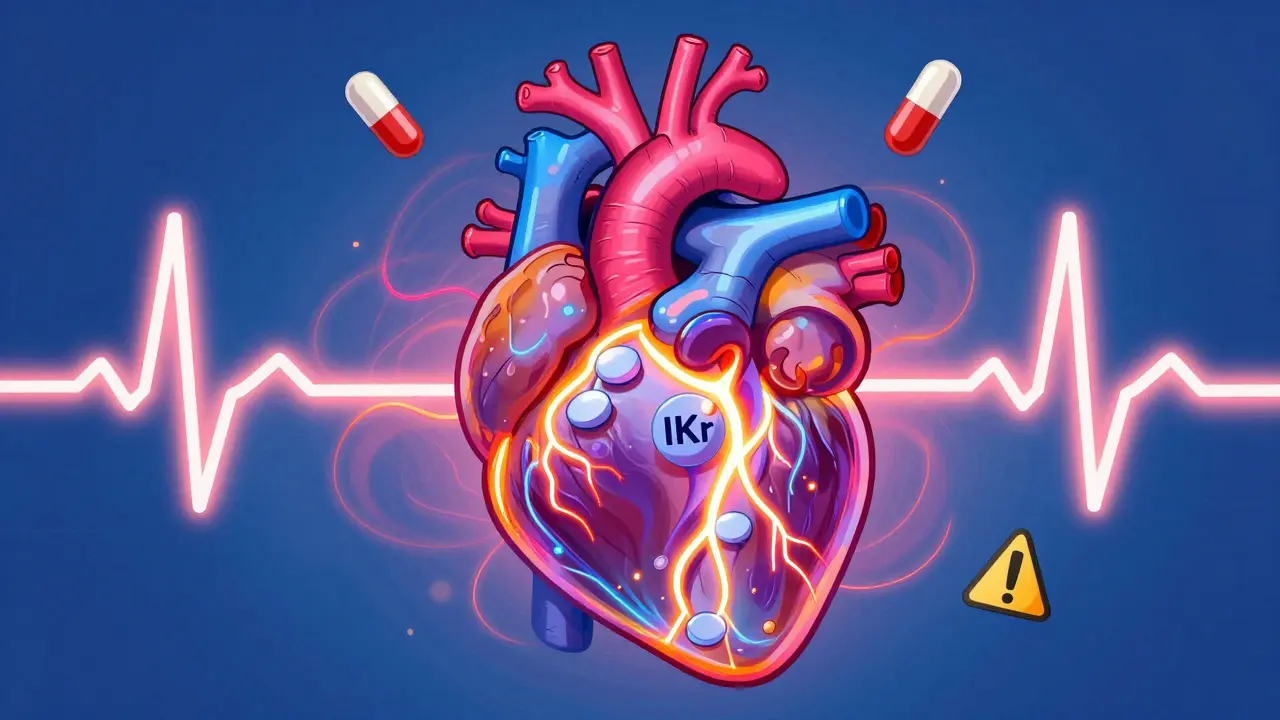
Macrolides work by stopping bacteria from making proteins. But they also interfere with a tiny electrical channel in your heart called the IKr potassium channel. This channel helps your heart reset after each beat. When it’s blocked, your heart takes longer to recharge, which shows up on an ECG as a prolonged QT interval.
This isn’t just a lab curiosity. A prolonged QT interval can cause your heart’s lower chambers to fire erratically, leading to Torsades de Pointes. It’s rare-but when it happens, it’s life-threatening. About 3 to 7 cases occur per million macrolide prescriptions, according to the European Heart Rhythm Association. But that number jumps dramatically if you have other risk factors.
The strength of this effect varies by drug. Clarithromycin is the worst offender, blocking the IKr channel more strongly than the others. Studies show it can lengthen the QT interval by 10 to 20 milliseconds. Azithromycin is milder-usually 5 to 10 ms-but still carries risk. Erythromycin falls in between, but it’s less used today because of stomach side effects.
Who’s at Real Risk?
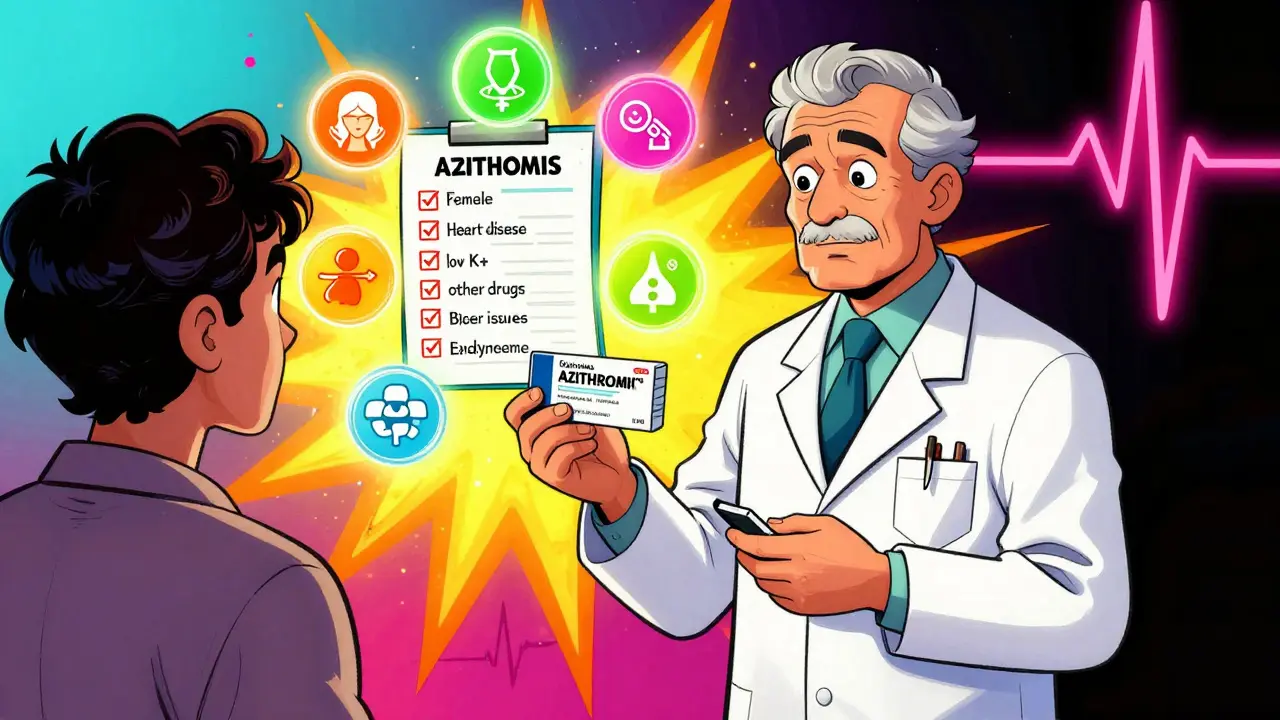
Most healthy people won’t have a problem. But if you have even one of these seven risk factors, your chance of trouble goes up fast:
- Female sex (women are 2 to 3.5 times more likely to develop TdP)
- Age over 65 (risk increases 1.8 times)
- Pre-existing heart disease (heart failure, past heart attack, or enlarged heart-doubles the risk)
- Low potassium or magnesium (hypokalemia raises risk 3 times)
- Other QT-prolonging drugs (taking more than one raises risk 2.5 to 5 times)
- Kidney problems (reduced clearance means higher drug levels-1.7 times higher risk)
- Genetic long QT syndrome (this is the big one-risk jumps 5 to 10 times)
Here’s the catch: many of these are silent. Someone might not know they have long QT syndrome until they take azithromycin. Or they might be on a blood pressure pill that also prolongs QT, and their doctor never connects the dots.
The Big Controversy: Is Azithromycin Really Dangerous?
In 2012, a study led by Dr. Wayne Ray in the New England Journal of Medicine made headlines. It found that people taking azithromycin had a 2.88 times higher risk of dying from heart problems than those taking amoxicillin. The FDA responded with a safety warning in 2013.
But here’s what didn’t make the news: later studies showed the original numbers were skewed. When researchers adjusted for everything-age, diabetes, smoking, prior heart issues, even how sick people were before taking the antibiotic-the risk dropped to almost nothing. One 2018 study in JAMA Heart found the odds ratio for cardiac death was 1.01-meaning no real difference.
So what’s going on? The answer is confounding by indication. People who get azithromycin are often sicker. They’re older. They have more chronic diseases. They’re more likely to be on other meds. The drug isn’t necessarily killing them-it’s just the marker for someone already at high risk.
Still, the FDA and the American Heart Association don’t take chances. They say: if you have risk factors, avoid macrolides when possible. Even if the absolute risk is low, the consequences are too severe to ignore.
What Drugs Make It Worse?
Macrolides don’t act alone. The real danger comes when they’re stacked with other QT-prolonging drugs. Common ones include:
- Antidepressants like citalopram, escitalopram
- Antiarrhythmics like amiodarone, sotalol
- Antifungals like fluconazole
- Antipsychotics like haloperidol, ziprasidone
- Fluoroquinolones like moxifloxacin
One 2022 study in JAMA Internal Medicine found that 42% of macrolide prescriptions in cardiac patients were paired with another QT-prolonging drug. That’s not an accident-it’s a systemic blind spot.
And it’s not just prescriptions. Some over-the-counter antihistamines like diphenhydramine (Benadryl) can also prolong QT. So can certain herbal supplements like licorice root.
What Are the Alternatives?
If you’re at risk, you don’t have to go without antibiotics. Here are safer options:
- Doxycycline (a tetracycline)-minimal cardiac risk, good for respiratory infections
- Amoxicillin or amoxicillin-clavulanate-first-line for many bacterial infections
- Cephalexin (a cephalosporin)-safe for most patients
- Levofloxacin or moxifloxacin-these are fluoroquinolones and DO prolong QT, so avoid them too if you’re high-risk
Don’t assume one antibiotic is automatically better. The right choice depends on the infection, your allergies, and your other meds. Talk to your doctor or pharmacist. Ask: “Is there a non-QT-prolonging option for my condition?”

What Should You Do Before Taking a Macrolide?
Here’s a simple 3-step check you can ask for before filling any macrolide prescription:
- Check your QT interval-if you’ve had an ECG in the last year, ask for the QTc value. If it’s above 450 ms for men or 470 ms for women, avoid macrolides.
- Review your meds-make a list of every pill, patch, or supplement you take. Bring it to your doctor. Many EHRs don’t flag interactions automatically.
- Test your electrolytes-if you’re on diuretics, have kidney disease, or are elderly, ask for a simple blood test for potassium and magnesium. Low levels make QT prolongation much more likely.
For high-risk patients, the University of Arizona’s QT Risk Score can help. It’s a 10-point tool that adds up risk factors. A score of 7 or higher means you should avoid macrolides entirely.
What’s Changing in 2025?
Things are slowly improving. Kaiser Permanente cut high-risk macrolide prescriptions by 28% after adding automated alerts in their electronic health records. The FDA’s 2023 draft guidance now requires all new antibiotics to be tested for QT effects before approval.
There’s also new hope in drug design. Solithromycin, a newer ketolide, showed no QT prolongation in trials-but the FDA rejected it in 2016 due to liver toxicity. It proves that safer macrolides are possible, if developers prioritize cardiac safety.
Meanwhile, clarithromycin use in cardiac patients has dropped 34% since 2013. Azithromycin use hasn’t changed much-probably because many still believe it’s “safe.” But the data says otherwise: even azithromycin has been linked to cardiac arrest in people with hidden long QT syndrome.
Bottom Line: Don’t Panic, But Do Ask Questions
Macrolides aren’t evil drugs. They save lives. But they’re not risk-free, especially when used carelessly. The key is awareness.
If you’re over 65, have heart disease, take multiple medications, or have ever fainted for no reason-you need to be extra careful. Don’t let a quick prescription for a cold turn into a cardiac emergency.
Ask your doctor: “Is there a safer antibiotic for me?” Ask your pharmacist: “Does this interact with my other meds?” And if you’ve ever had an unexplained fainting spell or a family history of sudden cardiac death, get tested for long QT syndrome.
One extra question could mean the difference between a quick recovery and a cardiac arrest.
Can azithromycin really cause sudden death?
Yes, but it’s rare and mostly happens in people with existing risk factors like heart disease, low potassium, or other QT-prolonging drugs. The overall risk is less than 1 in 100,000 for healthy people, but it jumps over 24 times higher if you have multiple risk factors. The 2012 NEJM study suggested a link, but later analyses showed much of the risk was due to underlying illness, not the drug alone. Still, because the consequences are so severe, guidelines recommend caution in high-risk patients.
Which macrolide is safest for the heart?
Among macrolides, azithromycin carries the lowest risk of QT prolongation, followed by erythromycin, then clarithromycin-which is the most dangerous. Clarithromycin blocks the IKr channel more strongly and has the highest association with Torsades de Pointes. But even azithromycin isn’t risk-free. For people with multiple risk factors, non-macrolide antibiotics like amoxicillin or doxycycline are safer choices.
Should I get an ECG before taking azithromycin?
The American Heart Association recommends checking a baseline ECG if you’re over 65, have heart disease, are on multiple medications, or have a history of fainting or arrhythmias. For healthy, young adults with no risk factors, routine ECGs aren’t needed. But if you’re unsure, ask your doctor. A simple ECG can rule out hidden long QT syndrome and prevent a dangerous interaction.
Can low potassium make macrolides more dangerous?
Yes. Low potassium (hypokalemia) is one of the strongest risk factors for macrolide-induced arrhythmias. It makes the heart more electrically unstable and lowers the threshold for Torsades de Pointes. If you’re on diuretics, have kidney disease, or have been vomiting or having diarrhea, your potassium may be low. A simple blood test can check this. If it’s low, correct it before taking any macrolide.
Are there antibiotics that don’t affect the QT interval?
Yes. Many common antibiotics have minimal or no QT effects. Amoxicillin, amoxicillin-clavulanate, cephalexin, and doxycycline are all considered safe for patients at risk of arrhythmias. Even penicillin V is a good alternative. Fluoroquinolones like levofloxacin and moxifloxacin do prolong QT, so they’re not safer options. Always ask your doctor: “Is there a non-QT-prolonging antibiotic for my infection?”
What should I do if I feel dizzy or have palpitations after taking a macrolide?
Stop taking the medication immediately and seek medical attention. Dizziness, skipped beats, or fainting could be signs of a dangerous arrhythmia. Call 911 or go to the nearest ER. Don’t wait. Tell the staff you recently took a macrolide antibiotic-this is critical information that can speed up diagnosis and treatment. Most cases of macrolide-induced TdP are reversible if caught early.
Erik J
December 17, 2025 AT 16:43Had a friend code 12 years ago after a Z-pack. No heart issues before. No other meds. Just azithromycin and a bad cold. They never knew they had hidden long QT until the ER did the ECG. Scary how silent this stuff is.
Steven Lavoie
December 18, 2025 AT 21:09There's a reason why pharmacists in teaching hospitals now run automated QT risk checks before dispensing macrolides. It's not paranoia-it's protocol. The data’s messy, but the stakes are too high to wing it. If your doctor doesn’t ask about your meds and electrolytes, ask them why.
Brooks Beveridge
December 19, 2025 AT 09:00Hey, I get it-antibiotics are quick fixes. But this isn’t just ‘take a pill and feel better.’ This is ‘take a pill and maybe never wake up’ territory if you’re high-risk. I used to think this was overblown until my grandma went into torsades after a clarithromycin script. She was 72, on a diuretic, and had never had an ECG. We got lucky she survived. Now I check every script for my family. Don’t be the person who says ‘it’s fine.’ It’s not always fine.
Meghan O'Shaughnessy
December 20, 2025 AT 03:35My dad’s on amiodarone and got prescribed azithromycin for bronchitis. His pharmacist flagged it immediately. That’s the system working. Why isn’t this automated everywhere? We’re still relying on overworked docs and pharmacists to catch this manually. It’s a miracle anyone survives.
Kaylee Esdale
December 20, 2025 AT 07:30My doc just handed me a Z-pack like it was aspirin. I didn’t even know QT was a thing. Now I Google every script. Turns out my blood pressure med and Benadryl are both on the list. Who knew my allergy pills could kill me? 😳
Jody Patrick
December 21, 2025 AT 09:55Stop the fearmongering. People die from the flu. This is one in a million. Stop making healthy people paranoid. Azithromycin saves lives.
CAROL MUTISO
December 22, 2025 AT 17:42Oh sweet jesus. So the FDA’s warning was just a ‘hey maybe check your meds’ and now we’re all acting like macrolides are the new opioid crisis? Meanwhile, my uncle’s on five QT-prolonging drugs and still gets his azithro like clockwork. And he’s fine. Maybe the real problem is that doctors don’t listen. Not the drug.
Martin Spedding
December 23, 2025 AT 23:46the fda is just scared of lawsuits. 99% of people are fine. why are we treating every cold like a cardiac emergency? also typo: torsades not torsades. lol.
Chris Van Horn
December 24, 2025 AT 21:48It is patently irresponsible to suggest that azithromycin is a significant cardiac threat in the absence of confounding variables. The 2012 NEJM study was methodologically bankrupt, and the subsequent JAMA reanalysis demonstrated no statistically significant mortality signal. To conflate association with causation is not just incorrect-it is a disservice to evidence-based medicine. One must consider the entire clinical context, not reduce pharmacology to fear-driven soundbites.
amanda s
December 25, 2025 AT 02:24My brother died from a Z-pack. He was 31. Healthy. No meds. No family history. The hospital said it was ‘unexplained cardiac arrest.’ Now I know. I’m telling everyone. If your doctor prescribes azithromycin, ask for an ECG. Or don’t take it. I lost my brother because no one asked. Don’t let this happen to yours.