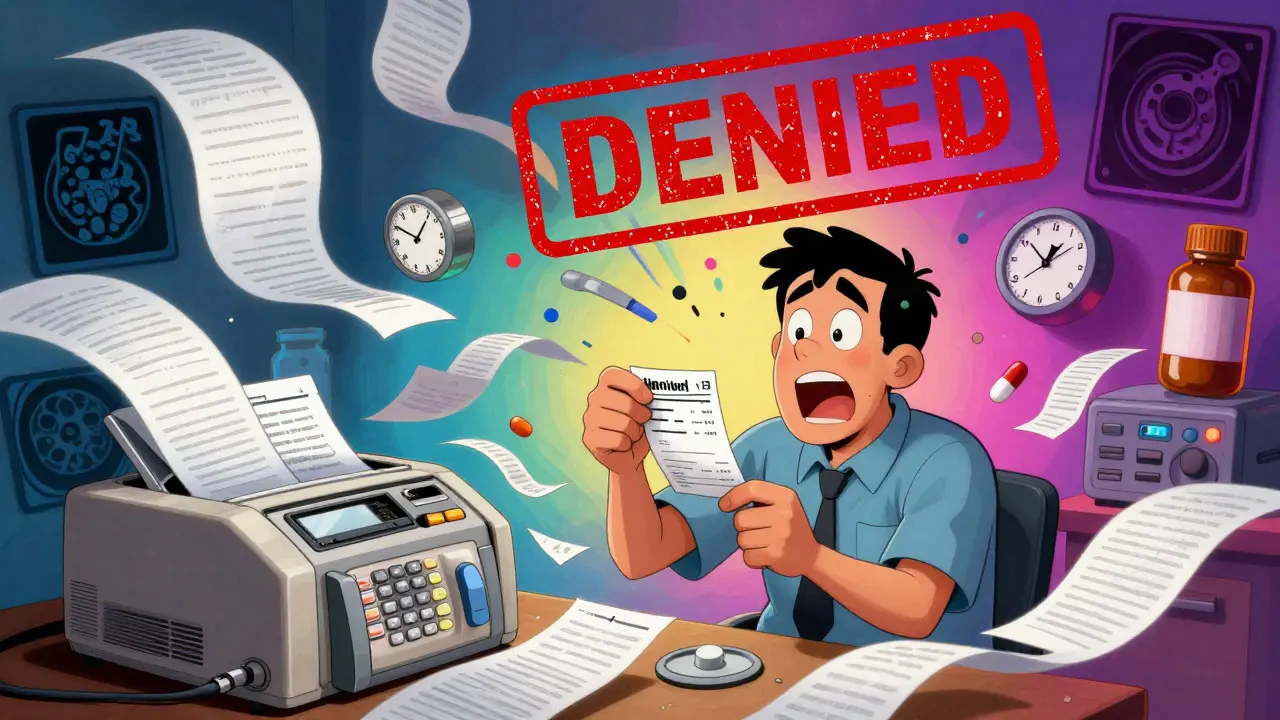
Imagine you’re on a life-saving medication. Your doctor prescribes it. You’re ready to start. But then-nothing. Days pass. Then weeks. You call your pharmacy. They say, "We’re waiting on approval." You call your insurance. They say, "We need more paperwork." By the time you get the drug, your condition has worsened. This isn’t rare. It’s happening to millions of people every year because of prior authorization.
What Prior Authorization Really Does
Prior authorization is supposed to make sure you get the right treatment at the right cost. But in practice, it often becomes a roadblock. Insurance companies require doctors to ask for permission before prescribing certain drugs or ordering tests like MRIs, CT scans, or surgeries. It’s meant to stop unnecessary spending. But instead, it’s causing dangerous delays. For example, if you have cancer and need a targeted therapy that costs $15,000 a month, your insurer might demand you try three cheaper drugs first-even if your doctor knows they won’t work. That’s called step therapy. And if your insurance denies the request? You’re stuck. No medication. No treatment. Just waiting. Medicare Advantage plans require prior authorization for nearly 25% of prescriptions. Commercial insurers do it for 60% of specialty drugs. Medicaid varies wildly-from 12% to 89% depending on your state. And here’s the kicker: only 15% of these requests are handled electronically. The rest? Fax machines, phone calls, and paper forms. In 2024, doctors still spend over 16 hours a week just filling out forms and chasing approvals.Why These Delays Are Life-Threatening
This isn’t just annoying. It’s deadly. A 2023 study in JAMA Oncology found that cancer patients who waited more than 28 days to start treatment had a 17% higher chance of dying. Why? Because cancer doesn’t pause for paperwork. Neither do autoimmune diseases, epilepsy, or severe diabetes. One Reddit user, a nurse named Jen, shared a case where a diabetic patient’s insulin pump was denied for 11 days. The patient ended up in the hospital with diabetic ketoacidosis-a life-threatening condition. Another case from 2016 involved a man with epilepsy who died after a seizure. He couldn’t afford his medication while waiting for approval. Doctors aren’t exaggerating. In a 2024 survey of nearly 1,000 physicians, 93% said prior authorization caused care delays. 91% saw negative health outcomes directly linked to it. And 82% reported patients giving up on treatment entirely because the process was too hard.Who Gets Hit the Hardest
It’s not just about cost. It’s about who bears the burden. Low-income patients, people with chronic illnesses, and those in rural areas get hit the hardest. They’re less likely to have someone to advocate for them. Less likely to have time to make dozens of phone calls. Less likely to afford out-of-pocket costs while waiting. Medicaid patients wait an average of 7.2 days for approval-longer than those with commercial insurance. In some states, the system is so broken that patients go without medication for weeks. Meanwhile, Medicare Advantage plans, which serve over 35 million people, are required by law to respond within 72 hours for urgent cases. But compliance? Patchy at best. Even when approvals come through, they’re often incomplete. A doctor submits the right forms, but the insurer says, “We need a letter from your specialist.” Then another letter. Then a copy of your last lab result. And none of it is digital. It’s all faxed. And faxes get lost. All day. Every day.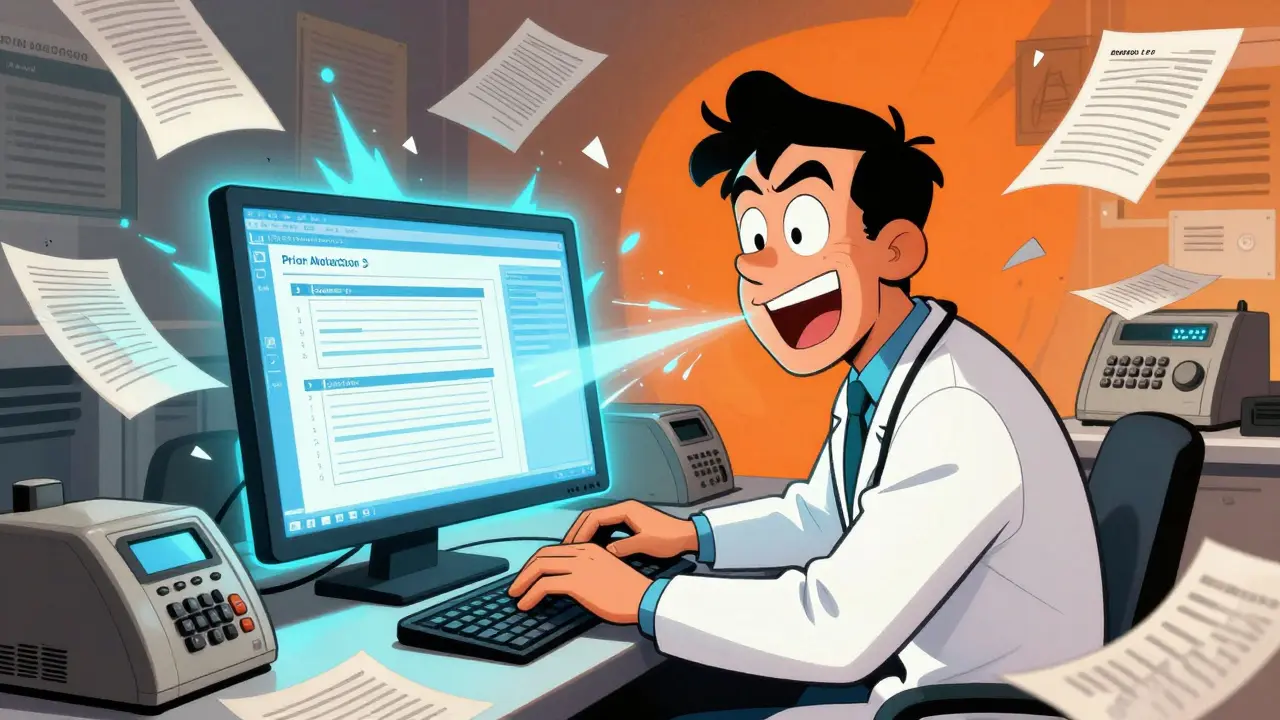
How Providers Are Fighting Back
Doctors aren’t just sitting still. They’re finding ways to cut through the red tape. One of the most effective fixes? Electronic prior authorization. Practices that switched from fax to digital systems cut approval time from over five days to under two. Some large health systems have integrated authorization checks directly into their electronic health records. When a doctor clicks “prescribe,” the system automatically checks if prior auth is needed-and even pre-fills the form. That’s cut denial rates by 35%. Another trick? Benefit verification at the point of care. Instead of waiting until after the appointment, staff check the patient’s insurance coverage right then and there. That alone reduces the number of authorization requests by nearly 30%. Some clinics now have dedicated prior authorization teams. One practice in Oregon hired two staff members just to handle authorizations. Their approval rate jumped 22%. They also use standardized templates for common requests-like for insulin pumps or biologics-which cuts documentation time by 40%. And for high-risk patients? Many providers now give a 7- to 14-day supply of medication as a “bridge” while waiting. But that’s expensive for clinics. And not all can afford it.What Patients Can Do
You don’t have to wait passively. As soon as your doctor says, “I’m prescribing this,” ask: “Will this need prior authorization?” If they say yes, ask for the name of the drug, the code, and the insurer’s phone number. Then call your insurance yourself. Ask: “What’s the process? How long does it take? What documents do they need?” A 2023 Aetna study found patients who asked this question upfront reduced delays by 63%. That’s huge. Also, check if your drug has a patient assistance program. Many pharmaceutical companies offer free or low-cost medication while you wait for approval. You can find these through the manufacturer’s website or sites like NeedyMeds.org. If you’re denied, don’t give up. You have the right to appeal. Ask your doctor to write a letter of medical necessity. Keep copies of every form, every call, every email. Document everything.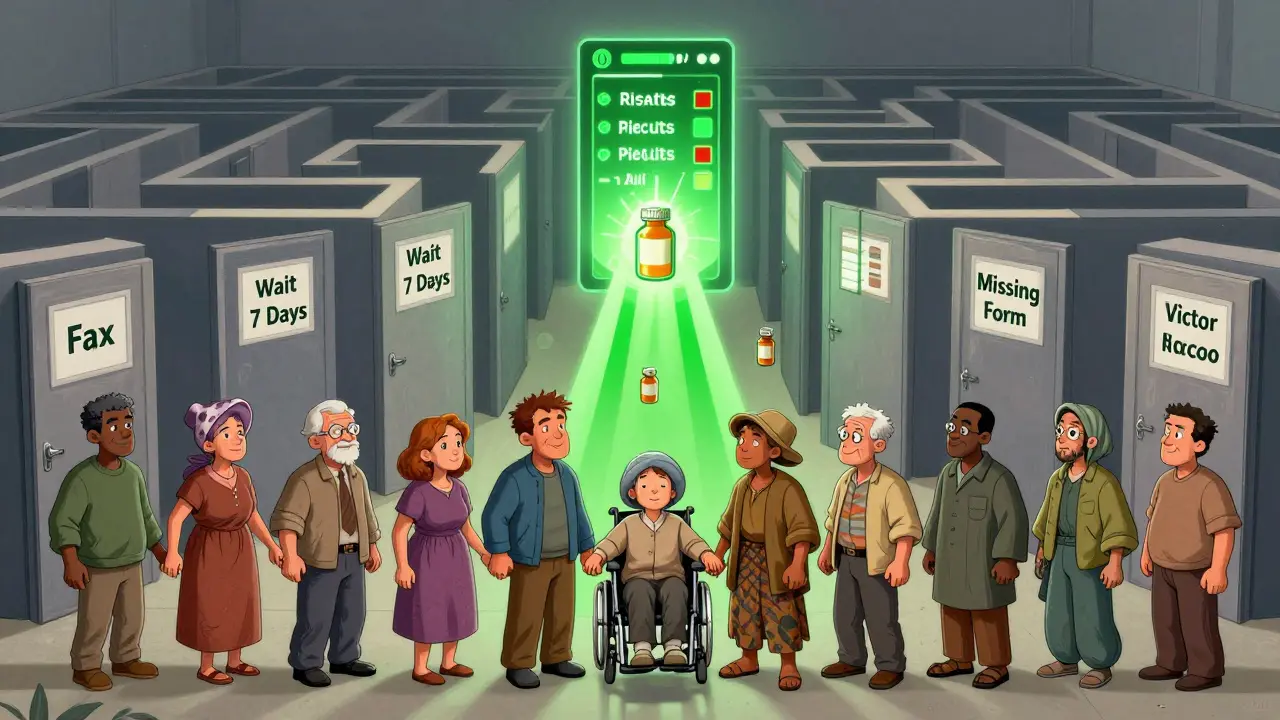
What’s Changing-And What’s Not
Good news: change is coming. In January 2024, the federal government ruled that by 2026, all Medicare Advantage and Medicaid managed care plans must use electronic prior authorization systems with real-time decisions. That means no more faxes. No more waiting days for a response. Some states are moving faster. California now requires emergency authorizations to be approved within 24 hours. Other states have capped approval times at 72 hours. New tech is helping too. AI tools like Kyruus and Apricus Analytics can predict which requests will be approved and auto-fill forms. The HL7 DaVinci Project’s PDEX standard-used by 87% of major health systems-is making it possible to check authorization status right in the doctor’s system, before the prescription even leaves the office. But here’s the problem: 63% of Medicaid programs still use fax machines. And only 41% of doctors say things have improved since the new rules were announced. Until every insurer uses real-time digital systems, and until step therapy is limited to cases where it’s truly safe, dangerous delays will keep happening.The Bottom Line
Prior authorization was meant to protect patients. Now, it’s putting them at risk. The system is broken-not because it’s flawed in theory, but because it’s outdated in practice. If you’re a patient: ask early. Advocate hard. Use every resource available. If you’re a provider: go digital. Build systems. Train your team. Protect your patients from bureaucracy. And if you’re someone who cares about healthcare: demand change. The people who need care the most can’t afford to wait any longer.What is prior authorization and why does it cause delays?
Prior authorization is when your insurance requires approval before covering certain medications or treatments. It’s meant to control costs, but most requests still go through fax machines or phone calls, which can take days or weeks. This creates dangerous delays, especially for time-sensitive conditions like cancer or epilepsy.
Which treatments commonly require prior authorization?
High-cost medications-especially specialty drugs over $1,000 per month-almost always require prior authorization. So do MRIs, CT scans, surgeries, durable medical equipment like oxygen tanks, and biologics for autoimmune diseases. Even some generic drugs need approval if they’re part of a step therapy protocol.
How long does prior authorization usually take?
For non-urgent requests, it can take 5 to 14 days. Medicare Advantage averages 5.3 days, Medicaid 7.2 days, and commercial insurers 4.7 days. For urgent cases, insurers are supposed to respond within 72 hours-but many don’t meet that deadline, especially in Medicaid programs.
Can I get my medication while waiting for approval?
Sometimes. Many doctors provide a 7- to 14-day supply as a "bridge" while waiting. You can also check if the drug manufacturer offers a patient assistance program to give you free or discounted medication during the wait. Always ask your doctor or pharmacist about these options.
What should I do if my prior authorization is denied?
Don’t accept it as final. Ask your doctor to write a letter of medical necessity explaining why the treatment is critical. File an appeal with your insurer-there’s a formal process. Keep records of every call, email, and form. You have rights under federal law, and many denials are overturned on appeal.
Is there a way to avoid prior authorization altogether?
Not always, but you can reduce the risk. Ask your doctor to prescribe a drug that doesn’t require prior authorization if it’s clinically appropriate. Use your pharmacy’s formulary list to check ahead of time. And always verify coverage at the time of your appointment-not after.
jay patel
February 3, 2026 AT 03:05so like... i got my dad on insulin last year and the insurance made us fax 3 times, lose one form, and wait 11 days. he ended up in the er. meanwhile the insurance rep on the phone was like "oh we got your request" like it was a pizza order. why do we still use fax machines in 2024? is this a joke? or is this just capitalism being lazy? i swear if i had to fill out one more paper form i’d start a revolution. also my doctor’s office still uses a landline. a landline. in 2024. what even is this timeline.
Ellie Norris
February 4, 2026 AT 05:46Oh my goodness, this is so true. I work in a GP clinic in London and we’re constantly battling with US insurers for our patients who’ve moved back home. One lady with MS had to wait 3 weeks for a biologic because they kept asking for a ‘second opinion’ from a specialist who’d already written one. We had to email them 7 times. And they still didn’t respond properly. The worst part? She was crying because she couldn’t walk to the bathroom without help. This isn’t healthcare-it’s a bureaucratic obstacle course. Please, someone fix this. I’m begging you.
Sandeep Kumar
February 5, 2026 AT 18:06why do americans think they deserve free stuff? if you want your fancy drugs pay for them. insurance is there to stop people from wasting money on overpriced pills. if you cant afford it then dont take it. also fax machines are fine they work. why do you need a computer for everything? you people are too soft. also why are you even on reddit complaining? go get a job and pay for your own meds. america is broken not the system
Gary Mitts
February 7, 2026 AT 10:00They call it prior authorization. I call it prior torture.
Brittany Marioni
February 8, 2026 AT 10:07As someone who works in community health outreach, I’ve seen patients cry because they couldn’t get their epilepsy meds for 18 days. One man lost his job because he couldn’t drive due to seizures-and then his insurance denied his pump because he didn’t have a letter from a specialist who didn’t even take his insurance. We had to call 17 different departments, write three appeal letters, and finally, after 22 days, they approved it. But by then, his kidneys were damaged. This isn’t just inefficient-it’s cruel. We need standardized digital systems, full stop. And we need to ban step therapy for life-threatening conditions. No one should have to beg for their life.
Monica Slypig
February 9, 2026 AT 05:50Look I get it people are upset but the real issue is that doctors overprescribe expensive drugs. If you just used generics like in Europe you wouldn’t need all this. Also why are you all so dramatic? In Germany they wait 2 days for everything and nobody complains. You Americans think your suffering is unique. It’s not. You just have too many lawyers and not enough discipline. Also faxes are fine. You’re just lazy.
Becky M.
February 10, 2026 AT 10:48I’m a nurse in rural Iowa. We don’t have specialists nearby. So when a patient needs an MRI for possible MS? We submit the request. Then we wait. Then we call. Then we fax again. Then we wait again. One woman waited 26 days. Her symptoms got worse. By the time she got the scan? She had two lesions. She’s on disability now. We didn’t fail her. The system did. And I’m tired of being the one who has to explain why her insurance won’t cover the thing that might save her life. We need help. Not more paperwork.
Eli Kiseop
February 10, 2026 AT 17:43so if you get denied can you just go to another insurer? like switch plans mid-treatment? or is that a myth? also what if your doctor just prescribes something that doesn’t need auth? does that work? i feel like i’m missing the whole workaround here
Brett MacDonald
February 11, 2026 AT 17:09It’s funny how we’ve outsourced our compassion to algorithms and fax machines. We’ve turned healing into a compliance form. The irony? The same people who built this system never have to wait for their own prescriptions. They get expedited care. They get concierge doctors. They get their drugs delivered in 2 hours. Meanwhile, the rest of us are stuck in a loop of bureaucracy that feels like a Kafka novel written by an insurance adjuster with a spreadsheet. We don’t need more tech. We need to remember that medicine is about people. Not profit margins. Not checkboxes. Not faxes.