
Scopolamine Interaction Checker
Check Medication Interactions
Scopolamine can dangerously interact with many common medications and substances. This tool helps you identify potential risks before using the patch.
Interaction Results
When you're on a boat, in a car, or flying through turbulence, motion sickness can strike fast and hard. For many, the go-to solution is the scopolamine patch - a small, discreet adhesive worn behind the ear. It works. But here's the catch: scopolamine doesn't just fight nausea. It also slows your brain down. And when you mix it with other sedatives, the results can be dangerous.
What Scopolamine Actually Does
Scopolamine, also known as hyoscine, is one of the oldest and most effective drugs for preventing motion sickness. Developed from plants like henbane and Jimsonweed, it blocks acetylcholine - a brain chemical that triggers nausea and vomiting. The transdermal patch (brand name Transderm Scōp) delivers a steady dose over 72 hours, making it ideal for long trips. Unlike oral pills that need to be taken every few hours, one patch lasts for days.
It's not just for cruise passengers. Military pilots, commercial fishermen, and even astronauts use it. The World Health Organization lists it as an essential medicine. And in clinical trials, it reduces motion sickness symptoms by nearly 80%, outperforming Dramamine and Bonine. But all that effectiveness comes with a trade-off: it crosses the blood-brain barrier easily. That’s why people feel so drowsy.
The Sedation Problem
Most users expect some drowsiness. What they don’t expect is how strong it can be. In user surveys, over 60% of people on scopolamine patches report feeling significantly sleepy. One Reddit user wrote: "I used it for a 7-day cruise. Worked perfectly - I didn’t vomit once. But I slept 18 hours a day. I had to take it off and switch to Dramamine just to function."
That drowsiness isn’t just inconvenient - it’s a safety issue. Driving, operating machinery, or even walking on a rocking deck becomes risky. The American Academy of Neurology recommends applying the patch the night before travel so the worst sedation happens while you're asleep. Still, many people don’t know this. A 2023 survey found that 58% of adverse events occurred during first-time use because users underestimated the effect.
What Happens When You Mix It With Other Sedatives
Scopolamine doesn’t just make you sleepy. It makes other sedatives stronger.
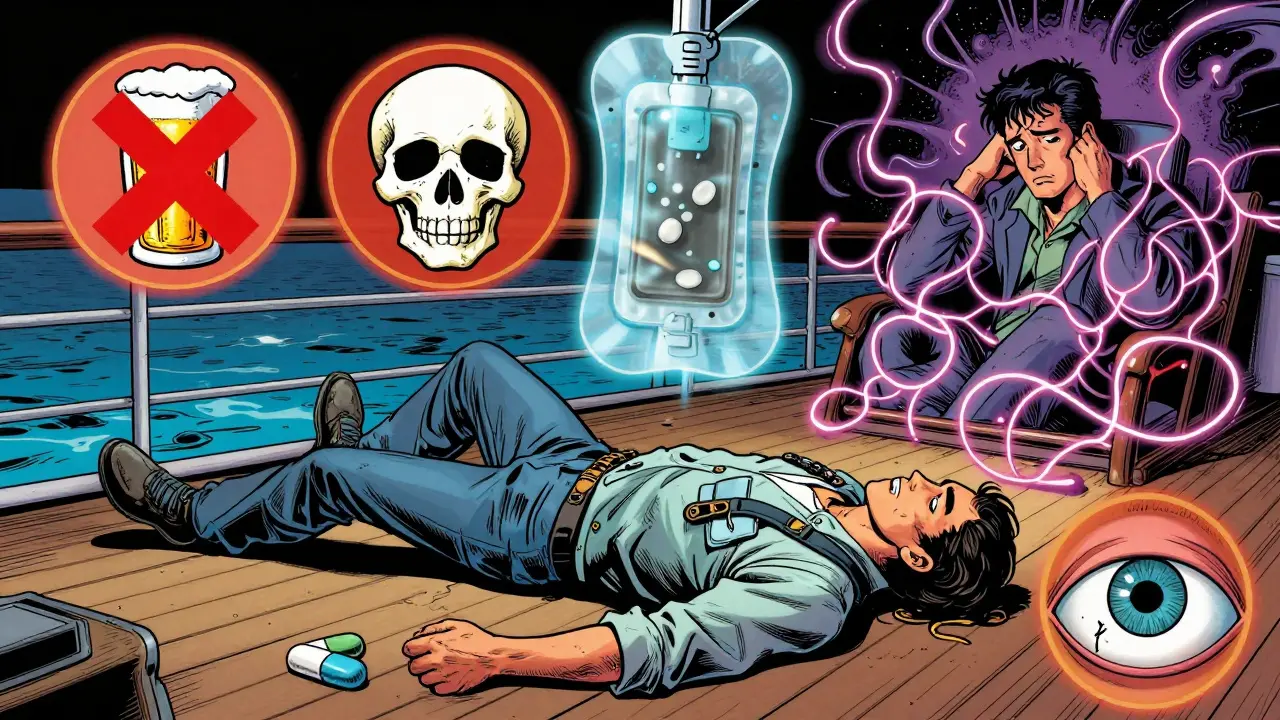
Alcohol is the most common culprit. Nearly half of negative reviews on drug forums mention combining the patch with even one drink. Users report extreme dizziness, confusion, and loss of coordination. One marine researcher said: "I saw a colleague become completely disoriented after one beer. He couldn’t stand up. We had to get him to medical."
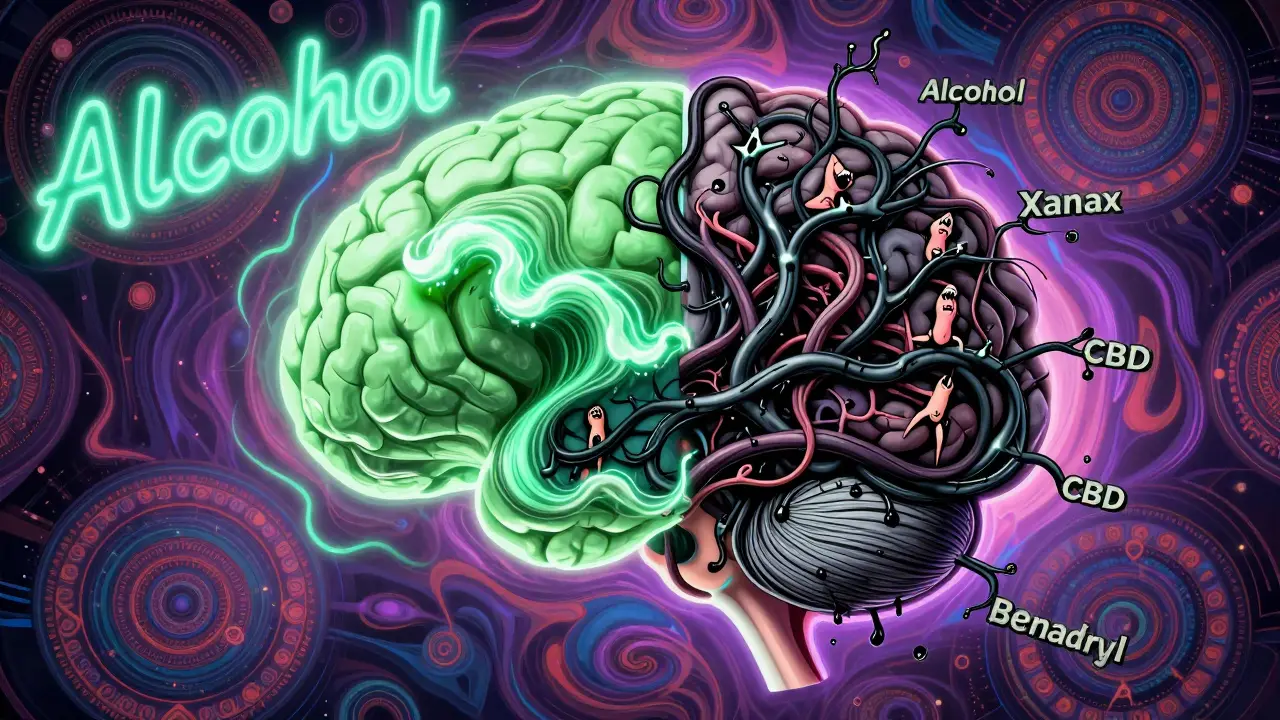
It gets worse with prescription drugs. Benzodiazepines like Xanax or Valium, opioids like oxycodone, sleep aids like zolpidem, and even some antidepressants can multiply scopolamine’s sedative effects. A 2021 study from the American Society of Anesthesiologists showed that elderly patients using scopolamine with benzodiazepines had a 40% higher chance of delirium. That’s not just grogginess - it’s acute confusion, hallucinations, and memory loss.
Even over-the-counter remedies like Benadryl or NyQuil can be risky. Many people don’t realize these contain antihistamines - which act like mild anticholinergics, just like scopolamine. When combined, they create additive effects. The European Medicines Agency now requires explicit warnings on all scopolamine packaging: "Do not use with other CNS depressants."
What About CBD and Newer Products?
As CBD becomes more popular, new risks are emerging. A December 2023 study found that CBD can inhibit the liver enzyme CYP3A4, which breaks down scopolamine. This means more of the drug stays in your system - increasing sedation by 22-35%. There’s no official warning yet, but doctors are already seeing cases of patients who used CBD oil for anxiety and then wore a scopolamine patch. The result? Severe drowsiness and slowed breathing.
Even caffeine - often used by users to "counteract" the drowsiness - isn’t a safe fix. While 27% of Reddit users report using coffee or energy drinks, it can raise heart rate, cause anxiety, or trigger arrhythmias in sensitive individuals. It doesn’t reverse scopolamine’s effects. It just masks them.
Who Should Avoid Scopolamine Altogether
It’s not just about interactions. Some people shouldn’t use it at all:
- People with glaucoma - scopolamine can raise eye pressure
- Those with myasthenia gravis - it worsens muscle weakness
- Anyone with bowel obstruction or severe constipation - it slows digestion
- Older adults - especially those on multiple medications
- People with liver disease - the drug is metabolized there
And pregnant women? The FDA classifies it as Category C. That means animal studies showed harm, but human data is limited. Most doctors avoid prescribing it unless absolutely necessary.
How to Use It Safely
If you decide to use scopolamine, here’s how to stay safe:
- Apply the patch at least 4 hours before travel - ideally the night before.
- Put it behind the ear on clean, dry skin. Don’t touch the sticky side.
- Remove it immediately if you feel too drowsy, confused, or have trouble breathing.
- Never drink alcohol while wearing the patch - even one drink.
- Check all your other medications. If it says "causes drowsiness," it’s likely unsafe with scopolamine.
- Don’t drive, operate tools, or make important decisions for at least 24 hours after applying.
- Store patches out of reach of children - one patch can be fatal if ingested.
Some users cut the patch in half to reduce the dose. This is off-label and not approved by manufacturers. But for people who need some protection without full sedation, it’s a common workaround. Just be aware: you’re guessing the dose.
What’s Changing in 2026
Scopolamine isn’t going away - but it’s evolving. In April 2024, the FDA approved a new lower-dose patch (0.5 mg over 3 days) designed to cut sedation by nearly half while keeping its anti-nausea power. Early trials show it’s just as effective for motion sickness but with 40% fewer reports of drowsiness.
Researchers are also testing a patch that releases small amounts of caffeine along with scopolamine. The goal? Counteract the sleepiness without overstimulating the heart. Results from a major NIH trial are expected in late 2025.
Meanwhile, a new drug called penehyclidine hydrochloride is showing promise in labs - it blocks nausea without crossing the brain as much. But it’s still years from being available.
Bottom Line
Scopolamine works better than anything else for motion sickness. But it’s not a simple pill. It’s a powerful drug with serious side effects - especially when mixed with other sedatives. The patch isn’t dangerous by itself. But when you don’t know what else you’re taking, or you think "a little alcohol won’t hurt," you’re playing with fire.
If you need motion sickness help, talk to your doctor. Ask about alternatives. Meclizine might be weaker, but it’s safer if you’re on other meds. Dramamine might make you sleepy, but at least you can take a dose and stop it. Scopolamine is a marathon, not a sprint - and you can’t turn it off once it’s on.
Can I use a scopolamine patch if I drink alcohol occasionally?
No. Even small amounts of alcohol can dangerously increase scopolamine’s sedative effects. You may feel extremely drowsy, confused, or have trouble breathing. The risk is real, even with one drink. Medical guidelines strongly advise against any alcohol use while wearing the patch.
How long does scopolamine stay in my system after I remove the patch?
The patch stops delivering the drug as soon as it’s removed, but scopolamine remains in your bloodstream for 12-24 hours. Most people feel back to normal within a day. However, side effects like dry mouth, blurred vision, or mild dizziness can linger for up to 48 hours. Don’t drive or operate heavy machinery during this time.
Is it safe to use scopolamine with anxiety medications like Xanax or Klonopin?
No. Benzodiazepines like Xanax and Klonopin are central nervous system depressants. When combined with scopolamine, they can cause extreme sedation, slowed breathing, and even respiratory failure - especially in older adults. This combination is considered high-risk by the American Society of Anesthesiologists. Always consult your doctor before combining them.
Can I use scopolamine if I take over-the-counter sleep aids like Unisom or NyQuil?
Not safely. Many OTC sleep aids contain antihistamines like doxylamine or diphenhydramine, which act similarly to scopolamine. Combining them increases the risk of severe drowsiness, confusion, and urinary retention. It’s not just "feeling tired" - it’s a dangerous drug interaction. Avoid all antihistamines while using the patch.
Why do some people feel restless or agitated instead of sleepy on scopolamine?
Scopolamine can cause paradoxical reactions - especially at higher doses or in people with certain brain chemistry. Instead of sedation, some experience agitation, hallucinations, or confusion. This is more common in older adults or those with pre-existing cognitive issues. If you feel overly restless, confused, or see things that aren’t there, remove the patch immediately and seek medical help.
Is there a safer alternative to scopolamine for motion sickness?
Yes. Meclizine (Bonine) and dimenhydrinate (Dramamine) are oral options with fewer central nervous system effects. They’re less effective than scopolamine, but safer if you’re on other medications, need to stay alert, or have liver or brain conditions. For short trips, they’re often the better choice. For long trips where you can’t take pills repeatedly, scopolamine remains the gold standard - if used carefully.
Can I use a scopolamine patch if I’m taking CBD oil?
It’s not recommended. Early research shows CBD can slow how your body breaks down scopolamine, increasing its concentration and sedative effects by 22-35%. While more studies are needed, doctors are already seeing cases of extreme drowsiness and confusion in people who combined the two. Until there’s clear safety data, avoid using them together.
Reggie McIntyre
February 13, 2026 AT 09:18Man, I used scopolamine on a Caribbean cruise last year and it was a game-changer-no puking, just vibes. But yeah, I slept like a rock for two days. Woke up feeling like I’d been hit by a truck made of pillows. Still worth it though. If you’re gonna ride the waves, go all in. Just don’t try to text your boss while on it. I learned that the hard way. 😴🌊
Brad Ralph
February 15, 2026 AT 00:34Scopolamine: nature’s way of saying ‘ chill out, you’re not in control.’
christian jon
February 15, 2026 AT 07:04ARE YOU KIDDING ME?! People are STILL mixing this with alcohol?! This isn’t a party trick-it’s a one-way ticket to the ER! I’ve seen it happen. A guy at a dockside bar took ONE BEER after his patch. Next thing you know, he’s hugging a lifeguard pole screaming about dolphins. The paramedics had to sedate HIM. And now people are talking about CBD?! Like, WHAT IS THIS, A DRUG FESTIVAL?! The FDA should slap a neon sign on these patches: ‘DO NOT TOUCH ANYTHING, INCLUDING YOUR OWN THOUGHTS.’
Autumn Frankart
February 15, 2026 AT 18:58Big Pharma doesn’t want you to know this-but scopolamine was originally used in mind control experiments during the Cold War. They called it ‘the truth serum’ because it makes you babble. Now they sell it as a ‘motion sickness patch’? Please. Who’s really benefiting here? The cruise companies? The airlines? The military? Someone’s making a fortune off people who can’t even stand up straight. And now they’re adding caffeine? Like, ‘Hey, let’s make this even more dangerous!’ Wake up, people. This isn’t medicine-it’s a Trojan horse.
Sophia Nelson
February 17, 2026 AT 17:32I took one patch for a road trip and woke up three days later on a park bench with my dog and no wallet. I don’t even remember driving. That’s not a patch. That’s a black hole. Never again. And no, I didn’t drink. I swear. I just… disappeared.
Ernie Simsek
February 19, 2026 AT 08:45LMAO at people saying ‘I just had one beer.’ Bro, scopolamine doesn’t care if it was one sip or a shot glass. It’s not a ‘maybe’ situation. It’s a ‘you’re dead weight now’ situation. I saw a guy try to fix his kayak while on it. He ended up in the water yelling at a seagull for stealing his dignity. The seagull won. 🦅💸
Joanne Tan
February 21, 2026 AT 07:55Y’all need to chilllll. I use scopolamine for my fishing trips and I’m fine! I just take it the night before, sleep it off, and boom-next day I’m reeling in tuna like a boss. And yeah, I had a little wine once. Didn’t die. Didn’t hallucinate. Just felt cozy. Maybe you’re just not used to it? Or maybe you’re overthinking it? 🌞🎣
Carla McKinney
February 21, 2026 AT 12:11Let’s be clear: scopolamine is not a ‘mild sedative.’ It’s a potent anticholinergic with documented cases of delirium, urinary retention, and fatal overdoses in children. The fact that it’s sold OTC in patch form is a regulatory failure. And now we’re entertaining CBD interactions? Without clinical trials? This isn’t innovation-it’s negligence dressed up as progress. If you’re not a medical professional, you shouldn’t be experimenting with this. Period.
Ojus Save
February 22, 2026 AT 11:48i use scopolamine for long train rides in india… works great… but i forgot to remove it and my eyes got real blurry… took 2 days to go away… oops 😅
Luke Trouten
February 23, 2026 AT 20:55There’s an interesting philosophical tension here: we seek drugs to restore autonomy (the ability to move without nausea), yet the drug itself removes autonomy (by impairing cognition). Scopolamine doesn’t just treat motion sickness-it temporarily dissolves the self. Is that healing? Or is it a surrender? We accept it because the discomfort of motion is unbearable. But what does it say about us that we’d trade consciousness for comfort? Perhaps the real sickness isn’t the motion… but our refusal to sit with discomfort.
Gabriella Adams
February 24, 2026 AT 02:31As a clinical pharmacist, I’ve reviewed over 200 cases of scopolamine-related adverse events. The most common? Polypharmacy. People take it with antihistamines, SSRIs, antipsychotics, even melatonin-and assume it’s ‘just a patch.’ It’s not. It’s a systemic CNS disruptor. I urge everyone: create a full medication list, bring it to your pharmacist, and ask: ‘Does this interact?’ Not Google. Not Reddit. A licensed professional. Your brain is worth it.
Pat Mun
February 24, 2026 AT 11:54Okay, I’m gonna say something unpopular: I think we’re overreacting. Yes, scopolamine is powerful. But so is driving a car. So is climbing stairs. So is breathing air if you’re allergic. We don’t ban cars because people get into accidents-we educate. The real issue isn’t the patch. It’s the lack of clear, accessible education. Why isn’t every pharmacy giving out a 30-second video on this? Why does the warning label sound like a legal document from 1987? We need better communication, not fear. I’ve helped dozens of patients use it safely by walking them through it. It’s not magic. It’s medicine. And medicine needs context, not panic.
athmaja biju
February 24, 2026 AT 17:16Scopolamine is a Western invention that ignores traditional wisdom. In India, we use ginger, black salt, and deep breathing. No patches. No drugs. Just nature and discipline. Why are we so quick to poison ourselves with chemicals when our ancestors survived voyages for centuries without them? This is cultural arrogance disguised as science.
Robert Petersen
February 25, 2026 AT 18:14Hey, if you’re nervous about using scopolamine, start low. Talk to your doc. Try the new low-dose patch. Or go with meclizine first. You don’t have to go all-in. Progress > perfection. And if you’re scared? That’s okay. Ask questions. Talk to someone who’s been there. You’re not alone. I’ve been there too. And I’m still standing. 💪
Gloria Ricky
February 26, 2026 AT 14:13so i used the patch for a flight and then took benadryl because i thought i was allergic to something? and then i woke up in the airport bathroom with my shoes on the wrong feet. i still dont know how i got there. but hey, no motion sickness 😅