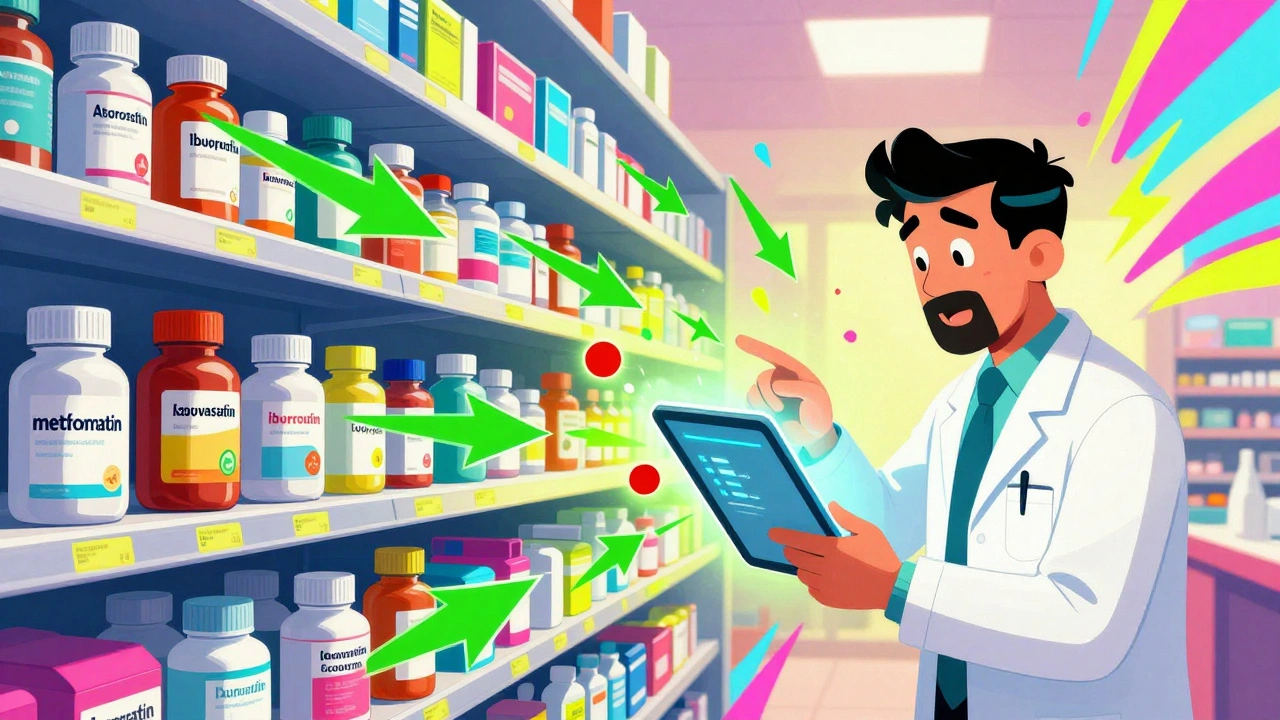
Most pharmacies carry hundreds of medications, but generic stocking strategies can turn that chaos into control. If you’re running a pharmacy, you know the pain: running out of metformin on a Monday, sitting on expired bottles of lisinopril, or losing sales because a patient walked out when the only brand-name blood pressure med was out of stock. The problem isn’t just supply-it’s how you manage it. Generic drugs make up 90% of prescriptions filled in the U.S. but only 20% of the total drug spending. That’s not a coincidence. It’s an opportunity-if you know how to use it.
Why Generic Drugs Demand a Different Approach
Generic medications aren’t just cheaper versions of brand-name drugs. They’re dynamic. When a patent expires, new generics flood the market. One week, you’re stocking Lipitor. The next, you’re switching to atorvastatin from five different suppliers, each with different pricing, lead times, and shelf lives. If you treat generics like brand-name drugs-with fixed orders and static inventory levels-you’ll end up overstocked, understocked, or both.Brand-name drugs have predictable demand. Patients stick with them. Generics? Demand shifts fast. A new generic hits, and sales of the brand drop 60% in three weeks. If your system doesn’t adjust, you’re stuck with $3,200 in obsolete inventory. That’s not theory-it’s what happened to a pharmacy in Ohio in 2023. Meanwhile, fast-moving generics like antacids, laxatives, and ibuprofen need constant attention. Patients won’t wait. If you only have one bottle on the shelf, they’ll go to the chain store down the road.
The 80/20 Rule in Pharmacy Inventory
Here’s the hard truth: 80% of your drug costs come from just 20% of the medications you carry. That’s the 80/20 rule. And guess what? The high-cost 20%? Mostly brand-name drugs. The low-cost 80%? Generics. That’s why your inventory strategy must flip the script. Instead of spending your budget on a few expensive items, you want to optimize volume, speed, and turnover on the cheap stuff.Independent pharmacies should aim for 65-75% of their total inventory value to come from generics. That’s not a suggestion-it’s a financial necessity. When inventory makes up 60-70% of your total assets, every dollar you save on holding costs adds directly to your bottom line. A pharmacy using smart generic stocking saw a 10% drop in average inventory holding costs and a 15% reduction in stockouts within six months. That’s not magic. That’s math.
How to Calculate Your Reorder Points
You can’t guess your way to good inventory. You need numbers. The key formula is simple:Reorder Point (ROP) = (Average Daily Usage × Lead Time in Days) + Safety Stock
Let’s say you sell 15 bottles of metformin 500mg per day. Your supplier takes 3 days to deliver. You add a 2-day safety buffer because you don’t want to run out on a Friday. That’s:
(15 × 3) + 30 = 75 bottles. When you hit 75, you order.
But here’s the catch: you can’t use the same ROP for everything. Metformin? Daily usage is steady. A new generic for cholesterol? Usage spikes for 3 weeks, then drops. You need dynamic ROPs. That means your pharmacy software must track daily sales, not monthly totals. If you’re still using spreadsheets or manual logs, you’re already behind.
Minimum/Maximum Stocking: The Secret Weapon for Generics
The minimum/maximum method is the most reliable strategy for generics. Set a floor and a ceiling for each item:- Minimum: The lowest amount you want on hand (enough to cover lead time + safety stock)
- Maximum: The most you want to carry (to avoid overstock and expiration)
For fast-movers like omeprazole or amoxicillin, the max should be about a week’s supply. That’s 7-10 days of sales. Why? Because generics have shorter shelf lives. Suppliers cut prices to move volume, so they ship products with 12-18 months left on the clock-not the full 24-36 months you get with brands. If you stock 3 months’ worth, you’re risking expiration.
For slow-movers like rare thyroid meds, the max might be 2-3 months. But even then, you need to check expiry dates weekly. One pharmacy lost $8,000 in expired generic insulin last year because they didn’t track lot numbers. Don’t be that pharmacy.
Software That Actually Works for Generics
Not all pharmacy management systems are built the same. If your software can’t handle:- Real-time sales tracking by day
- Automatic ROP adjustments based on recent trends
- Expiry date alerts by lot
- Generic transition alerts (when a new generic hits)
…you’re flying blind. The market for inventory software optimized for generics is growing fast-projected to hit $487 million by 2026. Why? Because the old systems can’t keep up. A pharmacy using software with predictive analytics for generic transitions reduced brand-to-generic imbalances by 28%. That’s not a feature. That’s a profit saver.
Look for tools that integrate with your suppliers’ data. Some platforms now sync with AmerisourceBergen and Cardinal Health to auto-adjust orders when a new generic is approved. Others use AI to predict demand spikes based on regional prescribing trends. If you’re still doing weekly manual counts, you’re wasting time and money.
Handling Generic Transitions Without Losing Money
When a new generic launches, the brand-name version doesn’t just disappear-it collapses. Demand can drop 50-80% in weeks. If you don’t act, you’re stuck with expensive inventory that won’t sell.Here’s what to do:
- Monitor new generic approvals weekly. The FDA approves 15-20 per month.
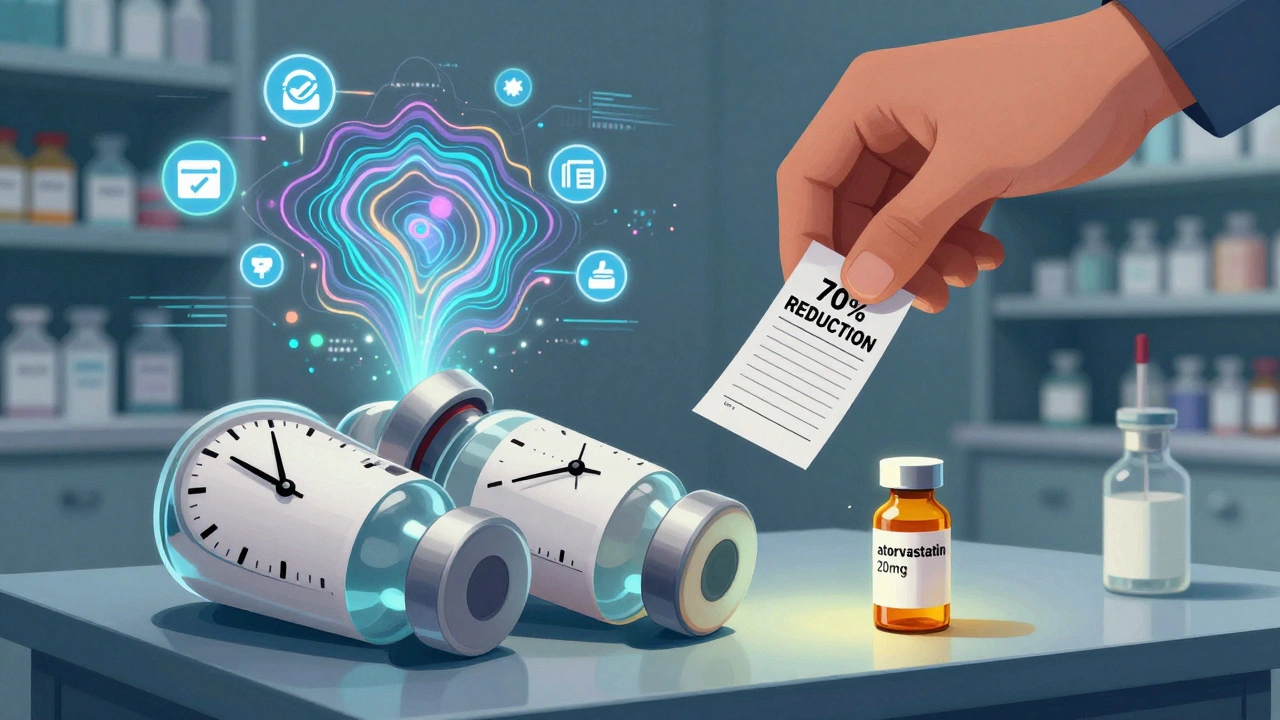
- When a new generic hits, immediately reduce your order size for the brand-name version by 70-90%.
- Start small with the generic. Order 1-2 weeks’ worth first. Don’t stockpile.
- Track patient response. Some patients prefer the brand. Others don’t care. Adjust accordingly.
- Recalculate your open-to-buy formula weekly during transitions: Planned Sales + Planned Markdowns + Planned End Inventory - Planned Beginning Inventory.
One pharmacy in Texas avoided $12,000 in losses by following this exact process during the atorvastatin transition. Another pharmacy lost $3,200 because they didn’t change their orders fast enough. The difference? One team checked their system daily. The other waited for the monthly report.
Staff Training and SOPs: The Hidden Key
Technology helps-but people make it work. If your tech team doesn’t know how to set up ROPs, or your techs don’t know to return unclaimed prescriptions to stock within 24 hours, your system will fail.Start with clear SOPs:
- Receiving: Log lot numbers and expiry dates for every generic received.
- Dispensing: Flag generics with less than 6 months left on expiry for early dispensing.
- Returns: Return unclaimed prescriptions to stock within 24 hours. This cut inventory errors by 22% in one study.
- Cycle counting: Do it weekly for fast-moving generics, not monthly.
Training takes 2-4 weeks. But the payoff? Fewer stockouts, less waste, and happier patients. And don’t forget to train your pharmacists on therapeutic interchange. In 17 states, pharmacists can switch a brand to a generic without a new prescription-thanks to collaborative practice agreements. That’s not just inventory management. That’s patient care.
What Happens When You Don’t Get It Right
Ignoring smart generic stocking has real costs:- Stockouts: One pharmacy lost $1,200 in sales in 3 months because they ran out of metformin 8 times.
- Expiration: $8,000 in expired insulin. Gone.
- Lost trust: Patients remember when you’re out of their meds. They don’t come back.
- Margin compression: Pharmacies using outdated systems face 8-12% lower profit margins by 2027.
And it’s not just money. A pharmacist in California told us her patient skipped doses because she couldn’t get her generic thyroid med. That’s not a supply issue. That’s a health risk.
Where This Is All Heading
The future of pharmacy inventory is automated-but not mindless. AI will predict demand shifts before they happen. Blockchain will track generic drug shelf life from manufacturer to patient. Systems will auto-add a generic to your assortment after four patient requests.But the best systems still need human oversight. Algorithms don’t know if a patient has kidney issues. They don’t know if a new generic has a bad taste that makes compliance hard. That’s where you come in.
Pharmacies that combine smart software with sharp staff will thrive. Those that treat generics like afterthoughts? They’ll fade.
The data is clear: if you want to cut costs, reduce waste, and keep patients satisfied, your generic stocking strategy isn’t optional. It’s your lifeline.
Paul Dixon
December 11, 2025 AT 21:22Man, this hit home. I work at a small-town pharmacy and we were drowning in expired lisinopril last year. Started using min/max for generics and now we barely have anything sit around. Big win.
Jim Irish
December 13, 2025 AT 13:36The 80/20 principle applies here as it does in most business functions. Prioritizing high-turnover generics reduces capital lockup and improves cash flow. Simple logic, often ignored.
Mia Kingsley
December 14, 2025 AT 11:56wait so you’re telling me we should actually *think* about inventory?? like… with numbers?? and not just order whatever the rep pushes?? i’m shocked. this is the most revolutionary thing i’ve read since ‘drink water’
Aidan Stacey
December 15, 2025 AT 17:52THIS. This right here. I’ve been screaming this from the rooftops for years. One of my techs just started using dynamic ROPs and our stockouts dropped like a rock. Patients are actually thanking us now. Like… real human thanks. Not just a nod. It’s beautiful. We’re not just a store anymore-we’re a lifeline. And it started with stopping treating generics like trash.
Jean Claude de La Ronde
December 16, 2025 AT 13:37So we’re supposed to trust AI to tell us when a generic is gonna blow up… but not trust the pharmacist who’s been filling that script for 18 years? Sounds like the future is just a bunch of algorithms trying to replace the one person who actually knows what’s going on. Also, ‘expiry date alerts by lot’? That’s not innovation. That’s basic hygiene.
Aman deep
December 18, 2025 AT 06:48Bro this is gold. I work in a rural clinic in Punjab and we deal with the same chaos-expired meds, no software, just handwritten logs. We started tracking daily sales on a Google Sheet and now we don’t run out of metformin during monsoon season. Small wins, big difference. Thanks for the real talk.
Eddie Bennett
December 19, 2025 AT 00:20Honestly I didn’t think this would be that deep. But the part about patients skipping doses because you’re out of their med? That got me. We’ve all been there. It’s not just inventory-it’s someone’s health. And yeah, software helps, but if your staff doesn’t care, none of it matters.
Vivian Amadi
December 20, 2025 AT 01:20Oh my god you actually mentioned therapeutic interchange?? In a real article?? Who even does that?? I’ve been trying to get my boss to let me switch brand to generic for months and they said ‘we don’t do that here.’ This is the first time I’ve felt seen.
Katherine Liu-Bevan
December 21, 2025 AT 01:18Excellent breakdown. The key insight is that generics aren’t static-they’re volatile. Static inventory models fail here. Real-time sales tracking, dynamic reorder points, and lot-level expiry tracking aren’t luxuries-they’re survival tools. And yes, SOPs matter. One misplaced lot number can cost thousands. I’ve seen it. Also, training pharmacists on therapeutic interchange isn’t optional-it’s legal in 17 states. If you’re not doing it, you’re leaving money and care on the table.