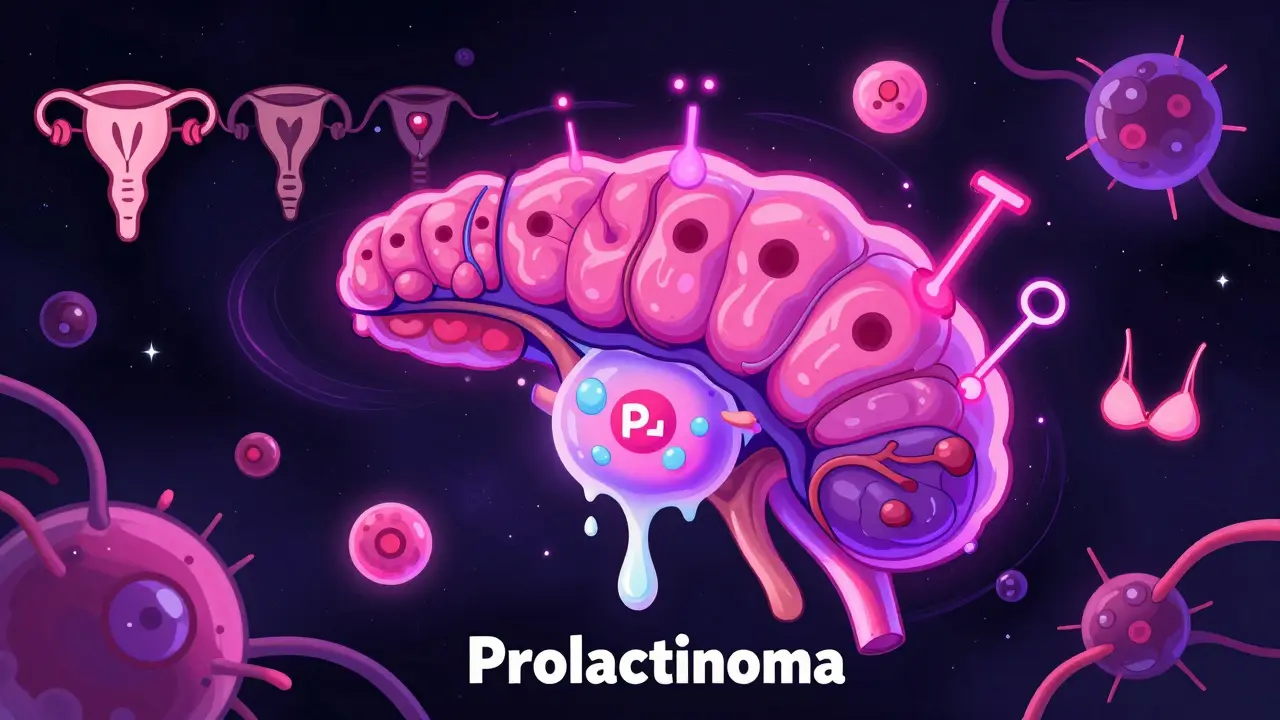
What Exactly Is a Prolactinoma?
A prolactinoma is a benign tumor in the pituitary gland that makes too much prolactin - a hormone that normally controls milk production after childbirth. But when it’s made in excess, it throws off your entire hormonal balance. These tumors are the most common type of pituitary adenoma, making up 40 to 60% of all cases. Most are small - under 1 centimeter - and don’t cause symptoms. But when they grow, they can squeeze nearby nerves, disrupt other hormones, and cause real, noticeable problems.
Women with prolactinomas often notice their periods stop (amenorrhea), breasts produce milk even when not pregnant (galactorrhea), or have trouble getting pregnant. Men may experience low sex drive, erectile dysfunction, or even breast enlargement. In both sexes, fatigue, headaches, and vision issues can show up if the tumor presses on the optic nerve. The higher the prolactin level, the bigger the tumor tends to be. Levels over 200 ng/mL usually mean a macroadenoma (larger than 1 cm), while levels under 100 ng/mL often point to a smaller microadenoma.
How Do You Know If You Have One?
Diagnosing a prolactinoma isn’t just about symptoms. Doctors start with a blood test to check prolactin levels. If your prolactin is above 150 ng/mL, there’s a 95% chance it’s a prolactinoma - not something else like stress, pregnancy, or certain medications. But you can’t stop there. A high prolactin level needs confirmation with an MRI of the pituitary gland. The scan needs to be done with 3mm slices to catch even tiny tumors.
If the tumor is bigger than 1 cm, you’ll also need a visual field test. This checks whether your peripheral vision is being affected - a sign the tumor is pressing on the optic chiasm. Missing this step can delay treatment. Many people think they just have "bad eyesight" or stress-related fatigue, but a simple blood test and MRI can reveal the real cause.
One case from Mayo Clinic involved a 34-year-old woman with a 2.4 cm tumor and prolactin levels at 5,200 ng/mL - over 100 times normal. She thought her missed periods and breast milk were due to hormonal issues after stopping birth control. It wasn’t until her doctor ordered an MRI that the tumor was found.
First-Line Treatment: Dopamine Agonists
The go-to treatment for prolactinomas isn’t surgery. It’s medicine - specifically, dopamine agonists. These drugs trick the brain into thinking there’s enough prolactin, so the tumor stops making it. The two main ones are cabergoline and bromocriptine.
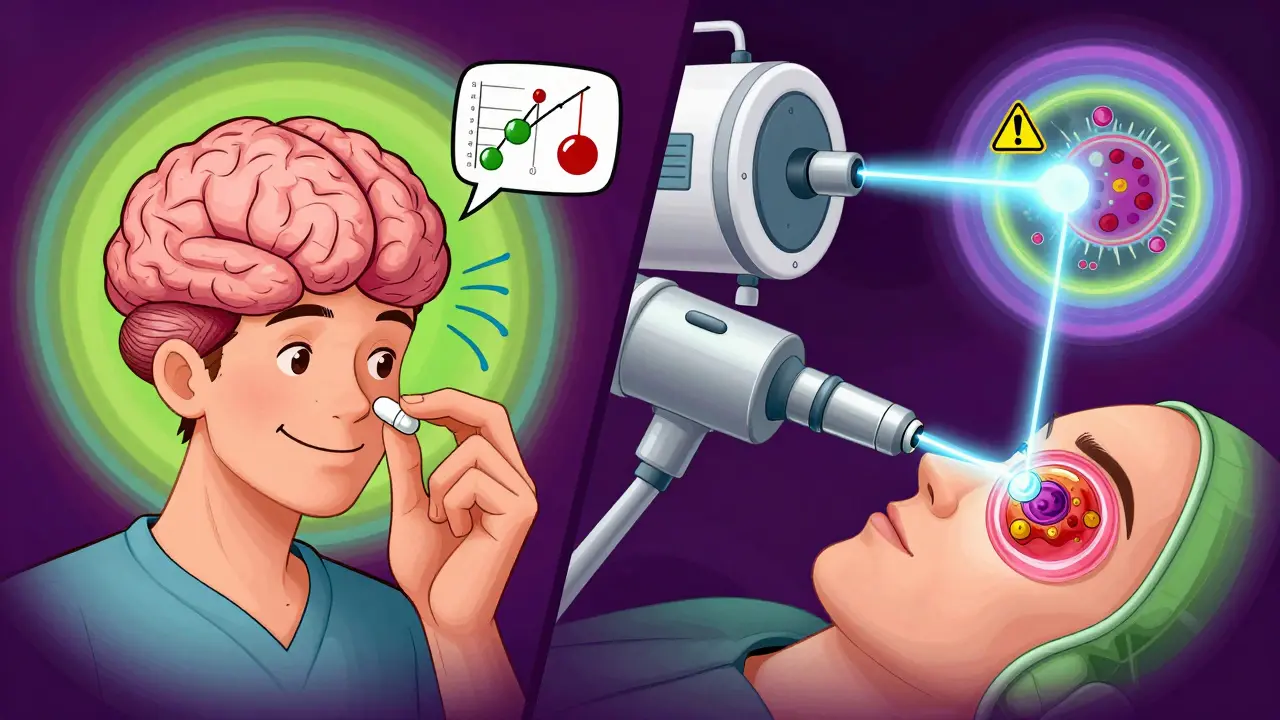
Cabergoline is the preferred choice. It’s taken just twice a week, usually starting at 0.25 mg per dose. Most people see prolactin levels drop within weeks. By three months, 80 to 90% of microadenomas and 70% of macroadenomas have normal hormone levels. Tumors shrink in about 85% of cases. Bromocriptine works too, but it needs to be taken daily and causes more side effects - nausea, dizziness, and low blood pressure affect up to 40% of users. Only about 18% quit cabergoline due to side effects, compared to 32% who stop bromocriptine.
Doctors usually start low and go slow. If prolactin doesn’t drop after four weeks, the dose is increased every two weeks until it’s under control. Most people stay on it for years. Some can eventually stop after two to five years if the tumor shrinks and prolactin stays normal, but 70% need lifelong treatment.

When Is Surgery Needed?
Surgery isn’t the first option - but it’s critical when medicine doesn’t work or the tumor is pressing on your vision. The standard procedure is transsphenoidal surgery: a tiny incision through the nose or upper gum, no skull opening needed. Endoscopic tools give surgeons a clear view, and success rates are high for small tumors: 85 to 90% of microadenomas are fully removed.
But for larger tumors - especially those that have grown into the cavernous sinus - success drops to 35 to 50%. Recurrence is more common too. Five years after surgery, 5% of microadenoma patients see the tumor come back. For macroadenomas, that number jumps to 25 to 30%.
Surgery carries risks: cerebrospinal fluid leaks (2-5%), temporary diabetes insipidus (5-10%), and in rare cases, pituitary apoplexy (1-2%). But patients who’ve had it often report high satisfaction. One survey showed 82% of surgical patients were happy with the results - especially because recovery was quick, often just 3 to 5 days in the hospital.
Radiation Therapy: The Slow but Safe Option
Radiation is usually reserved for tumors that don’t respond to medicine or surgery - or for people who can’t have either. It doesn’t work fast. It can take two to five years to see full results. But once it does, it’s durable.
Gamma Knife radiosurgery delivers a precise, high-dose beam in a single session. It controls tumor growth in 95% of cases at five years and causes less damage to the optic nerve than traditional radiation. Conventional radiation, spread over five to six weeks, has a higher risk of harming the optic nerve (5-10% vs. 1-2% with Gamma Knife).
The downside? Radiation often causes the pituitary gland to stop making other hormones over time. About 30 to 50% of patients develop hypopituitarism within 10 years. That means lifelong hormone replacement for cortisol, thyroid, or sex hormones. It’s a trade-off: you stop the tumor, but you might need to take pills for the rest of your life.
What About Long-Term Risks?
Cabergoline is safe for most people, but there’s a catch. At high doses - over 2 mg per day for more than three years - it can cause heart valve thickening. The risk is low (2-7%), but real. The European Society of Endocrinology recommends an echocardiogram after one year of high-dose use and every two years after that. The FDA has a black box warning for this, but it’s rarely a problem at standard doses.
Another concern: if you stop cabergoline, prolactin can spike back up within 72 hours. Missing a dose isn’t just inconvenient - it can undo months of progress. That’s why adherence is everything. Patients who take their pills consistently have the best outcomes.
There’s also the emotional toll. Many people feel isolated. A survey of over 1,200 patients showed that while 78% felt better within six weeks of starting cabergoline, nearly half worried about long-term side effects or whether they’d ever be "cured." Support groups, like those on Reddit’s r/pituitary, help - but they’re not a substitute for medical care.
What’s Next for Treatment?
Science is moving fast. In 2023, the FDA approved paltusotine for acromegaly, and early trials are testing it for prolactinomas. It’s a new type of drug that might work better with fewer side effects. Researchers are also exploring CRISPR gene editing to target mutations like MEN1, which drive some tumors. AI is being used to plan surgeries with more precision, predicting how a tumor will respond to treatment before it even begins.
But the biggest shift is personalization. In 2022, the WHO added molecular markers like GNAS and USP8 mutations to tumor classification. These tell doctors not just what the tumor is, but how it might behave. Soon, treatment won’t be one-size-fits-all. A patient with a certain mutation might get a targeted drug instead of cabergoline. Experts predict that within five years, cure rates could jump from 70% to 90%.
Still, not all tumors are curable. About 30% of large, invasive prolactinomas resist even the best treatments. For those patients, the goal shifts from cure to control - keeping prolactin low, preserving vision, and maintaining quality of life.
Living With a Prolactinoma
If you’re diagnosed, you’re not alone. Around 10,000 new cases are found in the U.S. every year. Most people live normal lives with treatment. The key is sticking with your plan - taking your medicine, showing up for follow-ups, and speaking up if something feels off.
Get your prolactin checked every three months at first, then annually if stable. Have an MRI every one to two years if you’re on medicine. If you’ve had surgery, monitor for signs of hormone deficiency: constant fatigue, feeling cold, dizziness, or unexplained weight gain. These could mean your pituitary isn’t working right anymore.
Don’t ignore symptoms. If your vision changes, your period stops, or you start leaking milk unexpectedly, see a doctor. Prolactinomas are treatable. They’re not cancer. But they won’t go away on their own. The right treatment - whether it’s a pill, a procedure, or a combination - can bring your life back to normal.
Rosemary O'Shea
December 24, 2025 AT 12:32Let me just say, if you're not getting an MRI with 3mm slices, you're not doing diagnostics-you're gambling. I've seen too many cases where 'routine' scans missed microadenomas because the radiologist was cutting corners. This isn't medical negligence-it's systemic laziness. And don't even get me started on how many GPs still think prolactin spikes are just 'stress' or 'post-birth control chaos.' Wake up, people. We're talking about a tumor pressing on your optic nerve, not a bad mood.
Also, cabergoline isn't just 'preferred'-it's the gold standard. Bromocriptine? That's the 1980s relic your grandfather took. If your doctor still pushes it first, find a new one. And yes, I've been on it for six years. My prolactin was 4,800. Now it's 8. I'm not 'in remission.' I'm cured. But only because I refused to settle for anything less than precision.
And for the love of all that is holy, if you're on more than 1mg/day for over a year, get that echocardiogram. No, it's not 'overkill.' It's called being responsible. The FDA didn't put that black box warning there for fun.
Also, support groups? Cute. But they don't replace endocrinologists. Don't confuse community with care.
Joe Jeter
December 26, 2025 AT 05:20Everyone's acting like prolactinomas are some rare, mysterious plague, but let’s be real-this is just Big Pharma selling lifelong pills. Cabergoline costs $300 a month. Who’s really benefiting here? The patient? Or the shareholders?
And why is surgery always the 'last resort'? Because insurance won’t cover it unless you’re blind or dying. Meanwhile, radiation’s the real villain-30-50% of people end up needing hormone replacements for life? That’s not treatment, that’s a lifetime subscription to pharmacy hell.
And don’t even get me started on the 'molecular markers' nonsense. We’re already treating symptoms like a magic trick. Now we’re going to sequence your DNA and call it 'personalized medicine'? More like personalized billing.
Stop pretending this is science. It’s a business model dressed up in white coats.
Sidra Khan
December 26, 2025 AT 19:23Okay but like… why is everyone so obsessed with the numbers? 200 ng/mL this, 5,200 ng/mL that. At some point, it’s just… you feel weird. Your boobs leak, you can’t get turned on, you’re tired all the time. Who cares if it’s 180 or 1800? The point is: something’s broken.
And yeah, cabergoline works. But the side effects? Like, I took it for 8 months and felt like my brain was wrapped in cotton. Like, I couldn’t focus on a conversation without zoning out for 30 seconds. I stopped. My prolactin’s back up. So what? I’d rather be mentally present than hormonally ‘normal.’
Also, why is no one talking about how weird it is that men get galactorrhea? Like… milk? From a dude? That’s not medical. That’s horror movie material.
And the MRI thing? My insurance denied it twice. Took me 11 weeks to get it. I’m not rich. Not everyone has a Mayo Clinic on speed dial.
Just… say something real for once. Not just stats.
Joseph Manuel
December 27, 2025 AT 20:37The clinical data presented in this article is methodologically sound and aligns with current endocrine guidelines as outlined by the Endocrine Society and the European Society of Endocrinology. However, the casual tone and omission of key confounders-such as the influence of antipsychotic medications, renal insufficiency, and hypothyroidism on prolactin levels-risks oversimplifying diagnostic pathways for non-specialist audiences.
Furthermore, the assertion that 'levels under 100 ng/mL often point to a microadenoma' is statistically misleading. The sensitivity and specificity of prolactin thresholds vary significantly across populations, and reference ranges are not universally standardized. A level of 95 ng/mL in a patient with chronic renal failure may reflect uremic hyperprolactinemia, not a tumor.
Additionally, the recommendation for annual MRI surveillance in stable patients on dopamine agonists lacks robust evidence. The 2021 European Consensus Guidelines suggest MRI intervals of 2–5 years depending on tumor size and response, not annual scans.
Finally, the narrative framing of 'cure' as a binary outcome is clinically inaccurate. Prolactinomas are chronic, often manageable conditions. The goal is not eradication, but physiological normalization and quality of life preservation.
While the article is informative, it lacks the nuance required for responsible medical communication.
Spencer Garcia
December 28, 2025 AT 16:18Just wanted to say-if you’re reading this and you’re scared, you’re not alone. I had a 1.8 cm prolactinoma. My prolactin was 3,200. I cried for three days after the diagnosis.
But cabergoline changed everything. Within 6 weeks, my periods came back. The milk stopped. My energy returned. I didn’t even need surgery.
Yes, you have to take it forever. Yes, it’s expensive. Yes, you’ll have to get your heart checked. But it’s worth it.
Don’t ignore symptoms. Don’t wait for someone else to validate your pain. Go get the blood test. Get the MRI. You’re not being dramatic. You’re being smart.
And if your doctor brushes you off? Find a new one. Your health isn’t optional.
Christine Détraz
December 29, 2025 AT 13:04I think everyone’s missing the real story here: this isn’t just about tumors or hormones-it’s about how medicine treats women’s bodies. My periods stopped, I started leaking milk, and my doctor told me to ‘try yoga’ and ‘reduce stress.’
It took me two years to get an MRI. Two years. I thought I was broken. Turns out I had a tumor the size of a grape.
Men get diagnosed faster. Women get told they’re ‘hormonal’ or ‘overreacting.’
This isn’t just medical-it’s cultural. And until we fix that, no amount of dopamine agonists will fix the system.
EMMANUEL EMEKAOGBOR
December 30, 2025 AT 02:01As a medical professional from Nigeria, I find this article both comprehensive and commendable in its clarity. In our setting, access to MRI and dopamine agonists remains a challenge, yet the principles remain universal: early detection saves vision, and adherence to medication preserves dignity.
One observation: in many African communities, prolactinomas are mistaken for spiritual afflictions or curses. Patients delay care for years, often presenting with large tumors and bilateral vision loss. This article, if translated and shared widely, could save lives.
I urge institutions to partner with local clinics to provide subsidized cabergoline and mobile MRI units. The science is here. What’s lacking is equity.
Thank you for writing this with both precision and humanity.
Jillian Angus
December 31, 2025 AT 02:28