Every year, over 90% of prescriptions in the U.S. are filled with generic drugs. They’re cheaper, just as effective, and saved the healthcare system more than $2 trillion between 2010 and 2019. But sometimes, a doctor steps in and says: no. Not the generic. The brand. And the pharmacy has to obey.
What Is Prescriber Override?
Prescriber override is the legal power a doctor has to block a pharmacist from swapping a brand-name drug for a generic version. It’s not a loophole. It’s a rule written into state pharmacy laws after the 1984 Hatch-Waxman Act, which created the modern system for approving generic drugs. The goal? Let patients save money-unless there’s a real medical reason not to.When a doctor writes a prescription for, say, Synthroid (brand levothyroxine), and checks a box or writes “Do Not Substitute,” that’s a prescriber override. The pharmacist can’t legally switch it to a generic, even if the patient asks or the insurance prefers it. The override is binding. And it’s used more often than most people realize.
When Is It Actually Necessary?
Not every override is justified. But there are real, life-threatening cases where switching to a generic can be dangerous.Take warfarin, a blood thinner. Small differences in how the body absorbs the drug-like a change in inactive ingredients between brands and generics-can lead to clots or dangerous bleeding. Studies have linked inappropriate substitutions of warfarin to strokes and hospitalizations. The same goes for phenytoin, an antiseizure drug. One study found 27 adverse events between 2018 and 2022 directly tied to substitutions of drugs like this.
Then there’s levothyroxine. Patients on this thyroid medication are especially sensitive to tiny changes in dosage. A 2023 Reddit post from a physician described a patient who went into thyroid storm after a pharmacy substituted a generic despite a DAW-1 override. The patient ended up in intensive care. That’s not rare. It’s a known risk.
Other valid reasons include:
- Patient allergy to dyes, fillers, or preservatives in the generic version
- Documented therapeutic failure-trying a generic and having symptoms return
- Drugs with a narrow therapeutic index (where the difference between effective and toxic dose is tiny)
- Bioequivalence concerns with certain generics (even if the FDA says they’re equivalent)
The FDA’s Orange Book lists which generics are considered therapeutically equivalent. But doctors don’t always trust it. And sometimes, they’re right.
How Overrides Work: The DAW Code System
It’s not enough for a doctor to just say “no generics.” There’s a system. The National Council for Prescription Drug Programs (NCPDP) created nine DAW codes to standardize how overrides are communicated.The most important one is DAW-1: “Substitution Not Allowed by Prescriber.” This is the code that tells the pharmacy: dispense the brand, no exceptions.
But here’s the problem: every state handles DAW-1 differently.
| State | Required Override Language | Format |
|---|---|---|
| Illinois | “May Not Substitute” | Box must be checked |
| Kentucky | “Brand Medically Necessary” | Handwritten on prescription |
| Massachusetts | “No Substitution” | Written or electronic |
| Michigan | “DAW” or “Dispense as Written” | Handwritten |
| Oregon | “No substitution” | Written, phone, or electronic |
| California | “Brand Medically Necessary” | Must be signed |
| Texas | Two-line format | Specific prescription template |
If a doctor writes “no generics” in Texas but the pharmacy expects “DAW,” the claim gets rejected. The patient gets sent home without medication. Or worse-they get the wrong drug.
Why Do Overrides Go Wrong?
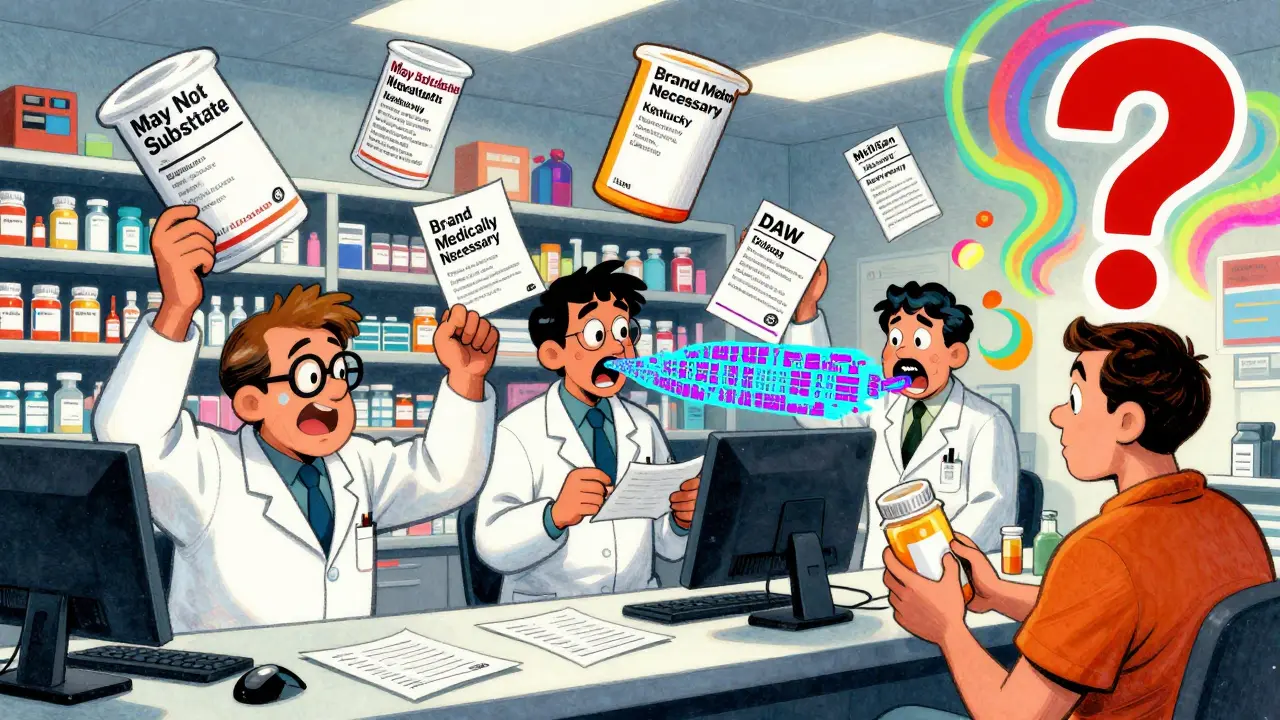
Only 58% of physicians correctly understand their state’s override rules, according to a national survey. That’s not a small number. That’s nearly half of all doctors.Electronic health records (EHRs) are supposed to help. But many EHR templates don’t match state requirements. One 2022 survey found that 41% of physicians said their EHR didn’t have the right fields for their state. So they scribble it in by hand. Then the pharmacy’s system doesn’t read it. Claim denied.
Pharmacists report that 68% of override-related claim rejections come from improper documentation. A handwritten “Brand Medically Necessary” on a paper script works fine. But if that same note is scanned into an e-prescribing system, the software might ignore it. Or misread it. Or drop it entirely.
And then there’s the insurance side. Many plans require prior authorization for any DAW-1 prescription. So even if the doctor does everything right, the patient still waits days for approval. That delay can be dangerous for someone on a critical medication.
How Much Does It Cost?
Prescriber override isn’t free. It’s expensive.On average, a DAW-1 prescription costs 32.7% more than a substituted generic. That adds up. In 2021, one pharmacy benefit manager found that 18.4% of brand-drug spending was avoidable-due to overrides that weren’t medically justified.
Experts estimate that inappropriate overrides contribute to $7.8 billion in unnecessary spending every year. That’s not because doctors are careless. It’s because many don’t realize how little difference there is between a brand and its generic. A 2019 JAMA Internal Medicine study found that physicians often overestimate the clinical impact of minor formulation changes.
For example: a generic levothyroxine has the same active ingredient as Synthroid. The FDA says they’re interchangeable. But if a patient’s thyroid levels were stable on Synthroid, and the doctor switches them to generic without testing, levels can drop. The doctor then sees the problem, assumes the generic is inferior, and overrides every future prescription. That’s not always the right call.
What’s Changing Now?
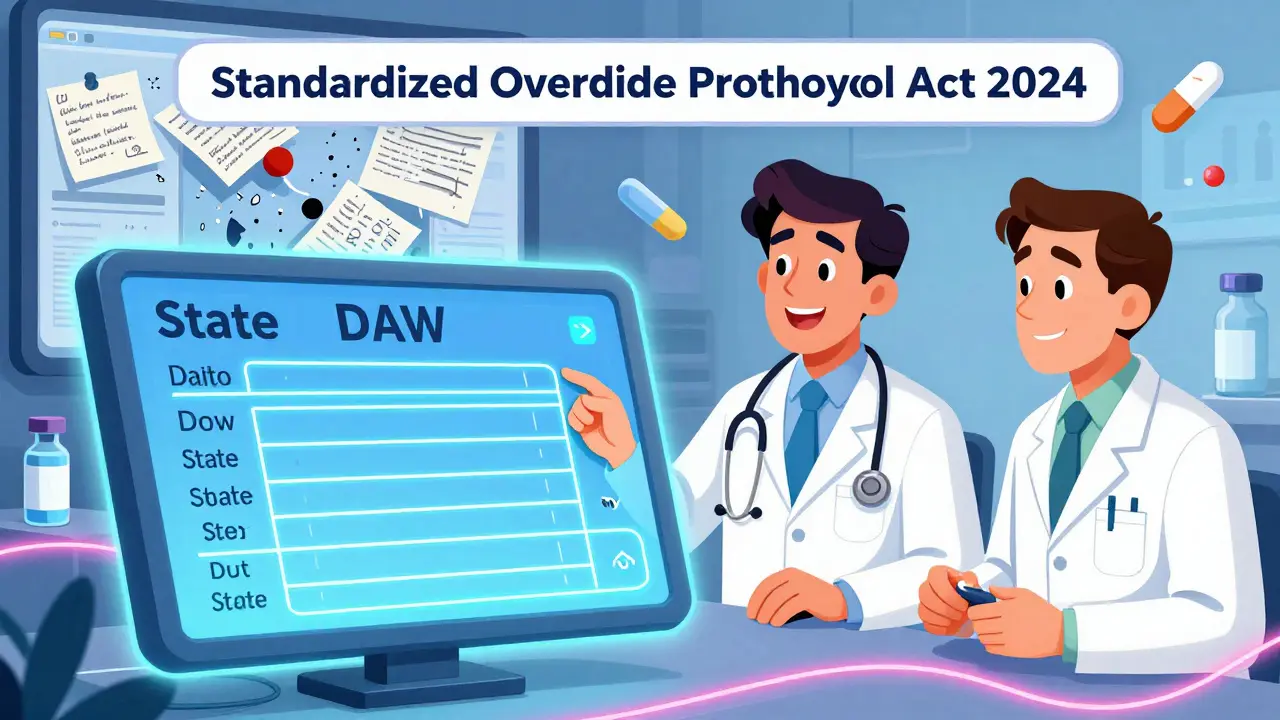
There’s movement to fix this mess.In 2023, Congress introduced the Standardized Prescriber Override Protocol Act. It would create one national standard for how overrides are documented. No more state-by-state confusion. No more handwritten notes that get lost in scanning.
The NCPDP is also updating its e-prescribing standard (SCRIPT 201905) to embed override rules directly into digital prescriptions. By late 2024, when a doctor selects “Do Not Substitute,” the system will auto-fill the correct DAW code based on the patient’s state.
The FDA’s Orange Book is getting updates too. Version 4.0, released in January 2023, now includes biosimilar interchangeability codes. That means future overrides won’t just be for small-molecule drugs-they’ll also apply to complex biologics like insulin and monoclonal antibodies.
What Should Doctors Do?
If you’re a physician, here’s what you need to do:- Know your state’s override rules. Visit the National Association of Boards of Pharmacy’s interactive map-it’s updated quarterly.
- Use your EHR’s override function correctly. Don’t rely on free-text notes. Use the dropdowns, checkboxes, and templates.
- Only override when there’s a documented clinical reason. Don’t do it because “I’ve always done it this way.”
- Document why. If a patient had a bad reaction to a generic, write it down. If they’re allergic to a dye, note the dye.
- Check if your patient’s insurance requires prior authorization for DAW-1. Submit it early.
Clincs that use standardized override templates cut claim rejections by over 60%. That’s not just saving money. It’s saving time. And sometimes, lives.
What Should Pharmacists Do?
Pharmacists are on the front lines. When a DAW-1 prescription comes in:- Verify the DAW code matches state requirements
- Check if the override is for a drug with a narrow therapeutic index
- Call the prescriber if the documentation is unclear
- Don’t assume a handwritten note means “no substitution”-it might be outdated
Pharmacies that train staff on override protocols see fewer medication errors and fewer patient complaints.
What’s Next?
The system is broken-not because doctors or pharmacists are careless, but because it’s a patchwork of 50 different rules. And it’s getting more complex as new drug classes emerge.But change is coming. Standardization. Better EHRs. Clearer guidelines. The goal isn’t to eliminate overrides. It’s to make them work when they matter-and stop them when they don’t.
Because in the end, this isn’t about brand names or generics. It’s about making sure the right drug gets to the right patient-on time, safely, and without unnecessary cost.
Can a pharmacist override a prescriber’s DAW-1 instruction?
No. Once a prescriber uses a valid DAW-1 code and meets state documentation requirements, the pharmacist is legally required to dispense the brand-name drug. Refusing to do so is a violation of state pharmacy law. Even if the insurance denies coverage or the patient prefers the generic, the prescriber’s order takes priority.
Do all generic drugs have the same effectiveness as brand names?
For most drugs, yes. The FDA requires generics to have the same active ingredient, strength, dosage form, and route of administration as the brand. They must also meet strict bioequivalence standards. But for drugs with a narrow therapeutic index-like warfarin, levothyroxine, or phenytoin-small differences in absorption can matter. That’s why overrides exist: to protect patients in high-risk cases.
Why do some states require handwritten override notes?
Many states require handwritten notes because their laws were written before e-prescribing became common. The language in the statute says “written,” so pharmacists and regulators interpret that literally. But as digital systems evolve, states are updating their rules. California, for example, now accepts electronic overrides if they follow specific formatting rules.
Can a patient request a brand-name drug even if the doctor didn’t override?
Yes. That’s called DAW-2: “Substitution Allowed, but Patient Requests Brand.” The patient must explicitly ask for the brand, and the pharmacy must document the request. The patient usually pays the full price difference out-of-pocket unless insurance covers it. This is common for drugs like statins or antidepressants where patients believe the brand works better-even when evidence doesn’t support it.
What happens if a pharmacy dispenses a generic despite a DAW-1 override?
The pharmacy can face disciplinary action from the state board of pharmacy, including fines or license suspension. The patient may suffer harm, leading to liability claims. Insurance may deny payment for the generic, leaving the pharmacy to absorb the cost. In extreme cases, if the substitution caused serious injury, criminal charges could be filed. It’s a high-risk error.
Skilken Awe
February 15, 2026 AT 06:49Let me get this straight - we’ve got a $7.8 billion problem because doctors are too lazy to learn their own state’s 50 different templates? And you’re telling me the FDA’s Orange Book is gospel but EHRs can’t even auto-fill a DAW code? This isn’t healthcare, it’s bureaucratic origami with a side of malpractice. Next they’ll require a notarized affidavit before you can refill your blood thinner. At this point, the only thing more dangerous than the generic is the paperwork.
Steve DESTIVELLE
February 16, 2026 AT 12:18The system is broken not because of incompetence but because we have forgotten that medicine is not a transaction but a relationship between body and knowledge and the state has inserted itself as the silent third party with its codes and its boxes and its scanned illegible handwriting that once was meant to be sacred ink now reduced to pixels that do not understand the weight of a human life
Stephon Devereux
February 18, 2026 AT 06:48This is one of those rare cases where the system actually works - when it’s used right. The real issue isn’t generics vs brands, it’s documentation hygiene. Doctors who treat override rules like a suggestion box are setting up patients for failure. Pharmacists aren’t the enemy - they’re the last line of defense against a patchwork of state laws that make no sense. The fix isn’t more bureaucracy, it’s training. Standardized templates in EHRs. Mandatory continuing ed on DAW codes. And if your EHR doesn’t support it, demand a better one. This isn’t just about cost - it’s about safety. One wrong substitution can kill. Don’t treat it like an administrative footnote.
athmaja biju
February 20, 2026 AT 00:58USA still can't fix a simple system after 40 years? In India, we have one national drug policy - no state-by-state nonsense. If a doctor says no substitution, pharmacy obeys. No scanning errors. No rejected claims. Just clarity. Why does America need 50 different ways to say 'do not substitute'? This is not innovation - this is dysfunction dressed up as federalism. You want efficiency? Centralize. Simplify. Stop letting bureaucracy kill patients one handwritten note at a time.
Reggie McIntyre
February 20, 2026 AT 23:34I love how this post breaks down the real-world chaos - the handwritten notes, the EHR glitches, the insurance delays. It’s like watching a Rube Goldberg machine built by committee. But here’s the beautiful part: we’re fixing it. The SCRIPT 201905 update? The FDA’s new Orange Book? That’s not bureaucracy - that’s progress. Someone finally said 'enough.' The fact that we’re even talking about this means change is coming. It’s slow, messy, and infuriating - but it’s happening. And that’s worth celebrating.
Jack Havard
February 22, 2026 AT 13:54Everyone’s acting like this is about patient safety. But let’s be real - the real reason overrides exist is because Big Pharma bribes doctors to keep prescribing expensive brands under the guise of 'clinical necessity.' The FDA says generics are equivalent. The studies say they’re equivalent. But somehow, every time a patient asks for a cheaper option, the doctor suddenly remembers a 'rare case' from 2007. Coincidence? I think not. The system is rigged. And the 'standardization' they’re pushing? Just another way to lock in brand dominance under the banner of 'safety.'
Gloria Ricky
February 24, 2026 AT 00:48my husband just got his thyroid med switched last month and ended up in the er. we had no idea the pharmacy could swap it even though his doc wrote 'no substitution' - turns out the e-prescription didn't carry the code. now i'm terrified every time he refills. please doctors - if you mean no substitution, make sure it actually goes through. this isn't just paperwork - it's life or death.
Stacie Willhite
February 25, 2026 AT 06:46Reading this made me think of my mom. She’s been on levothyroxine for 15 years. We switched to generic because of cost - and her anxiety skyrocketed. No one told us to monitor levels. No one warned us about absorption differences. We thought 'FDA-approved' meant 'identical.' It didn’t. Now she’s back on brand, and yes, it’s expensive. But she’s sleeping again. I get why overrides exist. It’s not about trust in pharma. It’s about trust in the body’s response. And sometimes, that’s more personal than any study can capture.
Jason Pascoe
February 27, 2026 AT 04:42Great breakdown. I’m a pharmacist in rural Australia - we don’t have this mess here. One national code, one system. But I’ve worked with U.S. pharmacies before, and yeah, the state-by-state chaos is insane. The real win here is the digital standardization. When the system auto-fills the correct DAW code based on location? That’s not just efficiency - that’s dignity. Patients shouldn’t have to fight just to get their meds. Simple, smart fixes are possible. We just need to stop treating compliance like an afterthought.
Sonja Stoces
February 28, 2026 AT 01:38LOL at the 'standardized protocol act'. Like that’s going to fix anything. You think the FDA cares about patient safety? They approved generics that caused strokes. They know the data is shaky. They’re just saving money. And now they want to make it *easier* to override? That’s not reform - that’s surrender. Next they’ll add a 'Brand Only' checkbox and call it 'patient choice'. Meanwhile, the real solution - price controls on brand drugs - is being ignored. This whole thing is a distraction. Stop pretending this is about safety. It’s about profit.