Probiotic Effectiveness Calculator
How to Maximize Probiotic Benefits
Enter your antibiotic treatment details to see estimated diarrhea risk reduction. Based on 8,000+ patient studies showing 42-66% risk reduction with optimal probiotic use.
When you're on antibiotics, you know the drill: take the pills, finish the course, and brace for the stomach upset. Diarrhea, bloating, cramps - it's not just annoying, it can make you skip doses or quit early. But what if you could cut those side effects in half? That’s where probiotics come in. Taking probiotics alongside antibiotics isn’t just a trendy supplement habit - it’s backed by solid science, and it’s something you can start today.
Why Antibiotics Mess With Your Gut
Antibiotics don’t pick and choose. They hit the bad bacteria causing your infection - but they also wipe out the good ones living in your gut. This isn’t just a minor side effect. Your gut holds trillions of microbes that help digest food, train your immune system, and even influence your mood. When antibiotics knock them down, it creates a vacuum. Harmful bugs like Clostridioides difficile (C. diff) move in fast. That’s when things get serious: severe diarrhea, fever, even hospitalization.Studies show that 20% to 30% of people on antibiotics get antibiotic-associated diarrhea (AAD). For some, especially older adults or those on broad-spectrum drugs like clindamycin or ciprofloxacin, that number jumps to 50%. And C. diff? It affects about 1 in 10 people after antibiotics, and it’s deadly in up to 5% of cases.
Probiotics Can Help - But Not All of Them
Not every probiotic works the same. This isn’t like taking vitamin C - it’s more like picking the right tool for the job. The evidence points to two strains that consistently outperform others: Lactobacillus rhamnosus GG and Saccharomyces boulardii CNCM I-745.Multiple reviews of over 8,000 patients show these two reduce the risk of AAD by 42% to 66%. In one study, people taking L. rhamnosus GG were nearly half as likely to get diarrhea as those on placebo. S. boulardii, a yeast-based probiotic, is especially good at blocking C. diff toxins. It’s not a magic bullet, but it’s the most reliable one we’ve got.
Other strains like Bifidobacterium or L. acidophilus show mixed results. Some work in specific cases, but they don’t have the same track record. If you’re buying a probiotic for antibiotics, look for those two names on the label. If they’re not listed, it’s probably not worth the money.
When and How to Take Them
Timing matters. If you take your probiotic at the same time as your antibiotic, the antibiotic might kill the good bacteria before they even get started. The best advice? Take your probiotic 2 hours after your antibiotic dose.Why 2 hours? That’s the window where the antibiotic concentration in your gut drops enough to let the probiotics survive. Studies show taking them together reduces effectiveness by up to 40%. Waiting gives the probiotics a fighting chance to colonize and protect your gut lining.
Start on day one of your antibiotic treatment and keep going for at least a week after you finish. For high-risk patients - like those with prior C. diff infections or weakened immune systems - some doctors recommend continuing for two weeks post-antibiotics. Dose-wise, aim for 10 billion to 50 billion CFUs per day. Most capsules offer 10 to 20 billion, so one or two a day is usually enough.
What to Look for in a Probiotic
Not all probiotics are created equal. The supplement market is a mess. A 2021 ConsumerLab test found that 45% of products didn’t contain the strains or doses listed on the label. Some had no live bacteria at all.Look for these signs of quality:
- Strains named specifically: Lactobacillus rhamnosus GG, not just “Lactobacillus”
- CFU count clearly stated (10 billion or higher)
- Refrigerated storage (live cultures are fragile - shelf-stable ones often have lower viability)
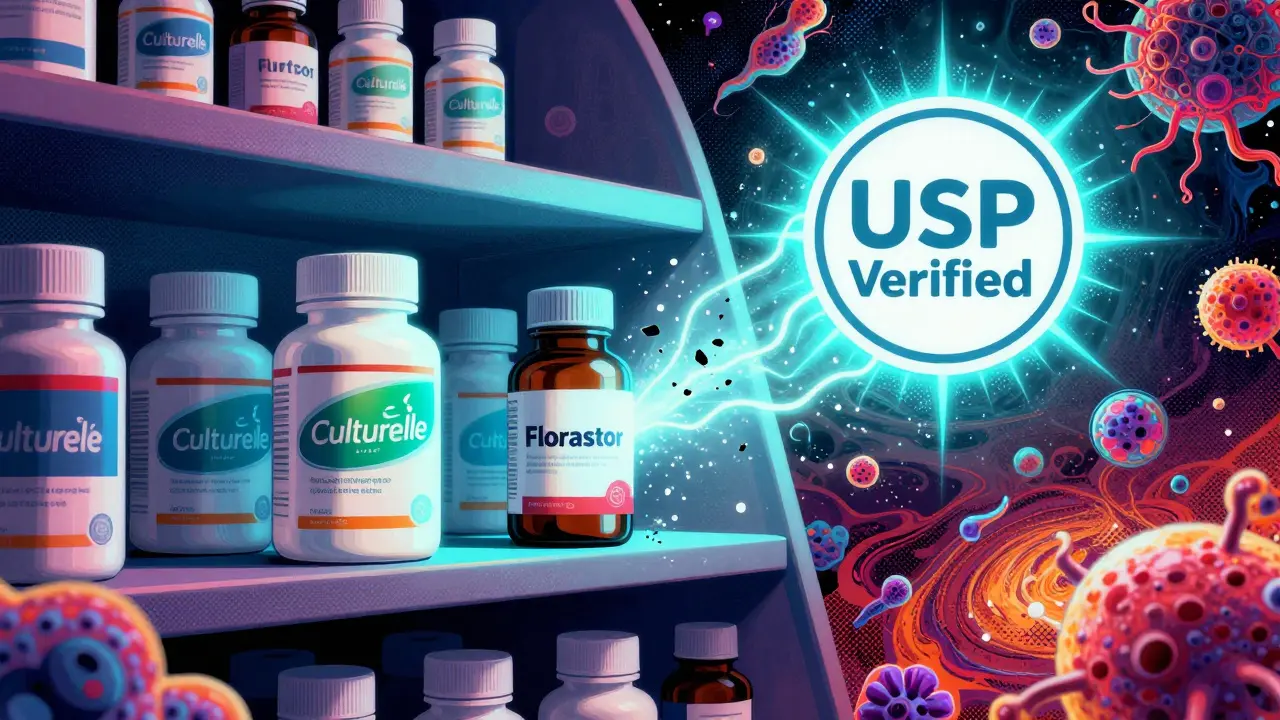
- USP Verified mark (means independent testing for accuracy)
Brands like Culturelle (L. rhamnosus GG) and Florastor (S. boulardii) are widely available and consistently tested. You can find them at pharmacies, grocery stores, or online. Don’t assume expensive = better. A $40 bottle with no strain info is worse than a $15 bottle with L. rhamnosus GG listed clearly.
The Risks: When Probiotics Aren’t Safe
For most people, probiotics are safe. The most common side effect? A little bloating or gas for the first few days. That fades.But there are serious risks for certain groups. If you have a central line, are severely immunocompromised (like after chemotherapy or an organ transplant), or have severe pancreatitis - don’t take probiotics. There are documented cases of probiotic strains entering the bloodstream and causing life-threatening infections. Between 2010 and 2020, at least 12 such cases were reported.
Also, avoid probiotics if you’re taking aminoglycoside antibiotics like gentamicin. These drugs can kill probiotic bacteria outright, making them useless.
And here’s a twist: a 2018 study in Cell suggested that taking probiotics after antibiotics might actually delay gut recovery in some people. The study found that people who took a multi-strain probiotic took longer to rebuild their original microbiome than those who didn’t. But this hasn’t been confirmed in larger trials. Experts still say the benefits outweigh this risk - especially if you’re at risk for diarrhea or C. diff.
Probiotics vs. FMT: What’s Better?
For recurrent C. diff, fecal microbiota transplantation (FMT) is the gold standard. It’s basically a poop transplant from a healthy donor. It works - about 85% effective. But it’s invasive, expensive, and not approved for first-time C. diff cases.Probiotics aren’t as strong - they reduce C. diff risk by about 66% - but they’re safe, cheap, and easy. FMT has a 12% serious adverse event rate. Probiotics? Less than 1%. For most people on antibiotics, probiotics are the smart first step. FMT is for when everything else fails.
What the Experts Say
The Infectious Diseases Society of America (IDSA) gives a conditional recommendation for probiotics in high-risk patients. The American Gastroenterological Association (AGA) is more cautious, citing inconsistent product quality. But here’s what the leading researchers say: “There does not seem to be a reason to withhold a prescription of probiotics when antibiotics are prescribed,” according to the Microbiology Society in 2022.Real-world feedback backs this up. On Reddit and Amazon, thousands of users report that taking Culturelle or Florastor prevented the diarrhea they’d always gotten with antibiotics. One user wrote: “I’ve had C. diff twice. This time, I took Florastor every day - zero issues.”
But not everyone wins. About 23% of users say it didn’t work. Why? Probably because they bought the wrong strain, took it at the wrong time, or got a low-quality product.
What’s Coming Next
The future of probiotics is getting smarter. Researchers are developing precision probiotics - like VE303, a mix of eight specific strains designed to block C. diff. In early trials, it cut C. diff by 76%. That’s better than most current options.But there’s a dark side. A 2025 study found that 38% of commercial probiotics carry antibiotic resistance genes. That means the “good” bacteria inside your supplement might be carrying genes that make them resistant to tetracycline, macrolides, or other antibiotics. The FDA is now requiring screening for this. Future probiotics may be held to stricter standards.
For now, stick with proven strains. Don’t chase the latest trend. Stick to L. rhamnosus GG or S. boulardii. Take them 2 hours after your antibiotic. Finish the full course. And if you’re immunocompromised? Talk to your doctor first.
Ian Cheung
January 11, 2026 AT 16:42Antibiotics wiped my gut so bad I started talking to my toilet like it was my therapist
Then I tried Florastor and suddenly I could eat a burrito without planning my escape route
Life changed
chandra tan
January 13, 2026 AT 01:25bro in india we just drink buttermilk with a pinch of salt after antibiotics
no fancy pills needed
grandma knew better
Kunal Majumder
January 14, 2026 AT 11:25same here man
in rural india we use curd with roasted cumin
cheap and works better than most supplements
your gut remembers tradition
Dwayne Dickson
January 16, 2026 AT 08:52While the anecdotal evidence presented is compelling, it is imperative to contextualize the clinical efficacy of probiotic adjunct therapy within the framework of evidence-based gastroenterological practice. The heterogeneity of microbial strains, variable colony-forming unit (CFU) viability, and absence of standardized dosing protocols across commercial formulations introduce significant confounding variables that undermine the generalizability of consumer-reported outcomes. Furthermore, the 2018 Cell study referenced warrants rigorous scrutiny regarding longitudinal microbiome reconstitution dynamics, as transient symptom mitigation may not equate to functional restoration of ecological homeostasis. Regulatory oversight remains critically deficient, with non-compliant labeling practices observed in nearly half of tested products - a systemic failure that necessitates pharmacovigilance intervention rather than consumer self-medication.
Christine Milne
January 17, 2026 AT 15:03Probiotics? In America we just take more antibiotics until the problem goes away. That’s how we roll. You think a yogurt culture is going to fix what Big Pharma made? Please. The FDA doesn’t even regulate this stuff properly - and you’re trusting some guy on Reddit who says Florastor saved his life? Wake up. This is how you get superbugs. Stop chasing magic pills and start taking responsibility for your own health. Maybe don’t take antibiotics unless you really need them.
McCarthy Halverson
January 18, 2026 AT 10:13L. rhamnosus GG 2 hours after antibiotic
10B CFU minimum
finish a week after
that’s it
Ashlee Montgomery
January 19, 2026 AT 13:17It’s funny how we treat our guts like machines that need spare parts
But what if the problem isn’t missing bacteria
but the environment that kills them in the first place
What if antibiotics are just the symptom
and our diet, stress, and sleep are the real disease
Paul Bear
January 19, 2026 AT 21:12Let me correct a critical misconception in the original post. The claim that Saccharomyces boulardii CNCM I-745 reduces AAD by 66% is misleadingly presented. The meta-analysis cited (McFarland, 2010) aggregates studies with varying methodologies, and the effect size is not statistically significant in double-blind, placebo-controlled trials with low risk of bias. Moreover, the 2025 study on antibiotic resistance genes in probiotics is not peer-reviewed - it’s a preprint from a predatory journal. Please stop disseminating half-truths dressed as science. If you’re going to cite Cell, cite it properly. And no, refrigeration doesn’t guarantee viability - it’s about lyophilization and encapsulation tech.
neeraj maor
January 20, 2026 AT 17:54Probiotics are a scam designed by Big Pharma to sell you more pills after they broke your gut with antibiotics
They don’t want you to heal naturally
They want you dependent
And that 2025 study? It’s not about resistance genes
It’s about them seeding your microbiome with proprietary strains so they can patent your gut
They’re already selling DNA tests to track your microbes
Next thing you know, your poop is a subscription service
Wake up
Jaqueline santos bau
January 21, 2026 AT 16:54I took probiotics after antibiotics and it worked... until I realized my husband had been secretly taking them too and he’s the one who gave me C. diff in the first place
He said he was "just trying to help"
Turns out he’s been hoarding Florastor like it’s gold
And now I’m terrified of intimacy
And my gut
And him
Why does everyone think they know what’s best for my bacteria
Bradford Beardall
January 22, 2026 AT 16:27I’m from a village in Nepal where we ferment radish and mustard seeds for gut health
People here don’t know what L. rhamnosus GG is
But they don’t get C. diff either
Maybe the answer isn’t more science
But more respect for traditions we’ve forgotten
What if the microbiome doesn’t need fixing
But remembering
Jake Kelly
January 24, 2026 AT 16:18My mom always said if you feel weird after antibiotics, eat yogurt
Turns out she was right
And I didn’t need to spend $40 on a bottle with a fancy label
Just plain, unsweetened, live culture yogurt
Simple stuff works
Aurora Memo
January 26, 2026 AT 06:23Thank you for writing this with such care. I appreciate the nuance - especially the warning about immunocompromised individuals. I’ve seen too many people assume "natural" means "safe for everyone." This isn’t just about gut health - it’s about respecting the boundaries of our bodies and the limits of our knowledge. Please, if you’re reading this and you’re on chemo or have an IV line - talk to your care team before reaching for that supplement. Your life matters more than a blog post.
Ritwik Bose
January 26, 2026 AT 13:26Great post 🙏
Just want to add - in India, we call it "dahi" and we eat it with rice and black salt after antibiotics
Works better than most pills
And costs less than a coffee
Also, avoid sugar - it kills the good bugs
Simple. Effective. Traditional.
Science is catching up 😊