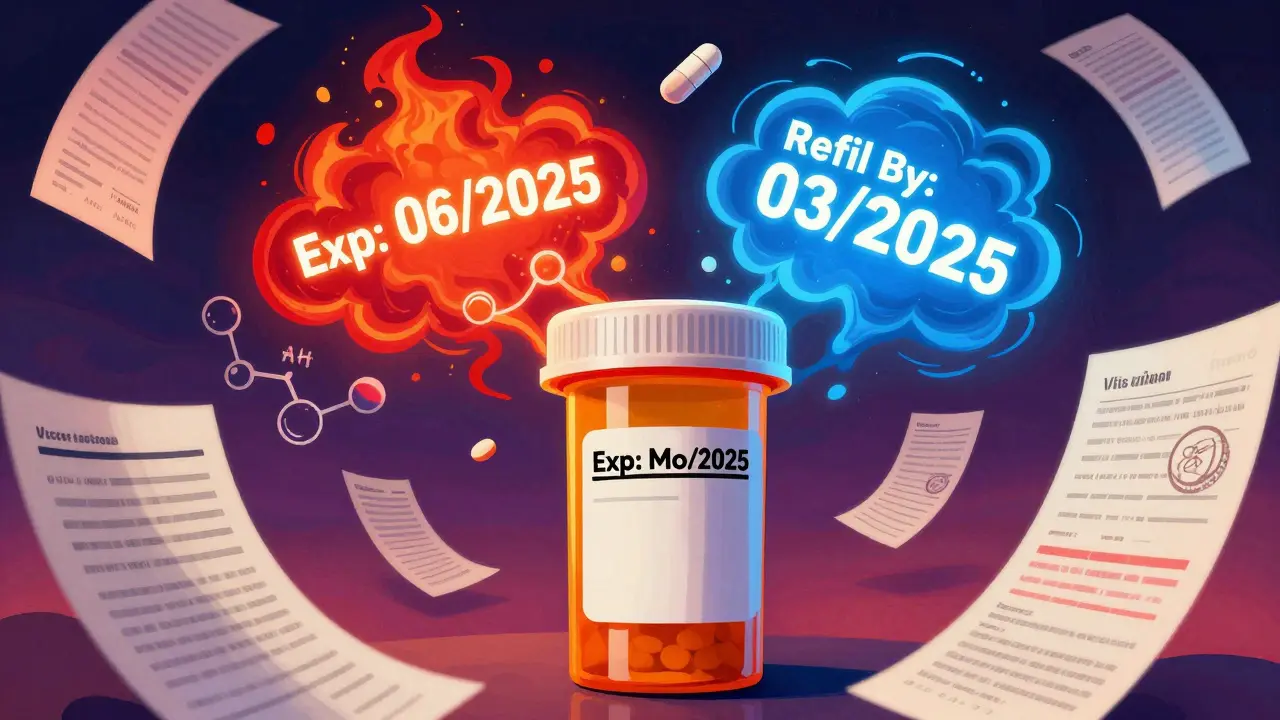
Ever looked at your prescription bottle and wondered why there are two dates? One says "Exp: 06/2025" and another says "Refill By: 03/2025"? You’re not alone. Most people assume they’re the same thing - that once the refill date passes, the medicine is no good. But that’s not true. And mixing them up could cost you money, disrupt your treatment, or even put your health at risk.
What’s the Difference?
The expiration date tells you when the medicine might stop working the way it should. It’s based on science. The drug manufacturer tests how long the pill, liquid, or injection stays stable under normal conditions - like room temperature, away from moisture and sunlight. After that date, they can’t guarantee it’s still safe or effective. The FDA requires this date to be printed on every prescription bottle.
The refill-by date (also called refill-through date) has nothing to do with how strong the medicine is. It’s an administrative rule. It tells you the last day your pharmacy can legally give you more refills without your doctor signing off again. After that, you need a new prescription.
Think of it this way: The expiration date is about the medicine itself. The refill-by date is about the paperwork.
Why Do Both Exist?
These dates came from federal law - specifically the Omnibus Budget Reconciliation Act of 1990 (OBRA '90). Back then, pharmacies were filling prescriptions without clear rules. Patients would get the same drug for years without check-ins. Doctors couldn’t track if it was still needed. So Congress stepped in. The goal? Keep people safe and make sure prescriptions aren’t being used long after they’re necessary.
Today, every pharmacy in the U.S. must follow the same rules. The National Association of Boards of Pharmacy (NABP) sets the standards, and state boards enforce them. That means whether you’re in Portland, Oregon, or Portland, Maine, your label will look the same.
Expiration Date: When It’s Real, When It’s Not
The FDA says you shouldn’t use medicine after its expiration date. But here’s the twist: many drugs stay effective way longer. A 2022 FDA study found that 88% of medications kept their strength even years past the printed date - if stored properly.
So why do pharmacies still say "don’t use it"?
Because they’re legally required to. Pharmacists can’t dispense expired medicine, even if it’s perfectly fine. If a patient takes an old pill and has a bad reaction, the pharmacy could be held liable. So they follow the letter of the law. It’s not about science - it’s about risk.
That’s why you’ll often see two expiration dates on your bottle:
- The manufacturer’s date (from the original bottle)
- The pharmacy’s date (usually one year from when you picked it up)
For most pills, the pharmacy sets the expiration at one year. For insulin, eye drops, or anything that needs refrigeration? Often just 30 days. That’s because those drugs break down faster once opened.
Refill-By Date: The Real Reason You Can’t Get More
This is where most confusion happens. You’ve got 3 refills left. But the bottle says "Refill By: 03/2025". You try to refill in April - and the pharmacy says no. Why?
Because federal law limits how long a prescription can be refilled without a new order. For most drugs, it’s one year. For controlled substances like opioids or ADHD meds? Only six months. And some states are stricter. California lets you refill for 12 months. New York cuts it to 6 for certain drugs.
Here’s the kicker: Your insurance might have its own rules. Medicare Part D, for example, sometimes only allows refills every 30 days - even if your doctor wrote a 90-day supply. That means you could have refills left, but your plan won’t pay for them until the next cycle.
A 2023 survey found that 23.7% of Medicare users had their treatment interrupted because they didn’t refill before the refill-by date passed. That’s not because the medicine was expired. It’s because they didn’t realize they needed a new prescription.
What Happens When You Mix Them Up?
People do this all the time.
One Reddit user, "MedTech2020," threw out $300 worth of insulin because the refill-by date had passed. The insulin wasn’t expired - it was still perfectly good. But they thought the refill date meant "stop using."
Consumer Reports surveyed over 1,200 people. Over half couldn’t tell the difference between the two dates. Nearly 30% admitted they’d thrown away medicine they didn’t need to.
On the flip side, some people keep taking pills past the expiration date. That’s risky. Especially with antibiotics, heart meds, or insulin. Even if the pill looks fine, its strength may have dropped. You might not feel it - but your body might.
Pharmacy Times found that 68.3% of medication errors linked to date confusion happen because patients think one date controls the other.
How to Avoid Mistakes
Here’s how to stay on top of both dates:
- Check both dates every time. Write them down in your phone or a notebook. Don’t assume.
- Set a reminder 7 days before the refill-by date. That gives you time to call your doctor if needed. Renewals can take 2-3 business days.
- Don’t use medicine past the expiration date. Especially if it’s changed color, smells weird, or looks different.
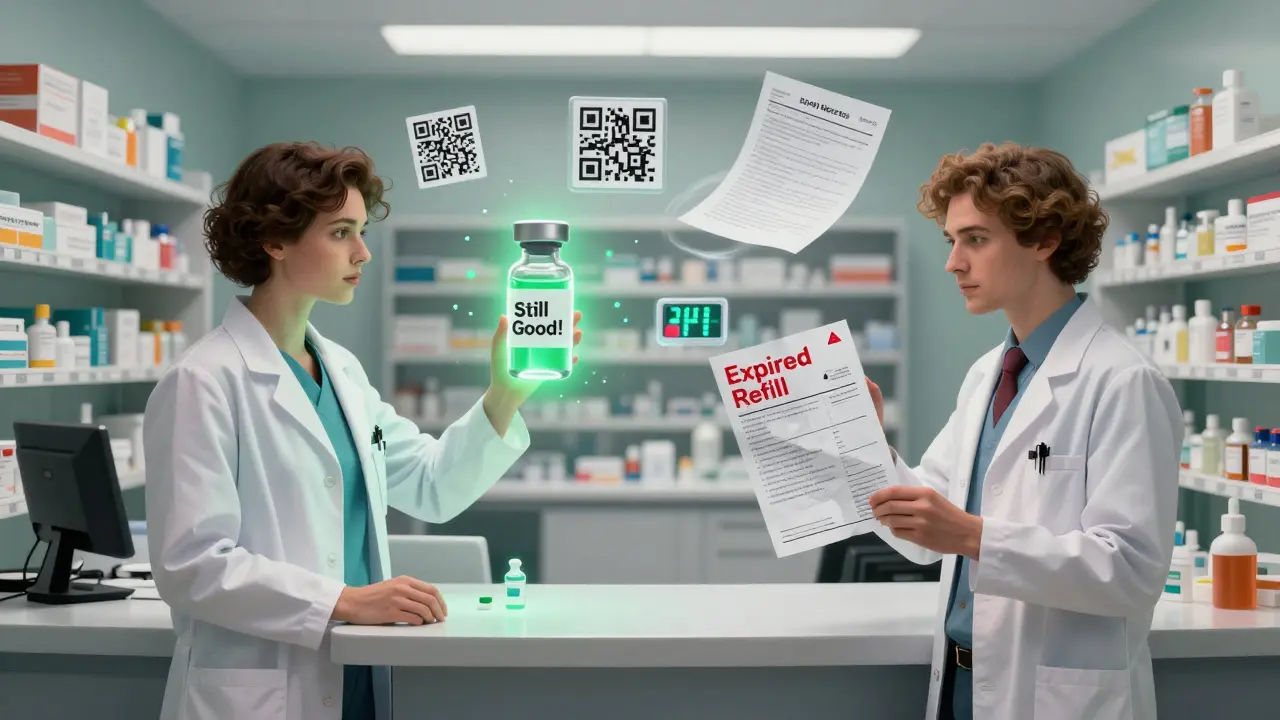
- Ask your pharmacist. They see this every day. A quick "Is this still good?" can save you a trip to the ER.
- Use your pharmacy’s app. CVS, Walgreens, and others now show both dates clearly in their apps - and even send alerts.
Patients who track both dates separately reduce medication gaps by over 60%, according to the American Pharmacists Association.
What’s Changing?
Pharmacies are starting to fix this confusion.
CVS and Walgreens now use color-coded labels: red for expiration (safety), blue for refill-by (admin). Some stores even put QR codes on bottles. Scan it, and a short video explains the difference.
By 2025, most prescriptions will have digital labels you can access via smartphone. Some systems will even show you a countdown to your next refill and warn you if your medicine is nearing expiration.
The FDA is pushing for clearer wording on labels - replacing "Refill By" with "Last Fill Date" to make it obvious it’s not about safety.
It’s not perfect yet. But progress is happening.
Bottom Line
Expiration date = medicine’s shelf life. Refill-by date = paperwork deadline.
One tells you if the pill still works. The other tells you if you’re allowed to get more.
Don’t let one confuse you into throwing out the other. Keep both dates clear in your head. Set reminders. Ask questions. And never assume.
Your health depends on it - not on a label you didn’t read.
Can I still take my medicine after the refill-by date if it hasn’t expired?
Yes - if the expiration date hasn’t passed and you still have refills left, the medicine is safe to take. But you won’t be able to get more refills from the pharmacy without a new prescription. The refill-by date only controls how long you can refill the script - not whether the medicine itself is still good.
Why does my pharmacy say I can’t refill my prescription even though I have refills left?
Because the refill-by date has passed. Even if your prescription says "3 refills," the law limits how long those refills are valid - usually one year from the original fill date. After that, your doctor must approve a new prescription. This isn’t about the medicine running out - it’s about legal authorization.
Is it dangerous to use medicine after the expiration date?
It’s not always dangerous, but it’s risky. Some drugs, like insulin, antibiotics, or heart medications, can lose potency over time. Taking a weakened dose might not work, or worse - it could lead to complications like antibiotic resistance or uncontrolled blood pressure. The FDA advises against using expired medicine because you can’t be sure it’s still effective.
Do all pharmacies follow the same refill-by rules?
Most do - but state laws vary. For non-controlled drugs, most states allow one-year refill periods. For controlled substances (like opioids or ADHD meds), federal law limits it to six months. Some states, like New York, make it even shorter for certain drugs. Always check with your pharmacist if you’re unsure.
What should I do if my refill-by date passed but I still need the medicine?
Call your doctor. Most doctors can approve a new prescription over the phone or through an online portal. If it’s a chronic condition like high blood pressure or diabetes, they often renew it without an office visit. Don’t wait until you’re out - plan ahead. Many pharmacies offer automatic refill reminders you can sign up for.
Digital Raju Yadav
February 18, 2026 AT 00:16Let me get this straight-Americans are too lazy to read two damn dates and now we’re blaming the system? In India, we’ve been managing expiry dates since the 1980s without apps, QR codes, or color-coded labels. This isn’t a pharmacy problem-it’s a cognitive laziness epidemic. Stop outsourcing your brain to CVS and learn to think.
Carrie Schluckbier
February 19, 2026 AT 09:18Did you know the FDA and Big Pharma are in cahoots? The real reason they push expiration dates isn’t safety-it’s profit. They want you to buy new bottles every 30 days so you keep paying. The ‘refill-by’ date? That’s a trap. They know you’ll panic and buy more. Wake up. The truth is hidden in plain sight.
Liam Earney
February 21, 2026 AT 02:20Oh, I see… so the expiration date is scientific, and the refill-by date is administrative… but wait-doesn’t that mean we’re living in a bureaucratic paradox? The medicine is perfectly fine, yet the system forces us to abandon it? And why does the government get to decide when our bodies can or can’t absorb a pill? I mean… if the drug is chemically stable, why is our autonomy being mediated by a piece of paper? It’s almost… Orwellian. I’m not angry. I’m just… deeply unsettled.
Geoff Forbes
February 22, 2026 AT 12:15Actually, the FDA’s 2022 study is deeply flawed-it didn’t account for degradation pathways in polypharmacy patients. And let’s not forget that stability testing is done under idealized conditions, not real-world humidity fluctuations in Midwestern basements. Also, ‘refill-by’ is a misnomer-it should be ‘authorization cutoff,’ but the NABP won’t fix terminology because they’re too busy lobbying for Medicare reimbursement loopholes. You’re all missing the structural issue.
Logan Hawker
February 23, 2026 AT 21:41Look, I get it-people are confused. But let’s be real: the system is designed to protect pharmacies from liability, not to educate patients. The fact that 23% of Medicare users had treatment gaps because they didn’t refill on time? That’s not ignorance-it’s a failure of design. Why not auto-renew prescriptions via EHR? Why not sync with Apple Health? Why do we still rely on paper labels in 2025? We’re treating patients like 1995-era consumers. Pathetic.
guy greenfeld
February 24, 2026 AT 00:55What if… the dates aren’t really about medicine at all? What if they’re symbolic? The expiration date = mortality. The refill-by date = control. We’re not just managing pills-we’re managing our fear of death, our dependence on institutions, our surrender to systems that say ‘you can’t have this anymore unless someone signs a form.’ I think we’ve lost something deeper here. Not just access to medication… but autonomy.
Adam Short
February 24, 2026 AT 07:57THIS IS WHY BRITAIN IS BETTER. We don’t have this nonsense. Our NHS prints ONE clear date: ‘Use By.’ No ‘refill-by.’ No color codes. No apps. Just a simple label and a pharmacist who actually talks to you. You want to know why Americans are so anxious? It’s because they’ve outsourced their healthcare to corporate jargon. We don’t need QR codes-we need human beings.
Steph Carr
February 24, 2026 AT 18:03So… you’re telling me I paid $120 for a 90-day supply of metformin, got three refills, but the pharmacy won’t give me the fourth because the refill-by date passed… even though the bottle says it’s good until 2027? And my insurance won’t cover it until next month? And now I have to wait three days for my doctor to approve a new script? That’s not healthcare. That’s a sitcom written by a bureaucrat with a vendetta against human beings. I love my meds. I hate my system.
Brenda K. Wolfgram Moore
February 26, 2026 AT 16:35Thank you for writing this. I’ve been managing diabetes for 12 years, and I’ve had so many people tell me, ‘Oh, your insulin is expired-just toss it.’ No. It’s not expired. The refill-by date passed. I called my doctor, got a new script, and kept using it. I saved $400 last year by not throwing away medicine. Please-don’t assume. Ask. Double-check. Your body deserves better than guesswork.
Agnes Miller
February 28, 2026 AT 00:27Just a heads up-some pharmacies use ‘Refill By’ to mean ‘last day to refill with insurance,’ not the legal cutoff. Check your plan’s formulary. Medicare Part D sometimes blocks refills 10 days before the date. Also-eye drops? Yeah, toss them after 30 days. Once opened, they grow bacteria. Don’t risk your vision over a label.
John Haberstroh
February 28, 2026 AT 17:38So the medicine’s still good, but the paperwork says ‘nope.’ That’s like being told you can’t drive your car because your license expired-even though the engine’s fine and you’re a great driver. I’m not mad. I’m just… weirdly fascinated by how we’ve turned survival into a formality. The system didn’t evolve to help us. It evolved to protect itself. And somehow, we’re the ones who get blamed for not reading the fine print.
James Lloyd
March 1, 2026 AT 17:51Correction: The FDA’s 2022 study tested only solid oral dosage forms-tablets and capsules. Liquid, injectable, and topical formulations degrade differently. Insulin, epinephrine, nitroglycerin-these are NOT stable past expiration. Also, ‘refill-by’ is federally mandated as one year for non-controlled substances under OBRA ‘90. State laws can’t override that. The confusion comes from pharmacies using their own expiration dates (1 year from fill) to simplify inventory. That’s not the law-that’s a convenience. Read the fine print on your prescription receipt.
Sam Pearlman
March 1, 2026 AT 18:05Wait, so you’re telling me I could’ve kept taking my blood pressure med for another 2 years because it’s still good… but the pharmacy won’t give me more? That’s not a system. That’s a glitch. I’m not mad-I’m just confused. Why does this even exist? Who thought this was a good idea? And why are we still using paper labels? This feels like a joke… but I’m not laughing.