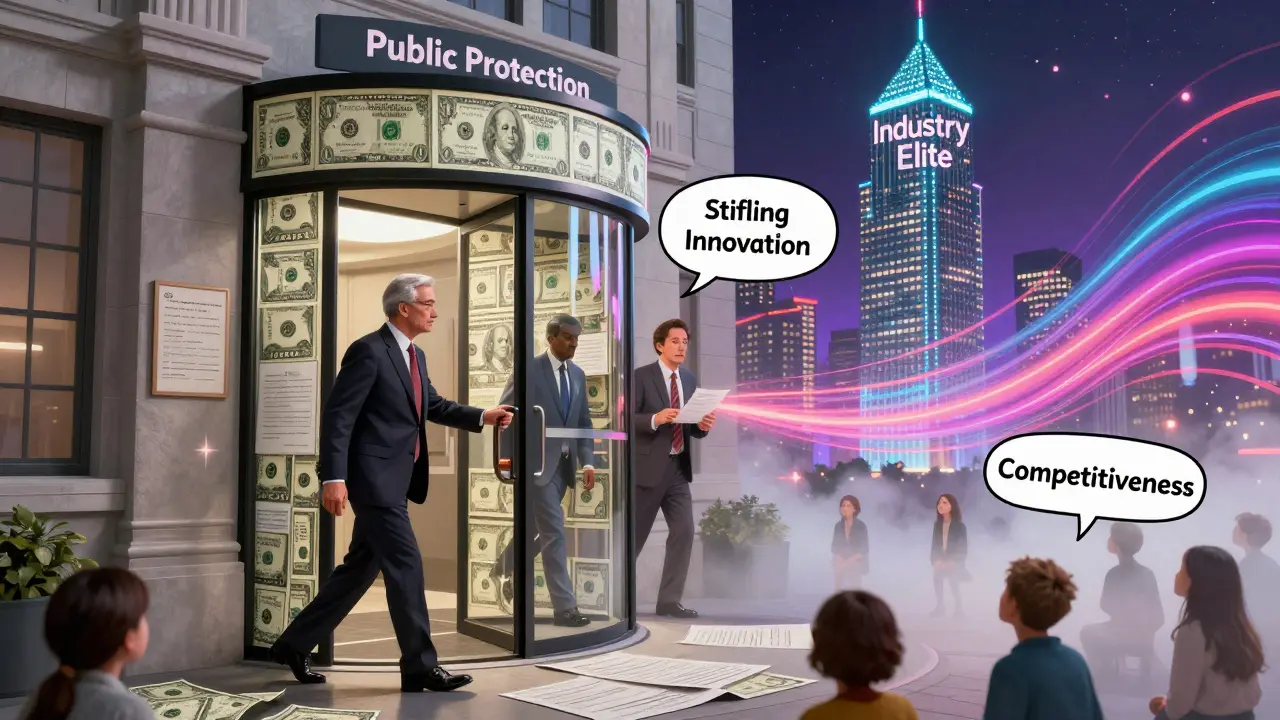
What Is Regulatory Capture?
Regulatory capture happens when the agencies meant to protect the public end up serving the industries they’re supposed to regulate. It’s not always about bribery or corruption. Often, it’s quieter-like when a regulator leaves the government to work for a company they once oversaw, or when the agency starts relying too much on data provided by the industry itself. The result? Rules get softened, enforcement gets delayed, and the public pays the price.
George Stigler first described this in 1971, pointing out that industries don’t just accept regulation-they learn how to shape it. Today, that’s more true than ever. A 2023 Pew Research survey found that 78% of Americans are seriously worried about this kind of influence. And it’s not just a feeling. Data shows it’s happening in finance, energy, pharmaceuticals, and even aviation.
The Two Main Ways Capture Happens
There are two big ways regulators get pulled into serving industry interests: materialist capture and cultural capture.
Materialist capture is about money and power. Think revolving doors: officials leave government jobs to join the companies they regulated. Between 2008 and 2018, 53% of senior Defense Department officials went straight into the defense industry. The same pattern shows up at the SEC-87% of its staff had ties to Wall Street firms they were supposed to monitor. Political donations and funding pressure play a role too. Agencies that depend on industry-funded budgets or lobbying cash are less likely to crack down.
Cultural capture is subtler. It’s when regulators start thinking like the people they’re supposed to be watching. After years of meetings, technical briefings, and shared jargon, they begin to see the industry’s side. They worry about "stifling innovation" or "hurting competitiveness." They don’t see themselves as enemies of business-they see themselves as partners. That shift in mindset leads to weaker enforcement. A 2021 study found agencies with formal industry advisory committees were 3.7 times more likely to adopt rules that favored business over public safety.
Real-World Examples You’ve Probably Heard Of
The Interstate Commerce Commission was created in 1887 to stop railroads from exploiting farmers and small shippers. But by 1900, it was hiking rates at the railroads’ request. The regulators didn’t become corrupt-they became aligned.
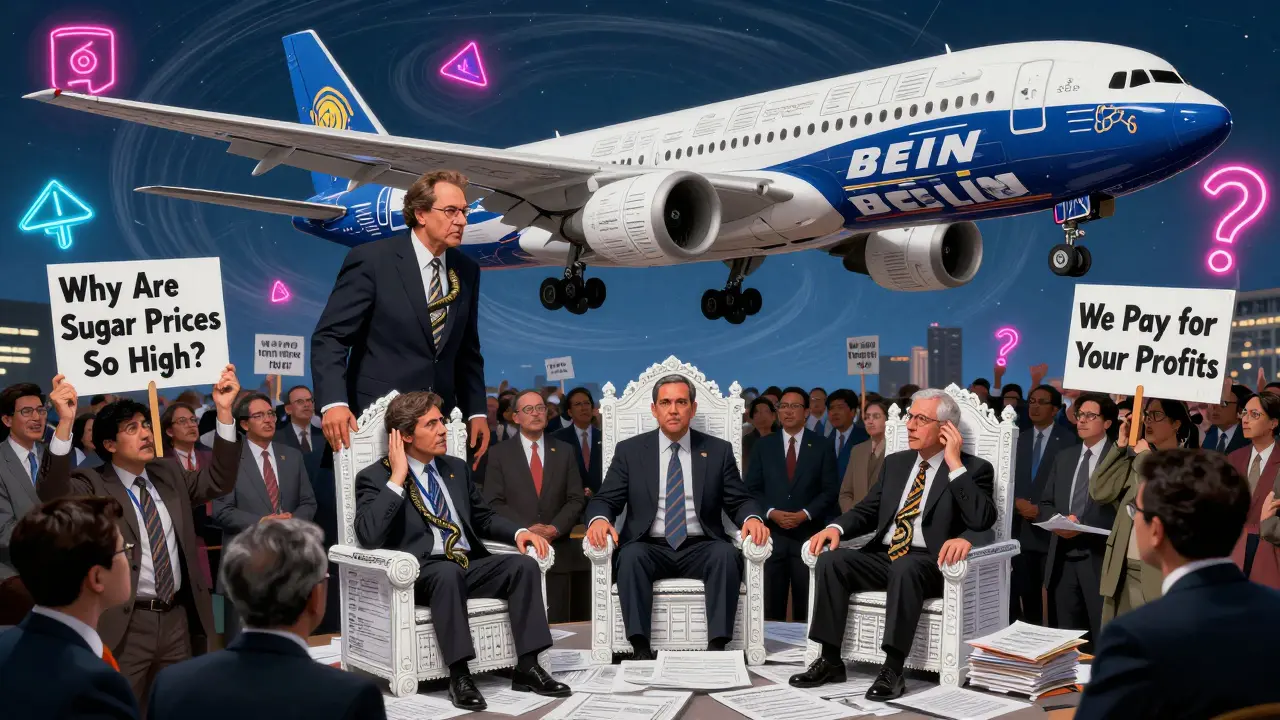
The FAA’s handling of the Boeing 737 MAX is a modern example. Instead of doing its own safety checks, the FAA delegated 96% of certification work to Boeing employees. When crashes happened, it wasn’t because of bad design alone-it was because the system that was supposed to catch flaws had become part of the company’s team.
In the UK, HM Revenue and Customs secretly gave over 1,800 multinational corporations tax deals averaging £427 million each, while publicly claiming a 19% corporate tax rate. Consumers and small businesses paid more. The big ones? They got a pass.
And then there’s sugar. U.S. tariffs keep sugar prices three times higher than global market rates. That costs every American household about $33 a year. It sounds small-but multiply that by 130 million households, and you get $3.9 billion. Meanwhile, just 4,318 sugar producers pocket $4 billion extra annually. The public pays a little. A few companies profit a lot. That’s classic regulatory capture.
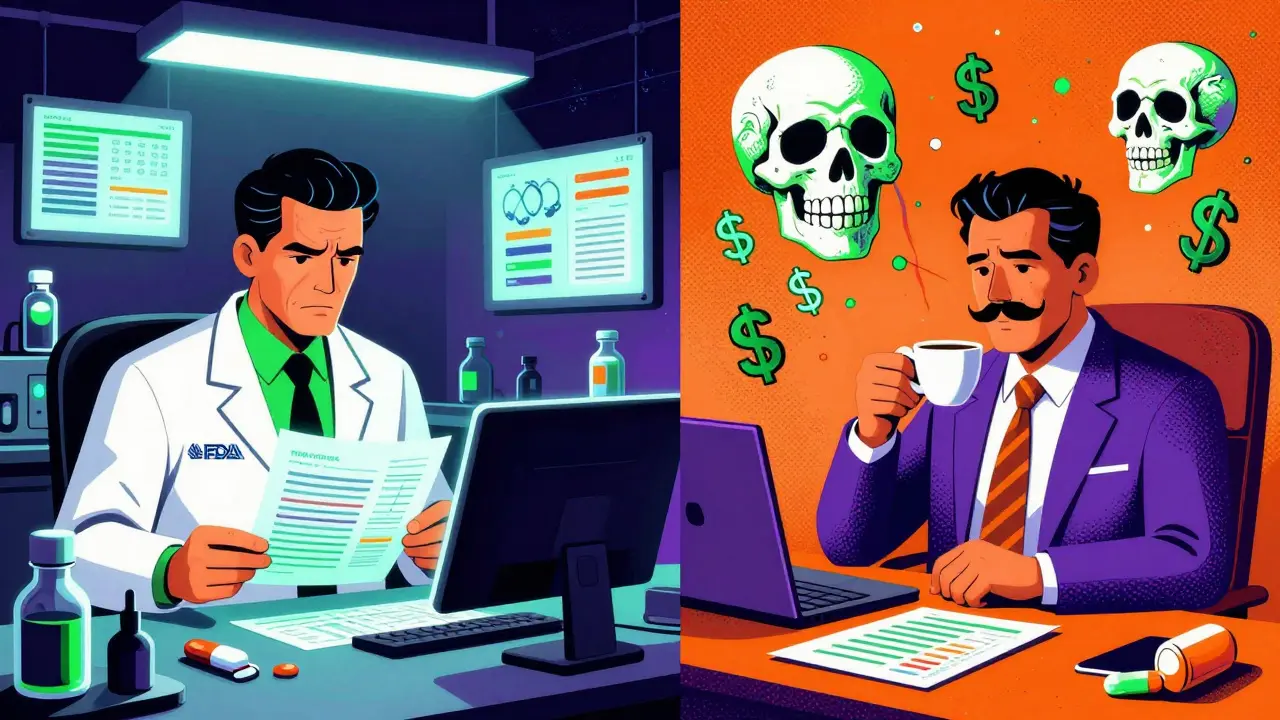
Why Does This Keep Happening?
It’s not luck. It’s math.
Industries have concentrated interests. A handful of companies stand to gain billions if regulations loosen. So they spend millions on lobbying, hiring former regulators, and funding think tanks. Meanwhile, the cost is spread out. Each person pays $33 a year. That’s not enough to make someone protest. No one organizes a rally over sugar prices.
Studies show industry groups spend 17 times more per person on lobbying than consumer groups. In the U.S., they spend 22 times more on political donations. And when agencies are isolated-no regular congressional oversight, no public hearings, no transparency-they’re sitting ducks.
Technical complexity helps too. Regulators don’t know how blockchain works. Or how AI-driven trading algorithms function. So they ask the industry for explanations. And suddenly, the industry isn’t just giving data-they’re writing the rules.
What’s Being Done About It?
Some places are trying. Canada’s "Regulatory Integrity Training" reduced industry meeting times by 27% and increased public input by 43%. New Zealand’s independent review process cut industry-preferred rules from 68% to 31% between 2016 and 2022.
The U.S. Federal Trade Commission launched its "Regulatory Capture Initiative" in March 2023, creating a new Office of Regulatory Integrity with a $23 million budget. It requires full disclosure of all industry contacts. That’s a start.
The EU now requires at least 40% of seats on advisory panels to go to consumer advocates. France’s "Convention Citoyenne pour le Climat" brought regular citizens into climate policy discussions-and cut energy industry influence by over half.
But most reforms fail. Between 2015 and 2022, 78% of proposed anti-capture laws didn’t pass. Cooling-off periods for former officials? Only 59% of violations get punished. Transparency registers? Only 32% of big corporations follow them.
Why It Matters to You
You don’t need to be an economist to feel the effects. When regulators are captured:
- Drug prices stay high because the FDA approves weaker clinical data.
- Power bills rise because energy regulators approve costly upgrades that boost company profits.
- Financial products with hidden risks get approved because the SEC is too cozy with Wall Street.
- Environmental rules get watered down because the EPA’s top officials all worked for oil companies.
Yelp reviews of financial services show consumers giving "government protection" a 2.1 out of 5 stars. On Reddit, people say the FDA approves drugs in the U.S. that wouldn’t pass in Europe. Twitter sentiment analysis shows 89% of mentions of "regulatory capture" are negative.
This isn’t abstract. It’s your wallet, your health, your safety.
Can It Be Fixed?
Yes-but not with wishful thinking.
Real change needs:
- Stronger cooling-off periods-not just one year, but three, with no industry contact.
- Public funding for regulators-so they don’t depend on industry for budgets or data.
- Independent oversight-congressional committees that actually audit agencies, not just hear their PR.
- Transparency in meetings-all industry contacts logged and made public.
- Consumer representation-mandatory seats for public advocates on advisory panels.
The World Bank calls regulatory capture a "systemic risk to effective governance" in nearly half the countries it studied. It’s not a glitch. It’s a design flaw in how power flows between industry and government.
The good news? We know how to fix it. We’ve seen it work. The hard part? Getting the people who benefit from the status quo to give up their advantage.
Is regulatory capture the same as corruption?
Not exactly. Corruption involves illegal acts like bribery or kickbacks. Regulatory capture is often legal-it’s about influence, access, and alignment. A regulator might not take money, but if they leave their job to work for a company they regulated, or if they start agreeing with the industry’s arguments out of habit, that’s capture. It’s a slow drift, not a single crime.
Which industries are most affected by regulatory capture?
According to the World Bank’s 2022 data, finance leads with 67% of countries showing signs of capture, followed by energy (58%) and pharmaceuticals (52%). These industries have high profits, complex regulations, and the resources to lobby heavily. The sugar, aviation, and tech sectors also show strong patterns. Even cryptocurrency, despite being new, spent $128 million on U.S. lobbying in 2022-up 273% from 2020.
Do regulators ever fight back against industry pressure?
Sometimes, but it’s rare. Independent regulators with strong mandates, public funding, and political backing can push back. Canada’s environmental regulators, for example, have resisted fossil fuel lobbying more than their U.S. counterparts. New Zealand’s system, which requires public review of all proposed rules, has reduced industry dominance. But in most cases, regulators who challenge industry interests get sidelined, defunded, or pressured out.
How does the revolving door contribute to regulatory capture?
The revolving door is one of the biggest drivers. When regulators know they’ll soon be working for the companies they regulate, they’re less likely to enforce rules strictly. Data shows 92% of former SEC commissioners took jobs with regulated firms within 18 months of leaving. That’s not coincidence-it’s incentive. The system rewards loyalty to industry, not to the public.
Can citizens do anything about regulatory capture?
Yes. Public pressure works. France’s citizen-led climate convention reduced energy industry influence by over 50%. In the U.S., consumer advocacy groups have forced transparency on drug pricing and bank fees. Writing to your representatives, attending public hearings, and supporting watchdog organizations all help. The problem is big, but it’s not unbeatable-when enough people pay attention, regulators can’t ignore them.
What Comes Next?
Regulatory capture isn’t going away. As industries get more complex-think AI, crypto, biotech-the gap between regulators and the people they regulate will widen. But awareness is growing. The OECD now requires member countries to conduct independent regulatory impact assessments by 2026. The U.S. and EU are testing new models of public oversight.
The real question is whether we’ll act before the damage becomes irreversible. Right now, the system favors those who can afford to play the game. If we want regulation to protect people-not profits-we need to rebuild it from the ground up. Not with more rules, but with more transparency, more independence, and more public power.
Kimberly Reker
January 30, 2026 AT 03:33And yeah, the sugar thing? I pay that $33 a year without even realizing it. It’s insane how invisible these costs are until someone spells it out.
Rob Webber
January 31, 2026 AT 21:12calanha nevin
February 2, 2026 AT 03:40It’s not about corruption it’s about structural imbalance
The revolving door isn’t a loophole it’s the entire design
Public funding for regulators isn’t optional it’s essential
Transparency isn’t a nice to have it’s the baseline
Consumer representation isn’t tokenism it’s justice
Fix this or accept that your safety your health your wallet are all auctioned off to the highest bidder
Lisa McCluskey
February 4, 2026 AT 03:28owori patrick
February 4, 2026 AT 09:06Claire Wiltshire
February 5, 2026 AT 04:00Darren Gormley
February 6, 2026 AT 14:05Mike Rose
February 8, 2026 AT 10:10Russ Kelemen
February 10, 2026 AT 00:14Sidhanth SY
February 10, 2026 AT 15:53Sarah Blevins
February 11, 2026 AT 18:05