Imagine spending a decade and billions of dollars developing a life-saving drug, only to find that by the time the government approves it, your patent is nearly expired. In the pharmaceutical world, patents aren't always enough. That's where regulatory exclusivity is a government-granted period of market protection that prevents competitors from obtaining approval for generic versions of a drug . Unlike patents, which protect an invention, this is a direct shield provided by regulatory agencies like the FDA to ensure companies can actually make money from their discoveries.
The Bottom Line on Exclusivity
- It is automatic upon approval, whereas patents must be filed and fought for.
- It protects the drug product itself, regardless of whether the patent is still valid.
- Different categories (NCEs, Biologics, Orphan Drugs) have different protection lengths.
- It creates a legal barrier that stops the FDA from approving generic applications during a set window.
How it Actually Differs from a Patent
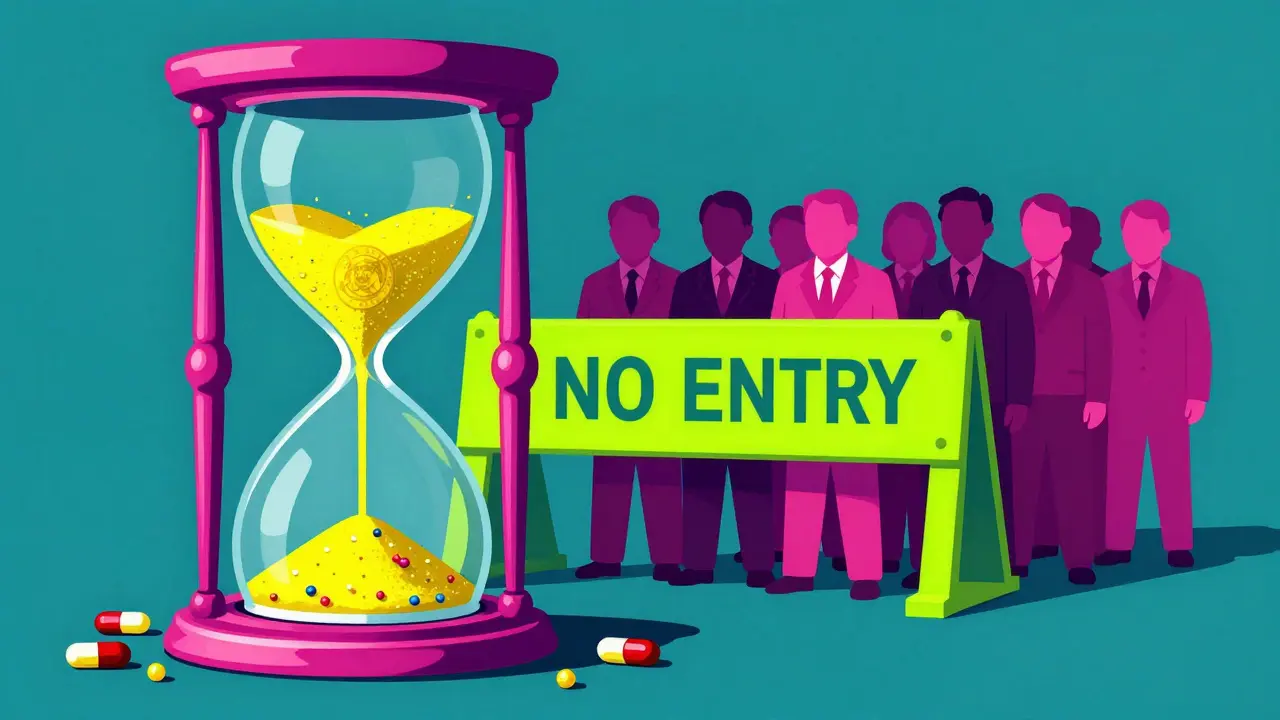
People often lump patents and exclusivity together, but they are very different tools. A patent is like a property deed-you own the "idea" and have to sue anyone who steals it. Regulatory exclusivity, on the other hand, is like a government-mandated "no-entry" sign for other companies. The FDA simply won't approve a generic version of the drug until the exclusivity clock runs out.
One of the biggest headaches for pharma companies is that patents start their countdown the moment you file them. If clinical trials take eight years, you've lost nearly a decade of your 20-year patent. Exclusivity solves this because the clock only starts ticking the day the drug is approved. This means if a company has both a patent and regulatory exclusivity, they can often keep competitors out of the market long after the original patent has expired. For example, the drug Humira used a combination of both to keep biosimilars off the US market until 2023, even though its primary patents had expired years earlier.
| Feature | Patent Protection | Regulatory Exclusivity |
|---|---|---|
| Source | Patent Office (USPTO) | Regulatory Agency (FDA/EMA) |
| Grant Process | Active prosecution/filing | Automatic upon drug approval |
| Enforcement | Company must sue in court | Agency refuses to approve generics |
| Trigger | Starts at filing date | Starts at approval date |
The Main Types of Market Protection
Not all drugs get the same level of protection. The length of the "shield" depends on what the drug is and who it helps. In the US, these rules are largely shaped by the Hatch-Waxman Act is a 1984 law that balanced the need for new drug innovation with the goal of bringing affordable generics to market .
For New Chemical Entities (NCEs) is drugs containing an active ingredient that has never been approved by the FDA , the protection is typically 5 years. During the first four years, the FDA won't even accept an application from a generic maker. This gives the original company a head start to establish their market share.
Things get even more intense with Biologics is complex medicines derived from living organisms, such as vaccines or monoclonal antibodies . Under the Biologics Price Competition and Innovation Act (BPCIA), these get a massive 12-year window. Because biologics are so hard to make, this long period is designed to recoup the enormous R&D costs.
Then there are "Orphan Drugs." If a drug treats a rare disease affecting fewer than 200,000 people in the US, it qualifies for Orphan Drug Exclusivity is a 7-year period of market protection for drugs treating rare diseases . This is a huge incentive for companies to tackle diseases that would otherwise be "too small" to be profitable.
Global Differences: US, EU, and Japan
If you're launching a drug globally, the rules change as soon as you cross the border. While the US focuses on specific categories like NCEs and Biologics, the European Union uses a system often called the "8+2+1" rule. This gives companies 8 years of "data exclusivity" (meaning generics can't use the original company's study data) and 2 years of "market exclusivity" (meaning the generic can't be sold). If the company finds a new use for the drug, they can often snag one more year of protection.
Japan takes a different route, generally offering a 10-year data exclusivity period for new chemical entities. These regional differences mean a drug might face generic competition in Europe while still being totally protected in the US, creating a complex puzzle for global pricing and distribution strategies.
The Economic Tug-of-War
This system creates a permanent tension between two groups: innovators and generic makers. From the innovator's perspective, these protections are the only reason to risk billions on a drug that might fail. Without them, a competitor could simply copy the finished formula without spending a dime on the initial research.
Generic companies, however, argue that these windows are too long. They claim that extending exclusivity-especially the 12-year biologics term-artificially inflates prices and keeps cheap medicine away from patients. Some argue that the 4-year submission barrier for NCEs forces generic developers to work "blind," increasing their risk because they can't get official feedback from the FDA until the window opens.
The data shows this works. Drugs under active exclusivity typically command prices over 3 times higher than their generic counterparts. While this fuels innovation, it also puts immense pressure on healthcare budgets and insurance premiums.
Strategy and Implementation Pitfalls
Managing these timelines isn't as simple as marking a calendar. Most major pharma companies now employ dedicated exclusivity managers because the overlap between patents and regulatory shields can get messy. A common mistake is failing to properly document the rarity of a disease for an orphan drug application, which can lead to a loss of those critical 7 years of protection.
Another pitfall occurs with "combination products." If a company creates a drug that combines two existing ingredients, calculating the exclusivity period becomes a nightmare. The FDA recently released guidance to help companies navigate these calculations, but it remains one of the most contested areas of regulatory law.
For those tracking these dates, the FDA's Purple Book is the gold standard. It's the primary database for biologics and biosimilars, though it doesn't cover the whole world. If you're a generic developer, the goal is to time your application perfectly to hit the market the second the exclusivity expires, often fighting for a "180-day exclusivity" window of their own to reward the first generic to successfully challenge a drug.
Does regulatory exclusivity end when the patent expires?
Not necessarily. They are independent. If a drug has a patent that expires in 2025 but was granted 5 years of regulatory exclusivity in 2023, the generic competitor is still blocked until 2028, even though the patent is gone.
Can a company get more than one type of exclusivity?
Yes. A drug could potentially qualify for both NCE exclusivity and Orphan Drug exclusivity. In these cases, the company generally benefits from the longest protection period available.
What happens to biologics after 12 years?
After the 12-year regulatory exclusivity period ends, the FDA can approve "biosimilars." Unlike generics, which are identical copies, biosimilars are "highly similar" versions of the original biologic drug.
Why is it called "data exclusivity" in the EU?
It refers to the fact that generic companies cannot use the clinical trial data submitted by the original innovator to prove their own drug is safe and effective. Since running new trials is too expensive, this effectively blocks generics from entering the market.
Do all new drugs get some form of exclusivity?
Most do. Recent data suggests around 88% of new molecular entities approved by the FDA qualify for at least one form of regulatory exclusivity, though the specific type and duration vary.
Next Steps for Industry Professionals
If you're navigating the approval process, your first priority should be a gap analysis of your IP portfolio. Don't rely solely on your patents; map out exactly which regulatory exclusivity categories your product fits into. If you're pursuing an Orphan Drug designation, ensure your patient population data is current and documented to avoid application delays.
For those on the generic side, monitor the Purple Book weekly. The strategy is no longer just about "beating the patent" in court-it's about precisely timing the regulatory window. If you're dealing with biologics, prepare for a longer game, as the 12-year window is currently the strongest barrier in the industry, though keep an eye on potential legislative changes that might shrink this window to 10 years.