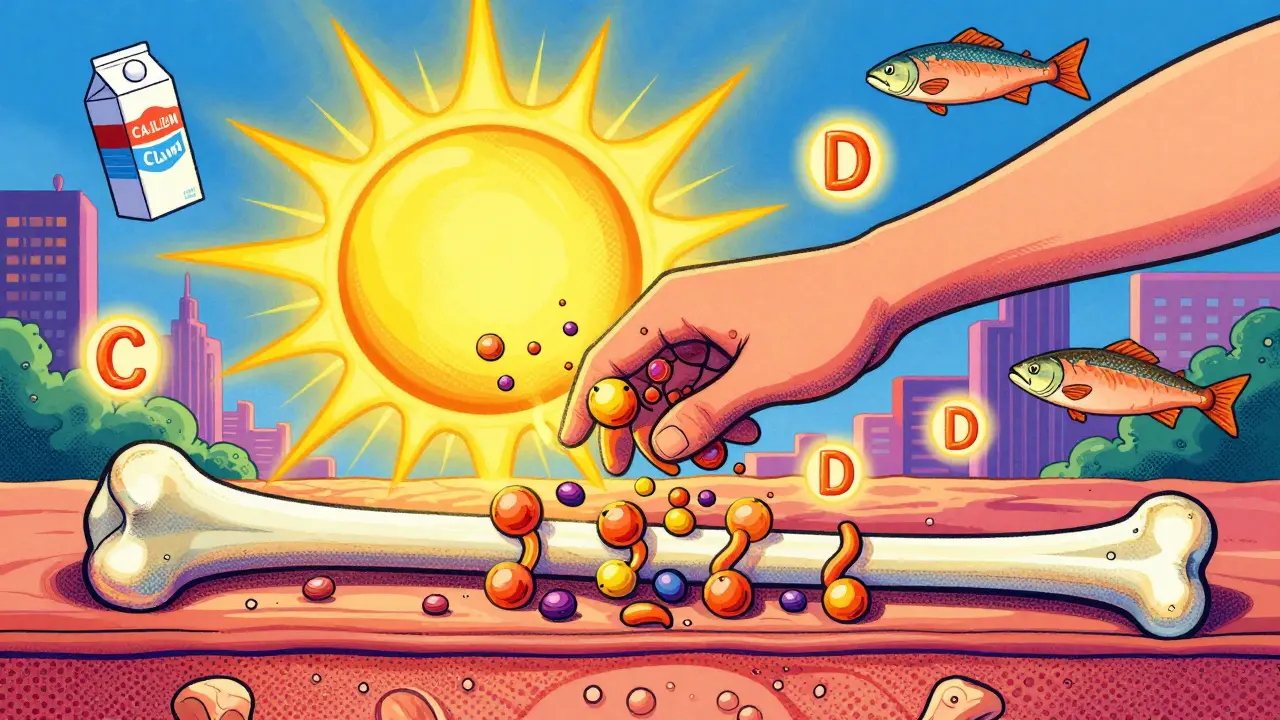
For decades, doctors told us: take vitamin D to protect your bones. Pop a pill every day, especially as you get older, and your skeleton will thank you. But here’s the twist-new research is turning that advice upside down. If you’re taking 2,000 IU or more of vitamin D daily hoping to prevent fractures or boost bone density, you might be wasting your time-or even hurting yourself.
What Vitamin D Actually Does for Your Bones
Vitamin D isn’t just a supplement. It’s a hormone your body makes when sunlight hits your skin. Its main job? Help your gut absorb calcium. Without enough vitamin D, your body grabs only 10-15% of the calcium you eat. With enough? That jumps to 60-80%. That’s the difference between weak, porous bones and strong, dense ones.
But it doesn’t stop there. Vitamin D also helps your bones renew themselves properly. Old bone breaks down, new bone forms-it’s a constant cycle. If vitamin D is low, that cycle gets messy. Bone doesn’t mineralize right. It becomes soft, brittle, or misshapen. That’s how rickets used to show up in kids before milk was fortified. And in adults? It leads to osteomalacia, where bones ache and bend under pressure.
There’s also the muscle connection. Low vitamin D weakens your leg muscles. That means you’re more likely to stumble, slip, or fall. And when you’re over 65, a fall isn’t just a bruise-it’s often a broken hip. So vitamin D isn’t just about bone density. It’s about keeping you steady on your feet.
What’s the Right Level? The Numbers That Matter
Doctors measure vitamin D with a blood test: 25-hydroxyvitamin D, or 25(OH)D. The numbers sound simple, but the debate is anything but.
For years, the standard was this:
- Below 20 ng/mL = deficiency
- 21-29 ng/mL = insufficient
- 30 ng/mL or higher = sufficient
That’s what the Endocrine Society said in 2011. But here’s the problem: those numbers were based on what looked good in lab tests, not what actually prevented fractures in real people.
The VITAL trial, led by Harvard Medical School, followed over 25,000 adults for five years. They gave some 2,000 IU of vitamin D daily. Others got a placebo. At the end? No difference in fracture rates. Not in the hips. Not in the spine. Not anywhere. Even people with baseline levels under 20 ng/mL didn’t get fewer breaks.
That’s huge. It means that if you’re not deficient, boosting vitamin D won’t make your bones stronger. And if you’re already at 30 ng/mL? Taking more won’t help. It might even hurt.
More Isn’t Better-And Sometimes It’s Worse
Here’s the most shocking part: high doses of vitamin D can lower your bone density.
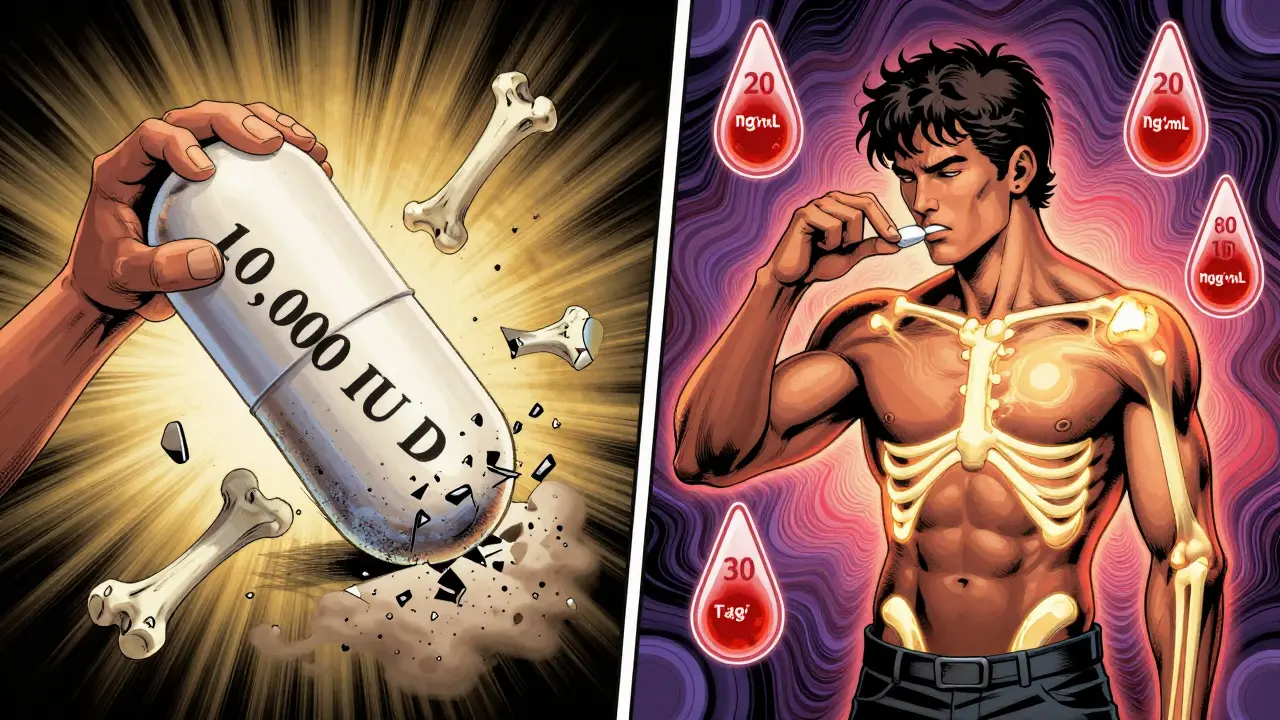
A 2020 JAMA study gave people 400 IU, 4,000 IU, or 10,000 IU of vitamin D daily for three years. Those taking 10,000 IU? Their radial and tibial bone density dropped significantly compared to those on 400 IU. The higher the dose, the more bone they lost.
Why? No one’s totally sure. But one theory is that too much vitamin D overstimulates bone turnover. Your body breaks down bone faster than it rebuilds it. Another idea: excess vitamin D may interfere with vitamin K2, which helps direct calcium into bones instead of arteries.
And it’s not just about density. A 2023 meta-analysis found that calcium and vitamin D together reduced hip fracture risk by 30%-but only when vitamin D was under 400 IU per day. At higher doses? Zero benefit. No improvement in femoral neck bone density. Just noise.
This isn’t a myth. It’s data. And it’s changing how doctors think.
Who Actually Needs Supplements?
If high doses don’t help most people, who *does* need them?
People with diagnosed deficiency. If your blood test shows 25(OH)D under 20 ng/mL, you’re not just low-you’re at risk. Doctors typically prescribe 50,000 IU weekly for 6-8 weeks, then switch to maintenance. That’s treatment, not prevention.
People with very limited sun exposure. If you live in Portland, Oregon, and never go outside between October and March, your body isn’t making vitamin D. Same if you wear full coverage clothing, work nights, or have dark skin (melanin blocks UVB rays).
People over 70. As you age, your skin gets worse at making vitamin D. Your kidneys also become less efficient at converting it to its active form. The Institute of Medicine says 800 IU/day is right for this group.
People with obesity (BMI ≥30). Vitamin D gets trapped in fat tissue. Studies show obese people need double the dose to reach the same blood levels as someone with normal weight.
People on certain medications. Steroids, anticonvulsants, and some weight-loss drugs interfere with vitamin D metabolism. Talk to your doctor.
For everyone else? You’re probably fine. Especially if you eat fatty fish (salmon: 570 IU per 3 oz), drink fortified milk (100 IU per cup), or eat eggs (44 IU per yolk). And yes-sunlight still counts. Just 10-15 minutes on your arms and face, 2-3 times a week, is enough for most people.
Supplements: What to Buy and How to Take Them
If you need a supplement, here’s what to know.
Choose D3, not D2. Vitamin D3 (cholecalciferol) comes from animals or lichen. D2 (ergocalciferol) is plant-based. D3 raises blood levels 87% more effectively than D2, according to a 2011 study in the Journal of Clinical Endocrinology & Metabolism. Stick with D3.
Take it with food. Vitamin D is fat-soluble. Taking it on an empty stomach? You absorb maybe 30%. Take it with your biggest meal? Absorption jumps 56.7%, according to a 2015 study. Dinner works best.
Check the label. ConsumerLab’s 2022 review found 15% of vitamin D supplements contained less than 90% of what’s on the bottle. One brand had only 72% of the labeled dose. Another? It had 128%. Stick to brands that test third-party verified (like NSF, USP, or ConsumerLab).
Avoid mega-doses. No one needs 10,000 IU daily unless under medical supervision. That’s a prescription-level dose. Over time, it can raise calcium levels too high-leading to kidney stones, nausea, or even heart rhythm issues.
Don’t combine with high-dose calcium. If you’re taking 1,200 mg of calcium daily *plus* high-dose vitamin D, you’re increasing your risk of calcification in arteries. Most people get enough calcium from diet. If you’re supplementing calcium, keep vitamin D at 600-800 IU.
The Bottom Line: Less Is More
The old rule-more vitamin D equals stronger bones-is broken. Science now shows that for most healthy adults, especially those over 50, taking more than 800 IU daily doesn’t reduce fractures. It doesn’t improve bone density. And at high doses, it can make bones weaker.
What you need:
- Get your 25(OH)D tested if you’re at risk (low sun, dark skin, obesity, over 70, on certain meds)
- If your level is under 20 ng/mL, treat it with medical guidance
- If it’s above 30 ng/mL, stop taking extra supplements
- If you’re unsure, take 600-800 IU of D3 daily with your largest meal
- Don’t assume more is better. Your bones don’t need a flood-they need balance
Strong bones aren’t built with megadoses. They’re built with consistent, moderate support: enough sun, enough food, enough movement, and just enough vitamin D to do its job-not to overdo it.
Frequently Asked Questions
Can I get enough vitamin D from food alone?
It’s very hard. Even the best food sources-like salmon, fortified milk, and egg yolks-don’t add up to 400 IU per day for most people. Unless you eat fatty fish daily and drink fortified milk with every meal, you’ll likely need some sun exposure or a low-dose supplement to reach the target level.
Is it safe to take vitamin D every day?
Yes, if you stick to 600-800 IU daily. That’s within the safe upper limit set by the Institute of Medicine (4,000 IU/day). But taking 5,000 IU or more daily without a medical reason increases your risk of high calcium levels, kidney stones, and even bone loss over time. Daily is fine-mega-doses are not.
Should I take vitamin D with calcium?
Only if you’re deficient in calcium. Most people get enough from dairy, leafy greens, or fortified foods. If you’re taking calcium supplements (like 1,200 mg/day), keep vitamin D at 600-800 IU. Higher vitamin D with high calcium can increase the risk of calcium building up in your arteries instead of your bones.
How long does it take for vitamin D to improve bone density?
Bone density doesn’t change quickly. Even with treatment, it takes 6-12 months to see measurable improvement on a DEXA scan. And if you’re not deficient, you won’t see any change at all. Don’t expect miracles in a few weeks.
Can vitamin D reverse osteoporosis?
No. Vitamin D alone cannot reverse osteoporosis. It helps your body use calcium properly, but it doesn’t rebuild lost bone. For osteoporosis, doctors prescribe medications like bisphosphonates or denosumab. Vitamin D is a supporting player-not the main treatment.
Are there side effects from vitamin D supplements?
At normal doses (up to 800 IU), side effects are rare. At high doses (5,000 IU+), you can get nausea, vomiting, weakness, frequent urination, or kidney stones due to elevated calcium. Some people also report constipation when taking calcium-vitamin D combos. Switching to liquid D3 drops often helps.
Meina Taiwo
December 21, 2025 AT 23:59Vitamin D isn't magic. If your levels are fine, stop popping pills. Sun and food work better anyway.
Jerry Peterson
December 22, 2025 AT 16:17I used to take 5000 IU daily because my doctor said ‘better safe than sorry.’ Turns out my blood test was always above 40. Stopped last year. No change in bone pain, no fractures. Weird how we all just assumed more was better.
Stacey Smith
December 22, 2025 AT 22:51This is why America’s healthcare system is broken. Doctors push supplements like candy because they’re paid to. Real medicine is getting sun and lifting weights. Not buying bottles labeled ‘mega-dose.’
Ben Warren
December 24, 2025 AT 18:54It is both intellectually and ethically irresponsible to disseminate the notion that vitamin D supplementation beyond physiological requirements confers any benefit to skeletal integrity. The VITAL trial, as cited, represents a paradigmatic example of evidence-based medicine supplanting dogma; however, the widespread misinterpretation of this data by laypersons and even some clinicians underscores a critical deficit in public health literacy. The notion that ‘more is better’ is a fallacy rooted in anthropomorphic extrapolation of nutrient dynamics, wherein the human organism is erroneously conceptualized as a vessel requiring constant pharmacological infusion rather than a self-regulating biological system. The JAMA study demonstrating reduced bone density at 10,000 IU/day is not merely statistically significant-it is mechanistically coherent, implicating dysregulated osteoclastic activity and potential interference with vitamin K2-mediated carboxylation of osteocalcin. To prescribe high-dose vitamin D in the absence of documented deficiency is not merely ineffective-it is iatrogenic.
mukesh matav
December 26, 2025 AT 14:55My dad in India takes 1000 IU daily and gets sun every morning. He’s 78, walks 5 miles a day, no fractures. No fancy supplements. Just food, sun, and walking. Maybe the answer isn’t in pills.
Peggy Adams
December 27, 2025 AT 03:32Big Pharma pushed this whole vitamin D thing so we’d buy more pills. They don’t want us to know sunlight is free. And don’t get me started on fortified milk-those additives are probably why we’re all sick.
Sarah Williams
December 27, 2025 AT 07:13So glad this got out there. I stopped my 2000 IU last year and didn’t think twice. My bones feel fine. I eat salmon, walk outside, and sleep well. That’s my routine now.
Theo Newbold
December 27, 2025 AT 20:11The JAMA study’s 10,000 IU group lost bone density? That’s not surprising. You’re basically flooding the system. Vitamin D doesn’t build bone-it regulates calcium. Too much calcium in the blood, and your body starts dumping it out of bone. It’s basic physiology. People think supplements are harmless because they’re ‘natural.’ They’re not. Dose matters. Always.
Christina Weber
December 27, 2025 AT 23:57There is a critical distinction between correcting a deficiency and promoting supplementation as a preventive measure. The former is evidence-based; the latter, in the absence of biomarker indication, constitutes medical overreach. Furthermore, the conflation of ‘bone health’ with ‘bone density’ is misleading. Bone quality, microarchitecture, and turnover rate are not captured by DEXA scans alone. The notion that vitamin D alone can prevent fractures ignores the multifactorial nature of skeletal fragility, including muscle strength, balance, and fall risk-all of which are independent of serum 25(OH)D levels above the deficiency threshold.
Cara C
December 29, 2025 AT 15:25It’s easy to feel overwhelmed by all the conflicting info. But the takeaway here is simple: test before you treat. If you’re not deficient, you’re probably fine. No need to stress. Your body knows how to handle this. Just get outside when you can, eat real food, and stop chasing supplements like they’re the answer to everything.
Michael Ochieng
December 30, 2025 AT 20:39I’m from Kenya. We don’t take vitamin D pills. We go outside. My grandma, 82, still carries water buckets. No hip replacements. No fractures. Sunlight is free. Movement is free. That’s the real medicine.
Grace Rehman
December 30, 2025 AT 22:55So we spent 30 years telling people to take vitamin D like it was a vitamin and not a hormone… and now we’re surprised it backfired? We treat our bodies like cars that need more oil, not like ecosystems that need balance. We’re so obsessed with fixing things we forget sometimes… they’re already working
Southern NH Pagan Pride
December 31, 2025 AT 22:09They’re hiding the truth. Vitamin D is a Trojan horse. The real agenda? To get us dependent on supplements so we stop trusting our own bodies. The FDA is in bed with Big Pharma. Look at the funding behind the VITAL trial. Who paid for it? You think it’s coincidence that the same companies selling D3 also sell calcium pills? Wake up.
Orlando Marquez Jr
January 2, 2026 AT 04:05The physiological rationale for vitamin D in calcium homeostasis remains unchallenged. However, the clinical translation of serum 25(OH)D thresholds into population-level supplementation guidelines requires rigorous risk-benefit analysis, which recent meta-analyses have demonstrated to be inconclusive for non-deficient populations. The JAMA findings, while compelling, must be contextualized within the broader framework of bone remodeling kinetics and the potential for hormetic responses to supra-physiological dosing. It is therefore prudent to reserve supplementation for individuals with documented insufficiency or conditions impairing endogenous synthesis.
Jackie Be
January 3, 2026 AT 17:35I took 10k IU for 2 years and got kidney stones. Like… I was in the ER screaming. I thought I was being healthy. Turns out I was just poisoning myself. Now I take 800 IU with dinner and feel better than ever. Don’t be like me.